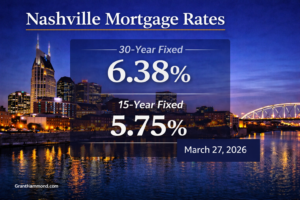
 Nashville mortgage rates averaged 6.38% for the 30-year fixed mortgage during the week ending March 27, 2026 according to the Freddie Mac Primary Mortgage Market Survey. Borrowing costs across Middle Tennessee continue to track movements in the 10-year Treasury yield, which held in the low-to-mid 4.4% range near 4.42% during the week. Mortgage rates have moved steadily higher from late February lows as markets adjust to rising inflation expectations tied to energy prices and global bond market volatility. For buyers and homeowners across Middle Tennessee, the current environment reflects a shift from stable improvement to a more reactive, headline-driven rate cycle.
This weekly Nashville mortgage rates report tracks current mortgage rates and borrowing conditions for buyers and homeowners across Nashville, Franklin, Brentwood, and the broader Middle Tennessee housing market.
The mortgage rate averages referenced in this report come from the Freddie Mac weekly survey, while Treasury yields referenced throughout the analysis are sourced from the Federal Reserve Economic Data database.
Key Weekly Mortgage Rate Data Summary
- Nashville 30-year fixed mortgage rate averaged 6.38% during March 23 to 27, 2026.
- Nashville 15-year fixed mortgage rate averaged 5.75% across Middle Tennessee.
- FHA 30-year mortgage rates remained in the low 6% range for qualified borrowers.
- The 10-year Treasury yield held near 4.42%, influencing long-term mortgage pricing.
- Mortgage spreads remained near 1.96%, within normal historical ranges.
- Federal Reserve policy remained restrictive with no material change in balance sheet posture in the latest H.4.1 release.
Mortgage Rate Dashboard
Nashville Mortgage Rates This Week
Nashville mortgage rates for the week ending March 27, 2026 averaged 6.38% for 30-year fixed mortgages and 5.75% for 15-year mortgages, according to Freddie Mac. Mortgage pricing across Middle Tennessee continues to follow movements in the broader bond market, particularly the 10-year Treasury yield.
Rates edged higher again this week, reaching another multi-month high. However, the path higher was not linear. Earlier in the week, rates pushed higher before improving slightly as bond markets stabilized later in the day. This highlights an important dynamic in the current environment. Rate movement is no longer slow and steady. It is reactive and often shifts within hours rather than days.
What Is Driving Mortgage Rates Right Now?
This market has become increasingly headline-driven.
At the highest level, the bond market is reacting in real time to global conflict and energy market volatility. Two variables have been moving together almost daily: the 10-year Treasury yield and oil prices.
When oil prices rise on geopolitical headlines, inflation expectations increase. When inflation expectations increase, Treasury yields rise, and mortgage rates follow. When headlines cool, oil prices often pull back, and rates can improve just as quickly.
This dynamic is what many refer to as a wartime economic environment. In these periods, traditional economic data such as jobs reports or inflation releases still matter, but short-term rate movements are often driven more by global events than by scheduled economic reports.
At the same time, central bank policy continues to reinforce a higher-rate environment. The Federal Reserve has made clear that it is not prepared to cut rates in the near term, particularly with inflation risks still elevated. Global central banks have echoed this stance, contributing to upward pressure on yields across developed markets.
The result is a market where volatility is elevated, direction can change quickly, and mortgage rates can move meaningfully within short timeframes.
Institutional Macro Snapshot
The 10-Year Treasury and Mortgage Spreads
The 10-year Treasury yield held near 4.42% during the week, remaining elevated relative to earlier in the year. Because mortgage rates track long-term Treasury yields closely, this continues to anchor mortgage pricing at higher levels.
Mortgage spreads held near 1.96%, remaining within a normal range. This suggests the recent increase in mortgage rates is being driven primarily by macroeconomic forces rather than disruptions within the mortgage-backed securities market itself.
Strategic Borrower Considerations in Today’s Market
Rate Volatility
Mortgage rates are moving more quickly than they have in recent months. While the overall range remains similar to the past year, the velocity of change has increased, which is often more important than the absolute level.
In practical terms, this means rate pricing can shift meaningfully within a single day as bond markets react to headlines. Borrowers who are under contract should pay closer attention to intraweek volatility, not just weekly averages, when making rate lock decisions.
Refinance Threshold
With rates now in the mid 6% range, refinance opportunities have narrowed compared with late February. Most homeowners still need a rate improvement of roughly 0.75% to 1.00% to justify refinancing after accounting for closing costs.
However, the more important consideration in this environment is trajectory, not just level. If rates stabilize or begin to trend lower, refinance demand can return quickly, particularly given how close many borrowers are to viable break-even points.
MBS Market and Inflation Risk
Mortgage-backed securities remain a key driver of mortgage pricing.
Current mortgage spreads are holding near 1.96%, which is within a normal range but slightly elevated relative to tighter historical periods. This indicates that lenders are still pricing in a degree of uncertainty in the bond market.
If spreads begin to compress, mortgage rates could improve even without a significant decline in Treasury yields. Conversely, if spreads widen further, rates could remain elevated even if Treasuries stabilize.
Buydown Economics
In higher-rate environments, temporary and permanent buydowns become more relevant.
For many buyers, a 2-1 buydown or seller-paid rate reduction can be more impactful than negotiating a lower purchase price, especially if the expectation is that rates may decline in the future.
This creates a shift in strategy where monthly payment optimization becomes more important than headline interest rate alone.
Buyer Strategy and Market Timing
For buyers in Middle Tennessee, this environment presents opportunity within volatility.
Higher rates can reduce competition and create negotiating leverage through pricing adjustments, seller concessions, or rate buydowns. However, if rates improve even modestly, demand can return quickly, often increasing competition within a short window.
The key distinction is that while rates are volatile, the underlying housing market remains stable. Inventory is not surging, demand has not collapsed, and we are not seeing signs of systemic stress.
This is a rate-driven adjustment, not a structural housing market shift.
What This Means for Nashville and Middle Tennessee
Mortgage rates in Nashville and Middle Tennessee are now operating in a more constrained affordability environment. However, housing fundamentals remain intact.
Demand remains resilient in key submarkets such as Brentwood, Franklin, and Hillwood, where inventory remains limited. The current environment reflects short-term volatility layered on top of a fundamentally stable housing market.
What to Watch Next Week
Mortgage markets will continue to be driven by a combination of macroeconomic data and geopolitical developments. The following factors will be particularly important in determining the near-term direction of Nashville mortgage rates:
- Oil price movements and geopolitical developments
Continued volatility in energy markets will directly influence inflation expectations and Treasury yields. - Inflation data releases
Any signs that inflation is stabilizing or reaccelerating will have immediate implications for mortgage rate direction. - Treasury auction demand and bond market liquidity
Weak demand for Treasury auctions could push yields higher, while strong demand could help stabilize rates. - Federal Reserve communication and policy signals
Markets will be watching closely for any shift in tone regarding the timing of potential rate cuts. - Mortgage application trends from the MBA survey
Changes in purchase and refinance activity will provide insight into how borrowers are reacting to current rate levels.
The key question for markets is whether inflation pressures tied to energy prices begin to ease. If they do, mortgage rates could stabilize or move lower. If not, rates may remain elevated or continue trending higher.
Nashville Mortgage Rates FAQ
What are mortgage rates in Nashville right now?
As of the week ending March 27, 2026, the average 30-year fixed mortgage rate is approximately 6.38%, while the 15-year fixed mortgage rate averages 5.75%.
Why are mortgage rates rising in Nashville?
Mortgage rates are rising due to higher 10-year Treasury yields, inflation expectations tied to energy prices, and a more restrictive Federal Reserve policy environment.
Do mortgage rates follow the 10-year Treasury?
Yes. Mortgage rates are closely tied to the 10-year Treasury yield because both are influenced by long-term inflation expectations and bond market demand.
Will mortgage rates go down in 2026?
Mortgage rates could decline if inflation pressures ease and Treasury yields move lower. However, current conditions suggest rates may remain volatile in the near term.
How do higher mortgage rates affect Nashville home buyers?
Higher mortgage rates reduce affordability in the short term, but they can also reduce competition and create opportunities for negotiation, especially in balanced or shifting markets.