As of September 14, 2026, Nashville 30-year fixed mortgage rates averaged 7.17% and the 15-year fixed averaged 6.70%, per the Mortgage News Daily rate index; the 10-year U.S. Treasury closed at 4.97%. These are market averages, not rate quotes.
| 30-year conformingMortgage News Daily | 7.17% ▲ |
|---|---|
| 15-year conformingMortgage News Daily | 6.70% ▲ |
| 10-year TreasuryTreasury CMT | 4.97% ▲ |
| 30-year jumboMortgage News Daily | 7.28% ▲ |
| FHA 30-yearMortgage News Daily | 6.75% ▲ |
| VA 30-yearOptimal Blue | 6.62% |
Rows are labelled with their source. Mortgage News Daily prices lender rate sheets the same day; Optimal Blue measures loans actually locked and publishes a day behind, so those rows carry an earlier date and will differ by a few basis points.
Mortgage rate trend
30- & 15-year fixed ( left axis ) vs. the 10-year US Treasury ( right axis ). This trend line is the Optimal Blue OBMMI series (daily since 2017) and Freddie Mac PMMS (weekly, deep history), plus US Treasury DGS10 — a longer history than the Mortgage News Daily figure quoted above, so its most recent point will sit a few basis points apart.
Historical data ( trailing 36 months )
| Month | 30-yr fixed | 15-yr fixed | 10-yr Treasury |
|---|---|---|---|
| Sep 2026 | 6.97% | 6.27% | 4.97% |
| Aug 2026 | 6.72% | 6.05% | 4.75% |
| Jul 2026 | 6.72% | 6.02% | 4.75% |
| Jun 2026 | 6.45% | 5.78% | 4.44% |
| May 2026 | 6.44% | 5.82% | 4.45% |
| Apr 2026 | 6.31% | 5.65% | 4.40% |
| Mar 2026 | 6.35% | 5.67% | 4.30% |
| Feb 2026 | 5.90% | 5.34% | 3.97% |
| Jan 2026 | 6.07% | 5.41% | 4.26% |
| Dec 2025 | 6.16% | 5.33% | 4.18% |
| Nov 2025 | 6.14% | 5.44% | 4.02% |
| Oct 2025 | 6.16% | 5.35% | 4.11% |
| Sep 2025 | 6.32% | 5.50% | 4.16% |
| Aug 2025 | 6.49% | 5.45% | 4.23% |
| Jul 2025 | 6.73% | 5.95% | 4.42% |
| Jun 2025 | 6.67% | 5.87% | 4.24% |
| May 2025 | 6.88% | 6.08% | 4.43% |
| Apr 2025 | 6.72% | 5.99% | 4.23% |
| Mar 2025 | 6.60% | 5.79% | 4.23% |
| Feb 2025 | 6.73% | 6.06% | 4.40% |
| Jan 2025 | 6.88% | 6.25% | 4.53% |
| Dec 2024 | 6.83% | 6.18% | 4.59% |
| Nov 2024 | 6.74% | 6.11% | 4.27% |
| Oct 2024 | 6.75% | 6.14% | 4.28% |
| Sep 2024 | 6.14% | 5.36% | 3.81% |
| Aug 2024 | 6.34% | 5.61% | 3.82% |
| Jul 2024 | 6.70% | 6.21% | 4.17% |
| Jun 2024 | 6.85% | 6.16% | 4.25% |
| May 2024 | 6.99% | 6.31% | 4.54% |
| Apr 2024 | 7.19% | 6.56% | 4.63% |
| Mar 2024 | 6.77% | 6.07% | 4.25% |
| Feb 2024 | 6.92% | 6.41% | 4.28% |
| Jan 2024 | 6.64% | 5.89% | 4.08% |
| Dec 2023 | 6.60% | 6.02% | 3.89% |
| Nov 2023 | 7.25% | 6.67% | 4.39% |
| Oct 2023 | 7.78% | 7.07% | 4.88% |
Historical context and starting estimates, not rate quotes or offers of credit. Broker fees and any lender compensation are not set by law and are fully negotiable.
market averages · Sources: Mortgage News Daily (daily rate index), Optimal Blue OBMMI and Freddie Mac PMMS via FRED, and the US Treasury daily par yield curve. Each figure above is labelled with the source and date it came from.
In this report:
- This week’s rate dashboard
- How do Nashville mortgage rates affect the local housing market?
- Nashville and Middle Tennessee housing statistics
- What is driving Nashville mortgage rates right now
- How do Treasury yields and spreads shape rates?
- How should Nashville borrowers approach this market?
- How this page compiles Nashville mortgage rate data
- Nashville mortgage rates by loan type
- Jumbo loans in Nashville
- 15-year vs 30-year fixed in Nashville
- What Tennessee first-time homebuyer programs help?
- How much house can you afford in Nashville?
- Nashville mortgage calculator
- How does a rate change affect monthly payments?
- How to find the best Nashville mortgage rate
- Should you use a Nashville mortgage broker?
- Frequently asked questions
- Sources
- Weekly Nashville mortgage rate updates
This week’s full analysis is available at Nashville mortgage rates: week ending September 11, 2026.
As of Friday, September 11, 2026, the Nashville 30-year fixed mortgage rate closed at 7.12% and the 15-year fixed at 6.65%, per the Mortgage News Daily Rate Index. The 30-year rose 23 basis points on the week from 6.89% and the 15-year rose 16 basis points from 6.49%, and the move came from the August inflation reports, with CPI at 3.4% over the year and core CPI at 2.4%, rather than from anything in the mortgage market. Higher oil on the Iran conflict and multi-year highs in UK, Japanese and French 10-year yields added to the pressure. The Freddie Mac weekly survey, collected Monday through Wednesday, averaged 6.76% and 6.09% for the same week and sits below Friday’s close for that reason. The FHA 30-year closed near 6.68%. The Federal Reserve has held its target range at 3.50% to 3.75%, and a mortgage spread of 188 basis points, down from 199 a month earlier, keeps mortgage rates elevated relative to the 10-year Treasury, which closed at 4.96% on Friday, September 11, 2026. Nashville mortgage rates today reflect movements in the 10-year Treasury yield, mortgage-backed securities markets, and broader macroeconomic conditions.
This page provides the most current 30-year fixed, 15-year fixed, FHA, and VA mortgage rates along with structured weekly analysis tailored specifically to buyers, sellers, investors, and real estate professionals across Nashville and Middle Tennessee.
This analysis applies to Davidson County, Williamson County, Wilson County, Rutherford County, and surrounding Middle Tennessee markets. Rates update daily from MND, with localized interpretation grounded in active transaction experience across the Nashville housing market.
Ready to shop with your rate locked in? browse the Nashville MLS from Grant Hammond, which filters every Greater Nashville listing by price, neighborhood, and property type from the live Realtracs feed.
How Do Nashville Mortgage Rates Affect the Local Housing Market?
Mortgage rates do not impact every market equally. In Nashville and the surrounding counties, sensitivity varies by price point, neighborhood, and loan size.
In Davidson County, many transactions fall between $400,000 and $650,000. Within this range, even a 0.50% change in mortgage rates can materially shift qualification thresholds. Buyers targeting neighborhoods such as the East Nashville housing market, Green Hills real estate, the 12 South condo corridor and other downtown Nashville condo neighborhoods, plus Sylvan Park and West Meade, often operate within defined monthly payment limits, making rate stability especially important.
In Williamson County, where average purchase prices in Brentwood and Franklin are higher, rate movements amplify more quickly due to larger loan balances. A modest rate increase can translate into several hundred dollars in additional monthly cost at executive price points. In competitive submarkets such as the Brentwood housing market and parts of Williamson County’s Franklin corridor, rate stability often correlates with stronger contract activity and improved negotiation leverage.
In suburban corridors such as Spring Hill and portions of Wilson County and Rutherford County, affordability remains a central driver of buyer participation. FHA and VA borrowers in these markets are frequently more sensitive to short-term rate direction.
Mortgage rates also influence listing behavior. When rates rise, homeowners who previously secured lower rates may delay selling, constraining resale inventory across Middle Tennessee. When rates stabilize or decline, listing activity and transaction velocity typically improve.
Understanding how rates translate into purchasing power across Davidson and Williamson County is critical for informed real estate decision-making.
The mortgage rate dashboard shows a 7.12% 30-year fixed rate, a 6.65% 15-year fixed rate, an FHA 30-year rate near 6.68%, a 10-year Treasury yield near 4.96%, and a mortgage spread near 1.88%, as of the week ending September 11, 2026. APR context: APR sits at or above the note rate once lender fees and discount points are included, because it expresses those costs as a rate. It depends on the fees and loan amount for each borrower, so there is no market-wide APR for Nashville. The only APR that describes your loan is the one on your Loan Estimate. ARM context: 5/1 and 7/1 ARM pricing is set off the yield curve and lender-specific margins rather than a fixed discount to the 30-year fixed, so the gap varies by lender and by week. Freddie Mac discontinued its weekly ARM average in November 2022, so no survey benchmark sits alongside the 30-year and 15-year figures on this page. Ask a lender to quote the ARM and the fixed on the same day. Borrowers planning shorter ownership horizons should request ARM quotes alongside conventional fixed-rate Loan Estimates to compare full cost over the actual hold period.
Weekly contract rate data and application trends are published by the Mortgage Bankers Association Weekly Applications Survey, which tracks conforming, FHA, and VA loan activity nationwide. While rates are reported at a national level, pricing in Davidson County, Williamson County, and surrounding Middle Tennessee markets typically aligns closely with those benchmarks, adjusted for borrower profile and lender overlays.
Which number applies to you. The dashboard above carries the Mortgage News Daily Rate Index, which prices actual lender rate sheets every business day and is the closest read on what lenders are posting right now. The Freddie Mac weekly survey is 6.76% on the 30-year and 6.09% on the 15-year in its release of September 10, 2026. From the week ending August 28, 2026 the headline figures on this page are Friday closes from the Mortgage News Daily Rate Index rather than the weekly survey, because this page is updated on Fridays and should tell you where the week actually ended. The survey is now the comparison benchmark rather than the headline. The two measure different things and will run a few basis points apart. Your own quote will differ from both, based on credit score, loan size, property type, occupancy, and lock period. None of these are rate quotes.
What Do Nashville Housing Statistics Tell Us About the Mortgage Market?
Mortgage rates operate against the backdrop of the Middle Tennessee housing market. The data below contextualizes how rate movements interact with current Davidson, Williamson, Rutherford, and Maury County conditions. All figures are drawn from the April 2026 Middle Tennessee Real Estate Market Update.
Middle Tennessee aggregate (10 counties)
- Median sale price: $450,000, up 1% year over year (12-month closed)
- Average sale price: $644,917, up 8% year over year (12-month closed)
- Active inventory: 12,317 units, up 11% year over year
- New listings (April): 6,094, down 20% year over year
- New under contract (April): 4,076, up 18% year over year
- Closings (April): 3,091, down 7%
- Days on market: 38 days, up 7%
- Months of supply: 4.76 (stabilized after rising in March)
County-level April 2026 snapshot
- Davidson County: average $679,444, median $475,000, months of supply 5.18
- Williamson County: average $1,344,141, median $977,000, months of supply 4.45
- Rutherford County: average $463,112, median $419,995, months of supply 4.03
- Maury County: average $449,325, median $400,000, months of supply 6.18
At the current Nashville 30-year fixed rate of 7.12%, a 0.50% rate change moves principal and interest by about $33 per $100,000 borrowed, or roughly $134 a month on a $400,000 loan and $217 on a $650,000 loan. The per $100,000 figure barely shifts as rates move, so it holds at 6% or at 8%.
Nashonomics 2026 read: NAR Chief Economist Lawrence Yun told the Greater Nashville Realtors audience this week that 6.5% rates plus pent-up Nashville demand mark the start of a multiyear housing recovery, not a one-year bounce. He pegged the 6% mortgage rate as the unlock threshold. My Sunday roundup covers the full Nashonomics read alongside two other May 31 stories.
What Is Driving Nashville Mortgage Rates Right Now?
Nashville mortgage rates primarily follow movements in the 10-year U.S. Treasury yield and the broader mortgage-backed securities market. The national benchmark for average 30-year and 15-year fixed rates is published weekly through the Freddie Mac Primary Mortgage Market Survey, which reflects lender pricing across the country.
When Treasury yields rise due to inflation expectations, economic growth data, or increased government bond issuance, mortgage rates typically move higher as well. Conversely, when bond markets stabilize or yields decline, mortgage rates often moderate.
In addition to Treasury movement, mortgage spreads and liquidity conditions influence how closely local pricing tracks national averages. These structural drivers shape borrowing costs across Nashville and the broader Middle Tennessee region.
How Do the 10-Year Treasury and Mortgage Spreads Shape Nashville Rates?
The 10-year Treasury yield serves as the benchmark for long-term borrowing costs. Mortgage-backed securities price off this yield, creating a consistent relationship between Treasury movements and mortgage rates.
When spreads compress, mortgage rates move closer to Treasury yields. When spreads widen, borrowers experience elevated pricing even if Treasury yields decline.
For Nashville buyers, understanding the spread dynamic is often more important than reacting to Federal Reserve headlines. Local affordability across Brentwood homes for sale, Franklin’s residential market, and Nashville proper is frequently shaped more by spread behavior than by short-term policy commentary.
How Should Nashville Borrowers Approach the Current Mortgage Market?
Mortgage strategy in Nashville at 7.12% on the 30-year fixed depends on price point, ownership horizon, and the gap between current market rates and any existing rate the buyer or move-up seller already holds. The three frameworks below cover the most common Davidson and Williamson County buyer scenarios at today.s rate.
Adjustable vs Fixed Rate Decisioning
With the Nashville 30-year fixed at 7.12%, ARM pricing is quoted off the yield curve and lender-specific margins rather than a set discount to the fixed rate, so the gap varies by lender and by week and at times closes entirely. Ask your lender to quote a 5/1 or 7/1 ARM and the 30-year fixed on the same day and compare the two directly. ARMs are best suited to East Nashville and 12 South buyers planning to move or refinance within the initial fixed period. Buyers settling into a Belle Meade or Forest Hills long-term hold should weigh any early savings against the reset risk at year five or seven.
Refinance Thresholds
Most Nashville homeowners need a 0.75% to 1.00% rate improvement to recover refinance closing costs within a reasonable horizon. At 7.12% today, that puts the break-even target near 6.12% to 6.37%. The lock-in effect this creates is the structural driver behind constrained resale inventory across Davidson and Williamson Counties. Homeowners holding 3.5% to 4.5% notes from the 2020 to 2022 cycle are unlikely to list unless personal circumstances force the move, which keeps Brentwood, Belle Meade, and Green Hills move-up inventory tighter than the headline rate alone would suggest.
Buydown Economics
Temporary buydowns are widely available in Nashville new construction, particularly across Williamson County suburbs and Maury County developments where builders are managing standing inventory. A typical seller-paid 2-1 buydown reduces the effective rate by 2.00% in year one and 1.00% in year two, then resets to the full note rate in year three. On a $500,000 loan at a 7.12% note rate, that translates to monthly principal-and-interest of approximately $2,721 in year one (versus $3,367 at the full rate) and $3,036 in year two. That is $646 less per month in year one and $330 less in year two, about $11,718 of total payment relief. Applied instead as a price reduction, the same $11,718 would lower the payment by roughly $79 a month, which is why buydowns negotiate better than price cuts in the first two years of ownership. The lifetime cost is paid up front by the seller through a closing-table credit, so the total transaction economics depend on whether the buydown is offered in lieu of a price reduction or in addition to one.
Active participation in both the Nashville and Williamson County housing markets makes mortgage rate trend interpretation a function of direct transaction experience, not just national data. The right financing structure depends on borrower profile, time horizon, and risk tolerance, and the analysis is best run against the specific property and the specific lender quote, not a generic rate sheet.
How Does Grant Hammond Compile Nashville Mortgage Rate Data?
Every Nashville mortgage rate data point on this page traces back to a primary source. The methodology below documents what data is used, how derived figures are calculated, and how national data is applied to the Nashville and Middle Tennessee market context.
Primary Data Sources
- Weekly comparison benchmark: Freddie Mac Primary Mortgage Market Survey (PMMS), released every Thursday at noon. Headline 30-year and 15-year rates on this page come from the MND Rate Index, priced from lender rate sheets each business day. Nashville borrower pricing typically tracks PMMS averages, adjusted for borrower credit profile and individual lender overlays.
- National survey reference: Mortgage Bankers Association Weekly Applications Survey, released every Wednesday. FHA and jumbo rates here come from MND; the VA rate from Optimal Blue OBMMI, which publishes a day behind.
- 10-year Treasury yield: U.S. Department of the Treasury daily yield curve rates, with end-of-week close used as the reported figure.
- Inflation data (Core CPI, PPI): U.S. Bureau of Labor Statistics monthly releases. Core PCE: U.S. Bureau of Economic Analysis, Personal Income and Outlays release.
- Federal Reserve policy: Federal Open Market Committee meeting statements, dot plots, and Chair press conferences.
Calculated Figures
- Mortgage spread: Freddie Mac PMMS less the 10-year Treasury weekly average for the same week, in basis points — both legs weekly, so they share one observation window. Since the November 2022 PMMS methodology change the spread has averaged 246 basis points, range 182 to 313 (199 weeks, Freddie Mac PMMS and 10-year Treasury via FRED, computed September 10, 2026). Figures published for the weeks ending August 28 and September 11, 2026 were originally computed from the daily index and have been restated on this basis.
- Payment impact calculations: Standard mortgage amortization formulas. Principal and interest payments assume the stated rate over the stated loan term with no additional fees. Property taxes, homeowners insurance, mortgage insurance, and HOA dues are not included in the principal and interest figures shown.
- Year-over-year (YoY) rate change: Compares the current week’s MND Friday close to the same calendar week from the prior year.
- Week-over-week (WoW) rate change: Compares the current week’s Friday close to the prior Friday’s close.
Local Application
National rate data is interpreted through the Nashville market context by considering Davidson County and Williamson County price distributions, typical borrower profiles in each sub-market, and active transaction experience. Payment impact examples on this page use loan amounts that reflect Nashville purchase price distributions across the under-$500K, $500K to $1M, $1M to $1.5M, and $1.5M+ ranges.
Update Cadence
- Live rate table: updated each business day. Weekly dashboard and analysis: Fridays
- Nashville housing market statistics: updated monthly
- Methodology section: reviewed quarterly; updated when sourcing changes
How Do Nashville Mortgage Rates Compare Across Loan Types?
Different loan structures respond differently to market conditions.
Conventional 30-Year Fixed
The most common loan type for qualified borrowers with stable income and strong credit. Pricing closely tracks national benchmarks adjusted for borrower profile and local lender overlays.
FHA Loans
Designed for buyers with lower down payments or moderate credit scores. FHA mortgage rates in Nashville are often slightly lower than conventional rates, though borrowers must consider upfront and annual mortgage insurance premiums.
VA Loans
Available to eligible veterans and active-duty service members. VA mortgage rates in Middle Tennessee frequently price competitively and require no down payment, though funding fees may apply. VA participation remains meaningful across the region.
Jumbo Loans in Nashville
A jumbo loan is any mortgage above the FHFA conforming loan limit for a one-unit home. Davidson and Williamson County are standard (non–high-cost) counties, so the baseline national limit applies — verify the current figure at the FHFA, which republishes it each January. A Nashville purchase crosses into jumbo territory when the loan amount (not the purchase price) exceeds that limit, which happens most often in Brentwood and Franklin at executive price points and on luxury high-rise condos downtown.
Nashville jumbo pricing currently runs near 7.06% on the 30-year fixed (see the rate table at the top of this page), typically 0.10% to 0.20% above conforming for a strong borrower, though on some weeks jumbo prices at or below conforming when banks compete for high-balance relationships. Jumbo qualification is stricter than conforming: expect larger reserve requirements (often 6 to 12 months of payments), a lower maximum debt-to-income ratio, and — above certain balances — two full appraisals. Because jumbo is portfolio-lender territory rather than agency-backed, pricing and overlays vary more lender-to-lender than conforming, so comparing at least three jumbo Loan Estimates is worth more here than on a conforming loan.
15-Year vs 30-Year Fixed in Nashville
The 15-year fixed prices below the 30-year — currently 6.65% versus 7.12% at Friday’s close — and retires the loan in half the time, so the lifetime interest difference is large. The tradeoff is a materially higher monthly payment. The table below shows both on a $400,000 loan amount (principal and interest only, taxes and insurance excluded):
| Loan | Rate | Monthly P&I | Lifetime interest |
|---|---|---|---|
| 30-year fixed | 7.12% | $2,694 | $569,669 |
| 15-year fixed | 6.65% | $3,517 | $233,150 |
| Difference | 0.47% | +$824/mo | −$336,519 |
The 15-year suits Nashville buyers with the cash flow to absorb the higher payment who want to own free-and-clear faster — common among move-up buyers in Green Hills and Belle Meade rolling significant equity from a prior sale. The 30-year suits buyers prioritizing monthly flexibility or keeping cash free for renovation or investment. A middle path some Nashville borrowers use: take the 30-year for payment safety and pay it on a 15-year amortization voluntarily, preserving the option to drop back to the lower required payment if circumstances change.
Understanding loan structure differences helps buyers align financing strategy with rate conditions.
What Tennessee First-Time Homebuyer Programs Help Nashville Buyers?
Beyond standard conventional, FHA, and VA financing, Nashville first-time homebuyers can access several Tennessee-specific programs that reduce upfront costs, lower effective rates, or provide tax benefits. The programs below are administered through the Tennessee Housing Development Agency (THDA) and apply across Davidson County, Williamson County, and surrounding Middle Tennessee markets. Current income limits, purchase price limits, and program rates are published by THDA and update periodically; verify against thda.org before applying.
Great Choice Home Loan Program
The Great Choice Home Loan program is THDA’s flagship first-time homebuyer offering. Key features include:
- Loan type: 30-year fixed-rate FHA, VA, USDA, or conventional
- Minimum credit score: 640
- Income limits: Vary by household size and county; current Davidson and Williamson County limits published by THDA
- Purchase price limits: Vary by county; current limits published by THDA
- Pairs with: Great Choice Plus down payment assistance for up to 100% financing
The Great Choice program applies most often to Nashville buyers in the entry-level price range who would otherwise face down payment or closing cost barriers.
Homeownership for Heroes
The Homeownership for Heroes program serves active and former military service members, law enforcement officers, paramedics, EMTs, and firefighters in Tennessee. Key features include:
- Interest rate: Approximately 0.50% below the Great Choice standard rate, per THDA’s current schedule
- First-time buyer requirement: Waived for eligible heroes
- Minimum credit score: 640
- Financing structure: Up to 100% of purchase price with VA or USDA pairing; up to 96.5% with FHA
Eligible occupations in Middle Tennessee can use this program to access a reduced rate compared to standard THDA financing.
Take Credit Mortgage Credit Certificate (MCC)
The Take Credit MCC program provides a federal income tax credit for qualifying buyers purchasing in designated Tennessee Targeted Areas. Key features include:
- Tax benefit: Federal tax credit up to the IRS maximum, recurring for the life of the loan
- Eligibility: First-time buyers, veterans, or repeat buyers purchasing in a Targeted Area
- Targeted Areas: Specified census tracts within designated Tennessee counties
- Combined with: Can stack with Great Choice or other THDA financing
Nashville buyers should verify whether a target property is within a Targeted Area before applying. THDA maintains the current Targeted Area map.
How These Programs Apply to Current Mortgage Rates
At the current Nashville 30-year fixed rate shown above, a Homeownership for Heroes participant accessing the THDA rate reduction lands at a lower effective rate. The exact rate depends on THDA’s current schedule, but the standard structure produces a meaningful monthly payment reduction at the same purchase price. Over a 30-year amortization, the lifetime interest savings can run into tens of thousands of dollars depending on loan amount.
For Nashville first-time buyers evaluating financing options, comparing Great Choice and Homeownership for Heroes program economics against standard FHA financing is a routine pre-approval analysis. A Nashville-area lender or THDA-approved originator can run both scenarios as part of the qualifying conversation.
How Much House Can You Afford in Nashville?
Affordability is a function of the monthly payment your income and existing debts support, not the headline price. Lenders generally apply the 28/36 guideline: housing costs at or below 28% of gross monthly income, and total debt payments at or below 36%. At the current Nashville 30-year fixed of 7.12%, the table below translates loan amount into monthly principal and interest so you can work backward from a comfortable payment to a target loan size (taxes, insurance, HOA, and any mortgage insurance are additional):
| Loan amount | Monthly P&I |
|---|---|
| $300,000 | $2,020 |
| $400,000 | $2,694 |
| $500,000 | $3,367 |
| $600,000 | $4,040 |
| $750,000 | $5,050 |
Most owner-occupied Davidson County transactions fall in the $400,000 to $650,000 range, where a 20% down payment puts the loan amount between roughly $320,000 and $520,000. Williamson County buyers in Brentwood and Franklin sit higher and more often approach or cross the jumbo threshold. Add estimated Nashville property taxes, homeowners insurance, and any HOA dues to the P&I figures above to reach the full monthly housing cost your 28% ceiling has to cover. Run the numbers for your own target below with the calculator, then confirm the qualifying figure with a lender against your actual income, debts, and credit profile.
Nashville Mortgage Calculator
Estimate the monthly principal and interest on a Nashville home loan. Enter a loan amount and rate, choose a term, and the calculator returns the monthly payment, lifetime interest, and total repaid. These are starting estimates, not rate quotes or offers of credit.
Principal and interest only; excludes property taxes, homeowners insurance, mortgage insurance, and HOA dues. Starting estimates, not rate quotes or offers of credit. Broker fees and any lender compensation are not set by law and are fully negotiable.
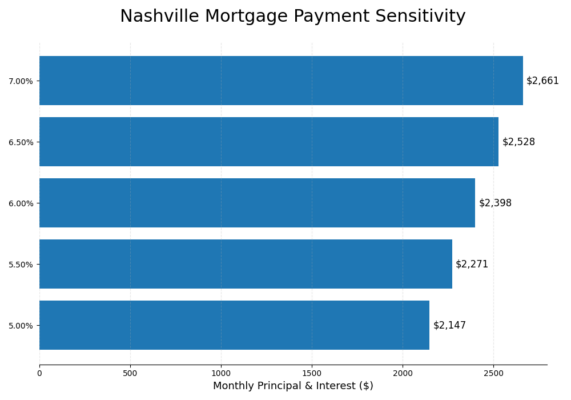
How Does a Rate Change Affect Nashville Monthly Payments?
To illustrate how rate movement affects affordability:
- $500,000 purchase price
- 20% down
- $400,000 loan amount
- 30-year fixed
How Do You Find the Best Nashville Mortgage Rate? A 5-Step Guide
Securing a competitive mortgage rate in Nashville and Middle Tennessee requires preparation before contacting any lender. The five steps below apply across Davidson County, Williamson County, and surrounding markets, regardless of loan type or price point.
Step 1: Strengthen Your Credit Score
Mortgage rate offers vary materially by credit score. A buyer with a 760+ credit score typically receives the best available pricing. A buyer at 640 receives offers 0.50% to 0.75% above that benchmark. Pull all three credit bureau reports at least 60 days before applying, dispute any errors, and pay down revolving balances to keep credit utilization under 30%.
Step 2: Determine Your Nashville Price Range
Where you land on price determines which loan products are available. Buyers below the current conforming loan limit for Davidson County qualify for conventional financing. Buyers above that threshold require jumbo loans, which carry different qualification standards. Determine your target price range before lender outreach. The current FHFA conforming loan limit is published annually and updates each January.
Step 3: Compare Loan Types for Your Situation
Nashville buyers should compare at least three loan types: conventional 30-year fixed, FHA 30-year fixed, and either VA (if eligible) or jumbo (if above conforming limits). For investment properties, also compare DSCR loans against conventional investment financing. See the Nashville Airbnb Financing Guide for DSCR, conforming, and commercial loan structures by deal type. Each loan type carries different rate structures, qualification thresholds, and total cost profiles.
Step 4: Get Quotes from at Least Three Lenders
Nashville investors purchasing properties for short-term rental need to verify NOOSTR eligibility under Davidson County's non-owner-occupied permit rules before committing capital. See the Nashville NOOSTR permit guide for the regulatory framework, zoning constraints, and renewal conditions that affect investor underwriting.
Mortgage rate offers vary by lender even for the same borrower profile on the same day. Federal disclosure rules require lenders to provide a Loan Estimate within 3 business days of application. Request Loan Estimates from at least three lenders within a 14-day window so credit pulls count as a single inquiry. Compare APR (the all-in cost) rather than just interest rate, since lender fees vary.
Step 5: Get Preapproved Before Active Home Search
Preapproval establishes the maximum loan amount a lender will extend based on verified income, assets, and credit. Nashville sellers in competitive submarkets typically require preapproval letters with offers. Preapproval also locks in pricing assumptions, which protects against last-minute rate movement during contract negotiation.
For Nashville buyers who want to evaluate financing strategy alongside specific property targets, the weekly archive of weekly mortgage analysis provides current market context and rate environment analysis.
Authored by Grant Hammond, broker at Compass RE with the BDG Partners team in Nashville. Tracking Nashville mortgage rates and Middle Tennessee real estate financing data weekly since 2018. See the Revenue and ROI Guide for how rate changes shape Nashville Airbnb investment returns.
Should You Use a Nashville Mortgage Broker?
Nashville buyers can finance through a retail lender (a bank or direct lender that funds its own loans) or a mortgage broker (an intermediary that shops your file across multiple wholesale lenders). Neither is categorically cheaper — the right answer depends on your file and the week.
A broker’s advantage is breadth: one application shopped across many wholesale lenders, which can surface a better price for harder-to-place files — self-employed income, jumbo balances, DSCR investment loans, or thinner credit. A retail lender’s advantage is control of the process end to end, which can matter on tight closing timelines common in competitive Nashville submarkets. Broker fees and any lender compensation are not set by law and are fully negotiable, and every lender — broker or retail — must disclose all costs on the Loan Estimate. The most reliable way to compare is not to pick a channel in the abstract but to put at least one broker and one retail Loan Estimate side by side and compare the APR (the all-in cost including fees), not just the note rate. Request all quotes within a 14-day window so the credit inquiries count as one.
Frequently Asked Questions About Nashville Mortgage Rates
Buyers, sellers, and investors across Nashville and Middle Tennessee often have practical questions about how mortgage rates influence timing, qualification, and purchasing power. The answers below address common concerns related to 30-year, 15-year, FHA, and VA mortgage rates in Davidson County, Williamson County, and surrounding markets.
What is the current 30-year mortgage rate in Nashville?
As of Friday, September 11, 2026, the Nashville 30-year fixed closed at 7.12% and the 15-year fixed at 6.65%, per the Mortgage News Daily Rate Index. The Freddie Mac Primary Mortgage Market Survey for the same week averaged 6.76% and 6.09%. The dashboard at the top of this page carries the Mortgage News Daily Rate Index, which prices actual lender rate sheets every business day and runs a few basis points off the weekly survey because the two measure different things. Rates are reported nationally, and borrower pricing in Davidson County, Williamson County, and the surrounding Middle Tennessee markets tracks those averages, adjusted for credit profile, loan size, occupancy, and lender overlays.
Even small rate changes can meaningfully affect purchasing power in Nashville’s $400,000 to $750,000 price range, where most owner-occupied transactions occur.
How often do mortgage rates change in Nashville?
Mortgage rates can change daily based on bond market activity. Intraday pricing is influenced primarily by movement in the 10-year Treasury yield and mortgage-backed securities markets.
However, the dashboard on this page updates weekly using official survey data to provide a consistent benchmark. Borrowers actively under contract may see more frequent pricing adjustments depending on market volatility.
Are FHA mortgage rates lower than conventional rates in Tennessee?
FHA rates typically run 0.10% to 0.25% below conventional in elevated-rate environments, with the current Nashville FHA 30-year near 6.68% versus conventional at 7.12%. The note-rate savings are real, but FHA carries mortgage insurance premiums (upfront 1.75% of the loan amount and ongoing 0.55% to 0.85% annually) that conventional borrowers with 20% down avoid entirely. For first-time Nashville buyers putting less than 10% down, FHA usually wins on total monthly cost. For buyers with 10% or more down and strong credit, conventional with private mortgage insurance often produces a lower all-in payment despite the slightly higher note rate.
How does the 10-year Treasury affect mortgage rates?
The 10-year Treasury yield serves as the primary benchmark for long-term borrowing costs. Mortgage rates generally move in the same direction as Treasury yields because mortgage-backed securities price off this benchmark.
When inflation data pushes Treasury yields higher, mortgage rates typically rise. When yields stabilize or decline, mortgage rates may moderate. However, mortgage spreads also play a critical role in determining final borrower pricing.
Should I lock my mortgage rate now?
Lock if your closing is within 30 to 45 days and the current Nashville 30-year fixed at 7.12% pencils for your payment. The 30-year closed at 7.12% on Friday, September 11, 2026, up 23 basis points on the week from 6.89%, and the 15-year closed at 6.65%, up 16 basis points. Measured on the weekly PMMS basis the spread was 188 basis points, down from 199 a month earlier, and that current-week figure stays provisional until the 10-year Treasury weekly average publishes Monday. The August inflation reports landed on September 10 and 11, 2026 and are the reason, and they are already in lender pricing. The next scheduled event is the Federal Reserve meeting on September 15 and 16. If your file is in underwriting and expires inside 30 days, that meeting is the event to plan around, so have the conversation with your lender before Tuesday. Locks longer than 60 days carry pricing premiums of approximately 0.125% to 0.25%, which can offset any expected near-term rate improvement.
How much does a 0.50% rate change affect monthly payments?
On a $400,000 loan amount, a 0.50% rate change alters principal and interest by about $134 per month. The general rule is about $33 per $100,000 borrowed for every 0.50%, and about $17 per $100,000 for every 0.25%, which holds across the rate range buyers are seeing today. Larger Williamson County loan balances scale proportionally.
Do mortgage rates vary by county in Middle Tennessee?
The headline 30-year fixed rate does not change by county, but borrower pricing and product mix do. Davidson County buyers in the $400,000 to $750,000 range most often use conventional or FHA loans, where pricing tracks the Freddie Mac PMMS average closely. Williamson County buyers in Brentwood and Franklin frequently cross into jumbo territory above the conforming loan limit, where pricing runs 0.10% to 0.20% above conventional for strong borrowers. Rutherford County and Maury County buyers see more FHA and VA volume, where pricing is similar to conventional but qualification rules differ. The rate is national; the product fit is local.
What is a jumbo loan in Nashville, and when do I need one?
A jumbo loan is any mortgage above the FHFA conforming loan limit for a one-unit home. Davidson and Williamson County use the standard national limit (verify the current figure at the FHFA, updated each January). A Nashville purchase becomes jumbo when the loan amount exceeds that limit — most common in Brentwood, Franklin, and on downtown luxury high-rise condos. Nashville jumbo pricing recently ran near 7.06% on the 30-year fixed, typically 0.10% to 0.20% above conforming, with stricter reserve and debt-to-income requirements.
Should I choose a 15-year or 30-year mortgage in Nashville?
At current Nashville rates, a $400,000 loan is about $2,694 per month on a 30-year fixed at 7.12% versus $3,517 per month on a 15-year fixed at 6.65% — roughly $824 more per month, but about $336,500 less in lifetime interest. The 15-year suits buyers with the cash flow to absorb the higher payment who want to own free-and-clear sooner; the 30-year suits buyers prioritizing monthly flexibility. Figures are principal and interest only.
How much house can I afford in Nashville?
Lenders generally apply the 28/36 guideline: housing costs at or below 28% of gross monthly income and total debt at or below 36%. At 7.12% on a 30-year fixed, monthly principal and interest runs about $2,020 on a $300,000 loan, $2,694 on $400,000, and $3,367 on $500,000, before taxes, insurance, and any HOA. Work backward from a comfortable payment to a target loan amount, then confirm the qualifying figure with a lender against your income, debts, and credit.
Is it cheaper to use a Nashville mortgage broker?
Not categorically. A broker shops one application across multiple wholesale lenders, which can help harder-to-place files (self-employed, jumbo, or DSCR investment loans); a retail lender controls the process end to end, which can matter on tight closing timelines. Broker fees and any lender compensation are not set by law and are fully negotiable. Compare at least one broker and one retail Loan Estimate side by side on APR, not just the note rate.
Where Does This Nashville Mortgage Rate Data Come From?
Headline rates on this page come from the Mortgage News Daily (MND) Rate Index, priced from lender rate sheets each business day. Supporting and comparison data:
- Freddie Mac Primary Mortgage Market Survey (PMMS). Weekly comparison benchmark for conventional rates. Accessed June 5, 2026.
- Mortgage Bankers Association Weekly Applications Survey. National weekly application and contract-rate reference. Accessed June 5, 2026.
- U.S. Department of the Treasury Daily Yield Curve Rates. Accessed June 5, 2026.
- U.S. Bureau of Labor Statistics Consumer Price Index. April 2026 release.
- U.S. Bureau of Labor Statistics Producer Price Index. April 2026 release.
- Federal Open Market Committee policy statements and projections. April 2026 FOMC meeting.
- Tennessee Housing Development Agency. Great Choice Home Loans and homebuyer assistance program data.
- Greater Nashville REALTORS monthly market statistics. April 2026 release. Accessed June 5, 2026.
How Have Nashville Mortgage Rates Moved Each Week in 2026?
Mortgage rate conditions can shift quickly based on Treasury movement, inflation data, and mortgage spread dynamics. For broader commentary, historical analysis, and additional rate-related insights, explore our Mortgage Rates and Financing section, which houses ongoing coverage of borrowing trends across Nashville and Middle Tennessee.
Featured Nashville mortgage analysis
The Nashville mortgage rate environment has shifted materially across 2026. The weekly updates below offer the most analytically distinctive recent breakdowns:
- September 11, 2026: Two inflation reports and another leg higher in oil drove the 30-year up 23 basis points to 7.12%, the highest reading of the daily index since early 2025. The 15-year rose 16 basis points to 6.65%, and the mortgage spread was 188 basis points on the weekly PMMS basis, down 11 from a month earlier. Fed funds futures priced an 86.5% chance of a hike at the September 16 meeting.
- September 4, 2026: Oil, renewed Iran strikes and a global bond selloff drove the 30-year to a 15-month high of 6.91% on Wednesday before it settled at 6.89% at Friday's close. The 15-year rose 14 basis points to 6.49%, and the mortgage spread was 193 basis points on the weekly PMMS basis, down 10 from a month earlier. A strong August jobs report moved rates just 1 basis point.
- August 28, 2026: Jackson Hole reset the week in a single session and the 30-year closed at 6.81%, its highest in just over three weeks. The 15-year closed at 6.35% and the mortgage spread was 198 basis points on the weekly PMMS basis. From this week these figures are Friday closes from the Mortgage News Daily Rate Index rather than the Thursday Freddie Mac survey, which averaged 6.66%.
- August 21, 2026: A Treasury buyback announcement reset long-end yields midweek before oil drove them back up, and the Freddie Mac survey eased 2 basis points to 6.65%. The 15-year fell to 5.95% and the mortgage spread compressed to 195 basis points, while daily lender pricing rose to 6.77%. Core PCE and the Jackson Hole symposium are the next catalysts.
- August 14, 2026: A cooler-than-forecast Producer Price Index drove daily rates to their lowest levels since July 17 as the Freddie Mac survey eased 2 basis points to 6.67%. The 15-year fell to 5.96% and the mortgage spread compressed to 199 basis points, with no FOMC meeting until September 16.
- August 7, 2026: A weak July jobs report and lower oil pulled daily mortgage rates to a three-week low even as the Freddie Mac survey ticked up 3 basis points to 6.69%. The 15-year eased to 6.01% and the mortgage spread widened to 203 basis points, with next week’s July CPI and PPI reports the key to a possible September Fed cut.
- July 31, 2026: An oil-driven inflation scare from the renewed Iran conflict pushed daily rates to one-year highs as the Freddie Mac survey rose 8 basis points to 6.66%. The 10-year Treasury eased to near 4.66%, and a wider spread pushed the weekly survey higher into the July 29 Fed meeting.
- July 17, 2026: Cooler June CPI and PPI pulled daily rates off one-year highs even as the Freddie Mac survey rose to a 2026 high of 6.55%. Daily pricing improved into Friday after the inflation reports priced out most of the 2026 Fed rate-hike risk.
- July 3, 2026: Quarter-end volatility lifted daily pricing even as the Freddie Mac survey fell to a 2026 low of 6.43%. Effective daily rates finished about seven basis points higher on the week while the weekly average set new lows
- June 26, 2026: The 30-year held at 6.49% as daily lender pricing eased to one-month lows on quarter-end bond buying. The weekly survey barely moved even as the daily trend improved into month end
- May 22, 2026: How global bond yields and the Iran conflict pushed Nashville rates to a fresh 2026 high. The 10-year Treasury holds its 4.45% to 4.65% range and the spread mechanics flow through one-for-one
- May 15, 2026: Daily lender quotes climb to a nine-month high as PMI and Treasury auctions reset expectations. Weekly average held lower than the daily peak by the largest spread in two months
- April 24, 2026: The multi-week descent from the April highs to the early-May lows. How spread compression and GSE intervention drove the move and why those mechanics now run in reverse
For detailed weekly breakdowns including Treasury movement, mortgage spread analysis, and local affordability implications, review our most recent updates:
- September 11, 2026: The 30-year rose 23 basis points to 7.12%, the highest reading of the daily index since early 2025. The 10-year Treasury closed at 4.96% on Friday, up 18 basis points on the week and its highest close since 2023, so Treasuries again did most of the work while the weekly PMMS spread narrowed to 188 basis points.
- September 4, 2026: The 30-year rose 8 basis points to 6.89%, a 15-month high for the daily index. The 10-year Treasury closed at 4.78% on Friday, up 5 basis points on the week after printing a 2026 high of 4.79%, so the Treasury side did all the work while the spread narrowed to 193 basis points.
- August 28, 2026: Jackson Hole reset the week in a single session and the 30-year closed at 6.81%, its highest in just over three weeks. The 10-year finished at 4.73% and the mortgage spread was 198 basis points on the weekly PMMS basis. From this week the headline figures are Friday closes from the Mortgage News Daily Rate Index rather than the Thursday Freddie Mac survey, which averaged 6.66%.
- August 21, 2026: Daily lender pricing rose to 6.77% even as the Freddie Mac survey eased 2 basis points to 6.65%. The 10-year finished flat near 4.70% after touching 4.75% on Tuesday, so a 2 basis point spread compression to 195 basis points did all the work.
- August 14, 2026: A cooler-than-forecast Producer Price Index drove daily rates to their lowest levels since July 17 and pulled the Freddie Mac survey down 2 basis points to 6.67%. The 10-year still finished the week higher near 4.70%, so a 6 basis point spread compression did all the work as mortgage-backed securities outperformed Treasuries.
- July 10, 2026 Nashville mortgage rates: 6.49% near 10-month highs as higher oil prices lifted bond yields
- June 19, 2026 Nashville mortgage rates: 6.47% as a hawkish Fed dot plot met easing Iran tensions
- June 12, 2026 Nashville mortgage rates: 6.52% with Treasury yields rallying on Iran de-escalation ahead of Warsh’s first FOMC
- Nashville mortgage rates June 5, 2026: 6.48% before Friday's jobs-report whiplash
- Week of May 29, 2026: 6.53% as the 10-year Treasury reversal pulled rates down
- Week of May 8, 2026: 6.37% as mortgage spreads widened against borrowers
- May 1, 2026 Nashville mortgage update: 6.30% after a hawkish Fed hold lifted yields
- Week of April 17, 2026: 6.30% as Treasury yields stabilized after late-March highs
- April 10, 2026 Nashville mortgage rates: 6.46% with the 10-year Treasury near 4.31%
- Nashville mortgage rates April 3, 2026: 6.46% as rates improved off the late-March peak
- March 27, 2026 Nashville mortgage update: 6.38% on inflation expectations and energy prices
- Week of March 20, 2026: 6.22% as the 10-year Treasury held near 4.25%
- Nashville mortgage rates March 13, 2026: 6.11% as Iran tensions lifted oil prices
- March 6, 2026 Nashville mortgage rates: 6.00% with the Treasury yield stable at 4.14%
- Week of February 27, 2026: 5.98% as mortgage spreads compressed to 1.96%
- February 20, 2026 Nashville mortgage rates: 6.01% with spreads at 1.93%
- Nashville mortgage rates February 13, 2026: 6.09% as the Treasury held 4.09%
Browse the full Nashville mortgage rates archive →
These reports provide structured time-series insight into mortgage rate direction across Davidson County, Williamson County, and the broader Middle Tennessee housing market.