Nashville’s real estate market continues to evolve as capital investment, corporate expansion, and large-scale development reshape housing demand across Middle Tennessee.
Over the past week, three important Nashville real estate developments stood out. A major mixed-use tower near Vanderbilt secured financing. At the same time, Oracle Corporation expanded its footprint in Nashville with a large office lease. In addition, Metro finalized a major East Bank ground lease with The Fallon Company, advancing one of the city’s most important redevelopment zones.
Nashville remains one of the fastest-growing metropolitan areas in the United States. As a result, both supply and demand dynamics are becoming more visible across the Nashville real estate market.
Together, these developments illustrate the key forces shaping Nashville real estate market trends. Key drivers include capital flows, corporate-driven housing demand, and large-scale land activation.
Quick Takeaways: Nashville Real Estate News This Week
Three developments shaped Nashville real estate news this week and highlight key Nashville real estate market trends.
Vanderbilt-Area Tower Secures Financing
- A $180M mixed-use tower near Vanderbilt secured a $130M construction loan, confirming continued capital investment in Nashville real estate development.
Oracle Expands at Neuhoff District
- Oracle Corporation signed a 116,000 square foot lease at Neuhoff in Germantown, reinforcing corporate-driven housing demand in Nashville.
East Bank Ground Lease Finalized
- Metro and The Fallon Company finalized a ground lease agreement, advancing large-scale mixed-use development on Nashville’s East Bank.
1. $180M Midtown Condo-Hotel Tower Secures $130M Construction Loan
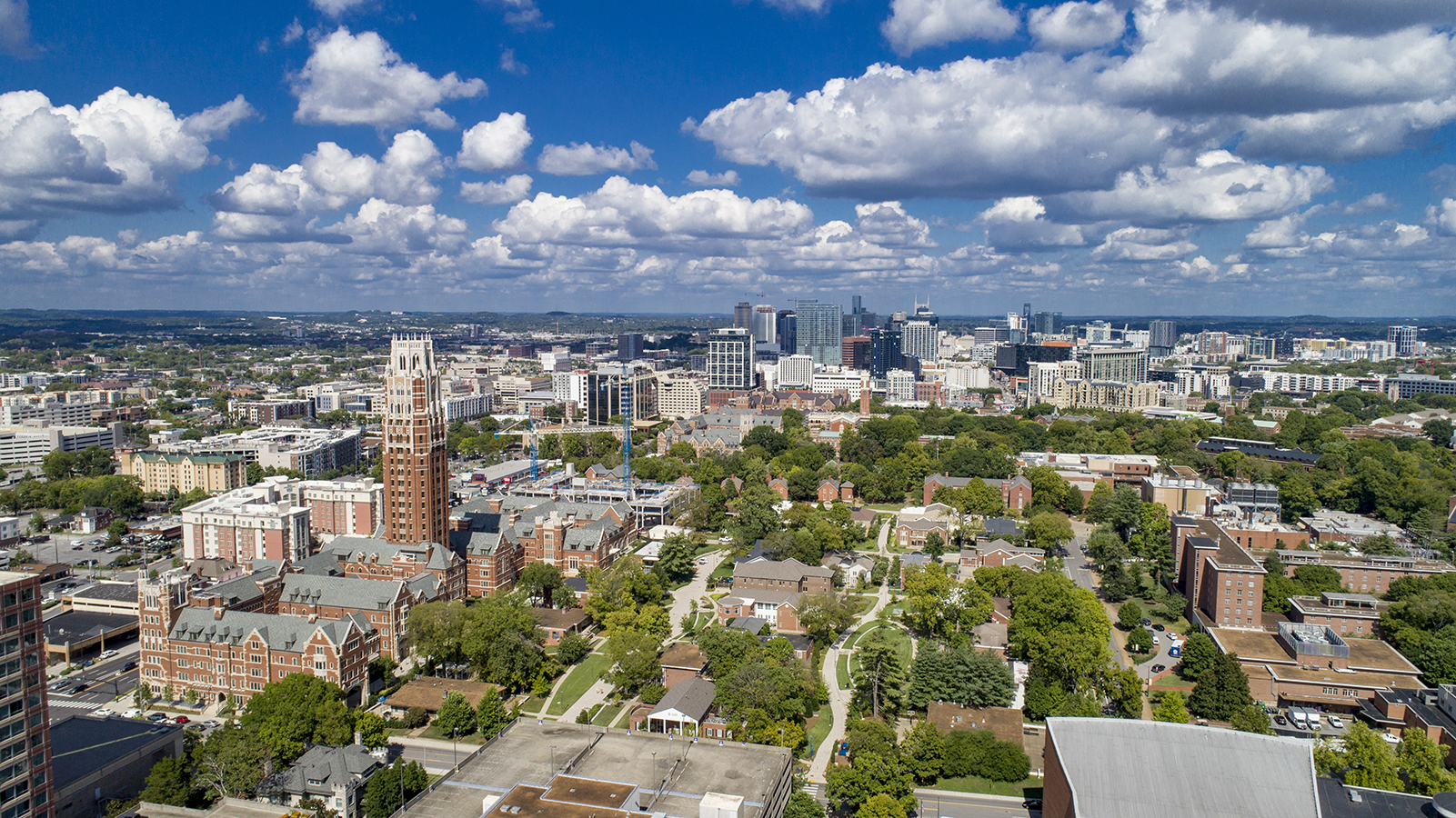
Midtown remains one of Nashville’s strongest submarkets due to its proximity to Vanderbilt and major employment centers.
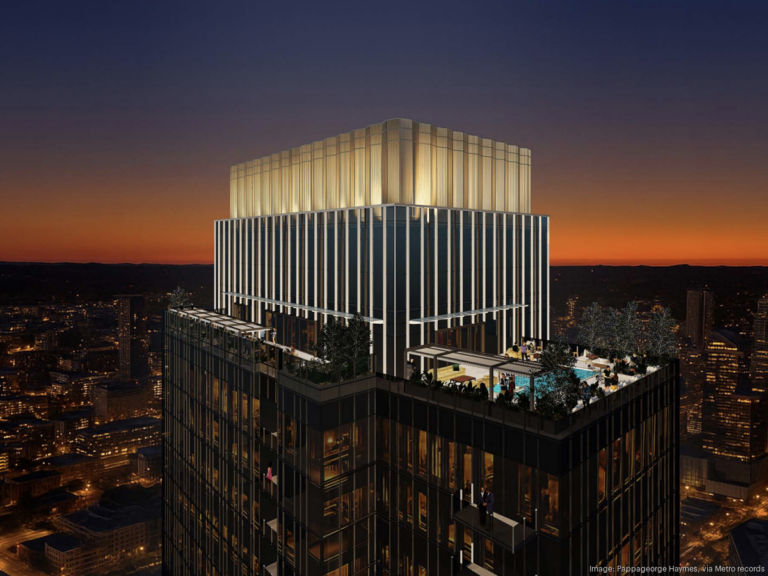
A major mixed-use condo-hotel project near Vanderbilt University secured approximately $130M in construction financing this week, moving a roughly $180M development into the execution phase.
The project, being developed by CA South, is located along Hayes Street near 19th Avenue South in Midtown Nashville, one of the city’s most active and resilient development corridors.
Plans call for approximately:
- 192 condominium units
- 114 hotel suites
- ~56,000 square feet of office space
- ~12,000 square feet of retail and restaurant space
Midtown sits adjacent to Vanderbilt University and within Nashville’s primary healthcare and employment hub. As a result, it continues to attract sustained investment across multiple property types.
Securing construction financing is one of the most critical milestones in the development process. It signals that lenders are confident not only in the project itself, but also in long-term demand for Nashville’s urban core.
At a time when capital markets remain selective, a construction loan of this size represents a clear vote of confidence in Midtown’s ability to support high-density mixed-use development.
Why This Matters for Nashville Real Estate
Large-scale mixed-use projects in Midtown tend to set pricing benchmarks for both condominium and rental markets.
By combining residential, hotel, office, and retail uses, developments like this create highly active, walkable environments that attract both residents and visitors. Over time, this density supports higher property values in surrounding neighborhoods.
More importantly, this project reflects a broader trend. Capital is continuing to target Nashville’s most supply-constrained, high-demand submarkets, even as financing conditions remain tight.
In the near term, this reinforces Midtown as one of the strongest housing demand zones in Nashville. Over time, projects like this contribute to upward pressure on pricing in adjacent areas connected to Vanderbilt and the West End corridor.
2. Oracle Signs 116,000 SF Lease at Neuhoff District
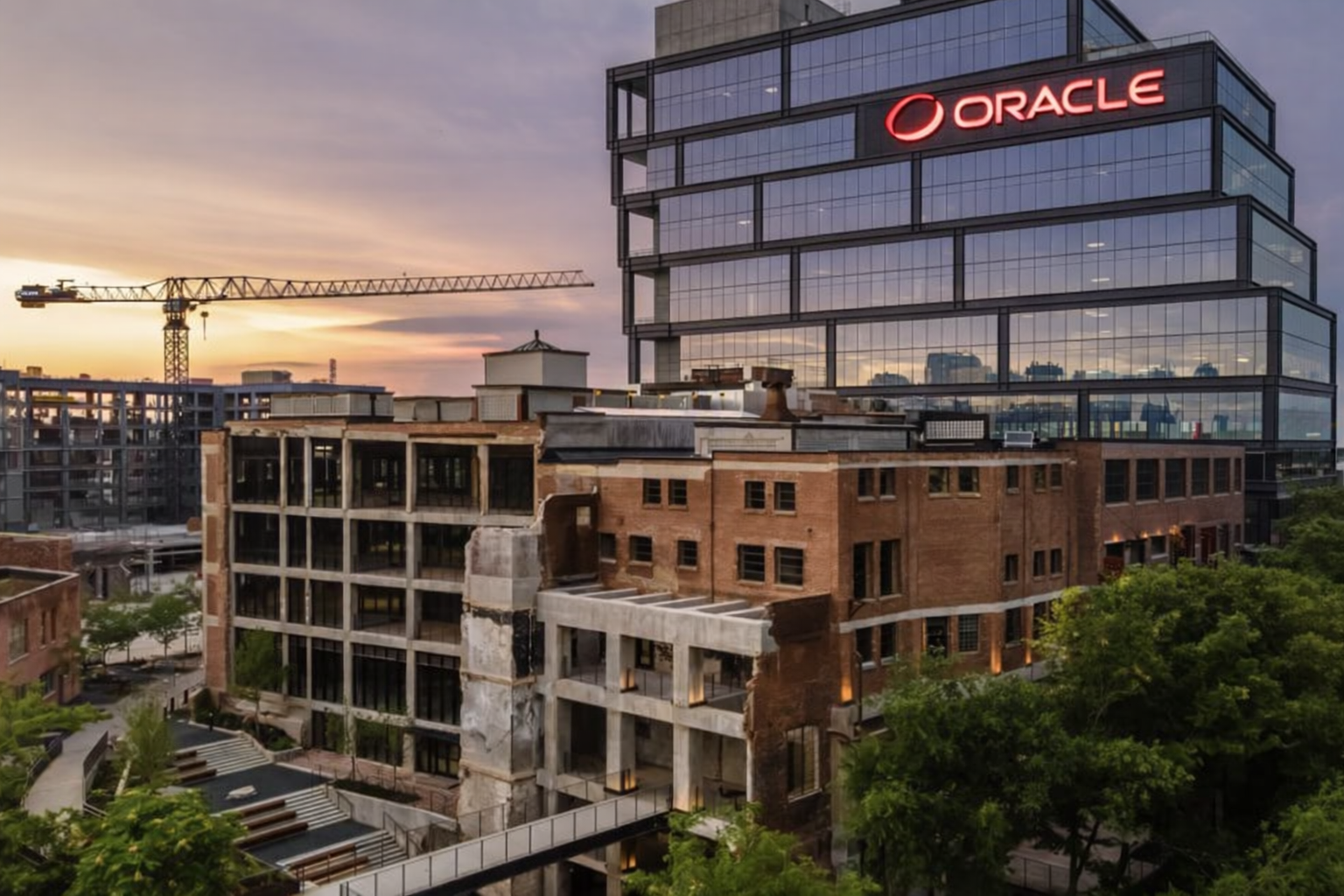
Oracle expands at Neuhoff in Germantown, directly overlooking its planned $4.5B East Bank campus.
Oracle Corporation signed a 116,000 square foot office lease this week within the Neuhoff District, located at 1316 Adams Street in Germantown along the Cumberland River.
The Neuhoff District is a major adaptive reuse project transforming a historic industrial site into a mixed-use development with office, residential, and retail components. The site sits directly along the riverfront and within immediate proximity to Nashville’s rapidly developing East Bank.
What makes this lease particularly significant is its geographic relationship to Oracle’s broader Nashville expansion. The Neuhoff site overlooks Oracle’s planned East Bank campus, a project expected to total approximately $4.5 billion and span nearly 80 acres.
That campus is projected to include millions of square feet of office space and support thousands of employees over time, making it one of the largest corporate investments in Nashville’s history.
This 116,000 square foot lease represents a measurable and immediate demand signal tied directly to that long-term expansion strategy.
Why This Matters for Nashville Real Estate
A lease of this size represents meaningful absorption of Class A office space in Nashville. However, the bigger story is the layering of demand.
Oracle is not only building a long-term campus, but also actively expanding its footprint in surrounding developments. This creates a concentrated demand zone across Germantown, the East Bank, and surrounding urban neighborhoods.
In the near term, this type of expansion drives housing demand tied to employee relocation. Over time, it reinforces sustained upward pressure on residential demand in walkable, high-amenity areas near the riverfront.
3. Metro Finalizes East Bank Ground Lease With The Fallon Company
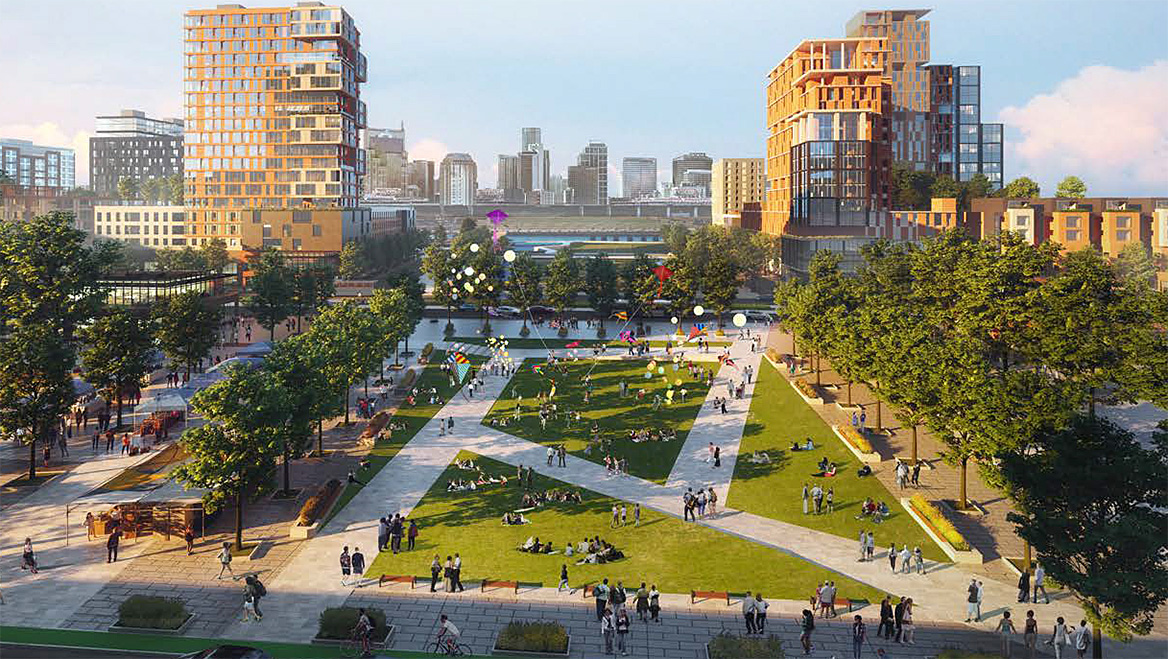
The East Bank is planned as a walkable mixed-use district connecting multiple major developments along the riverfront.
Metro Nashville finalized a major ground lease agreement this week with The Fallon Company, advancing large-scale development on the East Bank along the Cumberland River near 1 Titans Way and the new Nissan Stadium site.
The East Bank represents one of the largest coordinated redevelopment efforts in Nashville’s history. The broader district spans hundreds of acres and is expected to include billions of dollars in mixed-use development over time.
The Fallon Company’s involvement signals movement toward vertical development within a district that is expected to deliver:
- Residential units
- Office space
- Retail and entertainment
- Hospitality development
In addition, the East Bank is expected to anchor several major civic and cultural investments, including the planned relocation of TPAC (Tennessee Performing Arts Center).
The area is also directly connected to multiple large-scale developments, including:
- The former PSC Metals site redevelopment
- Station East
- River North
- Oracle’s $4.5 billion campus
This level of coordinated development is rare and positions the East Bank as a true extension of downtown Nashville.
Why This Matters for Nashville Real Estate
The scale of the East Bank cannot be overstated. This is not a single project. It is a multi-phase, multi-billion-dollar district-level transformation.
Ground lease execution signals that development is moving from planning into structured implementation. As a result, land that was previously underutilized is beginning to transition into future housing and mixed-use density.
Over time, this will shift Nashville’s center of gravity eastward. New residential demand is likely to cluster around the riverfront, creating entirely new high-value neighborhoods adjacent to downtown.
This type of large-scale development typically creates:
- Long-term housing demand
- New pricing benchmarks
- Sustained investor interest
Nashville Real Estate Market Outlook
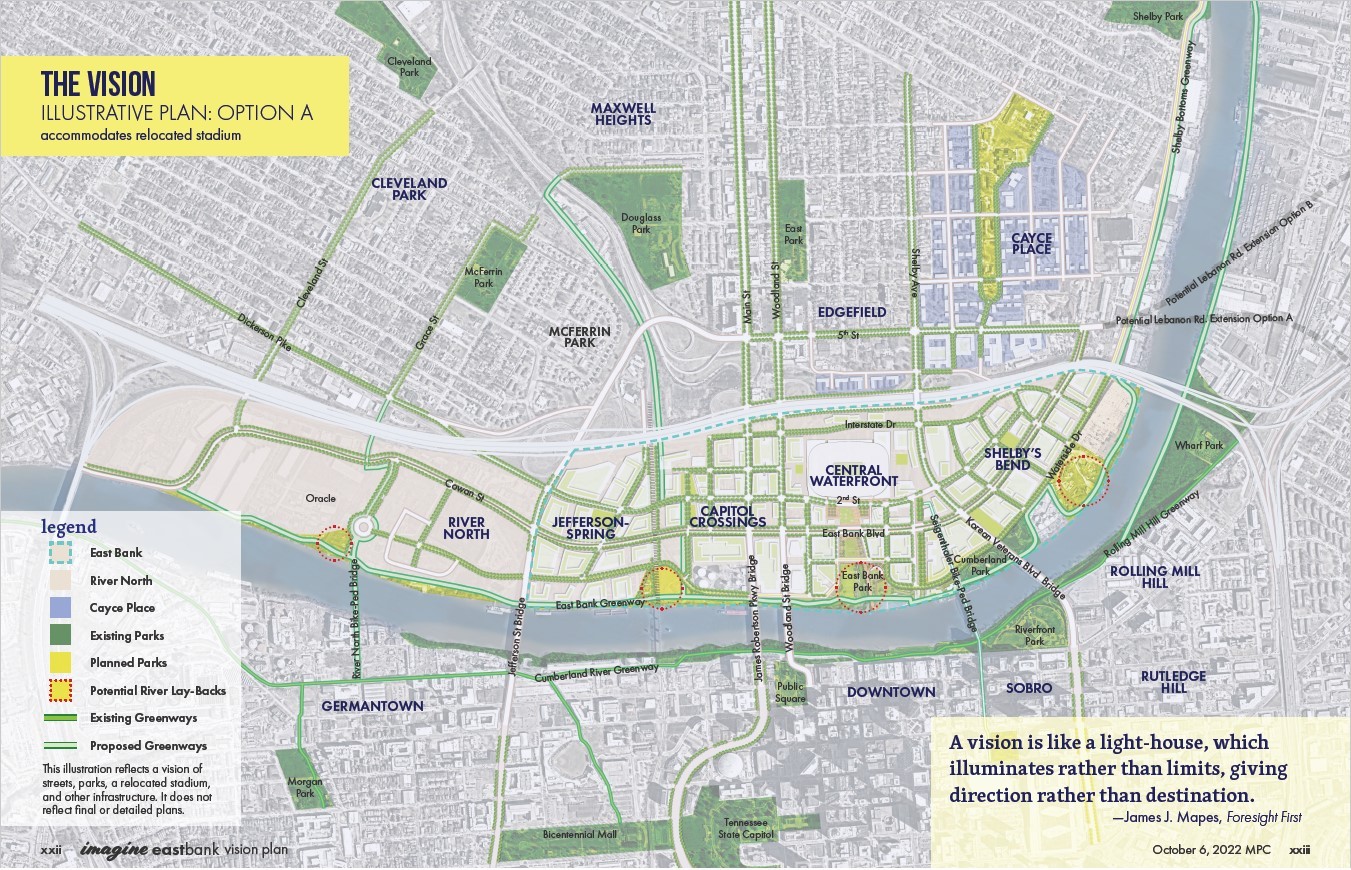
The East Bank connects River North, Oracle’s campus, and multiple redevelopment zones into one large-scale urban district.
Recent developments across Nashville point to a market entering its next phase, where capital, demand, and supply are beginning to rebalance.
Capital investment, corporate expansion, and land activation indicate that Nashville remains firmly in a growth phase, even as higher financing costs begin to influence development pacing and housing supply.
Capital Flow and Development Confidence
The Vanderbilt-area project demonstrates that lenders remain willing to fund large-scale developments in Nashville. At a time when capital markets remain selective, financing of this scale signals continued confidence in well-located urban projects.
As a result, mixed-use developments in high-demand submarkets are likely to continue moving forward, even as marginal projects face greater constraints.
Corporate-Driven Housing Demand
Oracle’s expansion reinforces the direct relationship between job growth and housing demand. When large employers expand, nearby residential markets typically experience increased demand and upward pricing pressure.
In this case, demand is becoming more geographically concentrated around walkable, amenity-rich districts near employment centers.
Land Activation and Future Supply
The East Bank ground lease signals that one of Nashville’s most important redevelopment areas is moving toward execution. Over time, this will introduce new housing supply, but it will also establish a new center of gravity for residential and commercial activity.
Large-scale districts like the East Bank tend to reshape development patterns across the entire metro area rather than simply adding isolated supply.
Residential Market Implications
For the Nashville housing market, these forces point to continued growth, but with increasing segmentation between submarkets.
In the near term, housing demand is likely to remain strong in areas near job centers, mixed-use developments, and infrastructure investment zones. Midtown, Germantown, and the East Bank corridor are likely to see the most sustained interest.
At the same time, supply is beginning to expand incrementally through both large-scale development and smaller infill projects. However, this supply is likely to enter the market more slowly than demand is increasing.
Over a 12 to 24 month horizon, the most likely outcome is:
- Continued population-driven demand
- Slower but still positive price growth
- Increased inventory in targeted submarkets
- Stronger performance in high-amenity, walkable areas
This dynamic creates a period of partial rebalancing rather than decline, where increased supply improves buyer options without materially weakening overall pricing.
As a result, Nashville real estate market trends are becoming increasingly location-specific, with performance diverging between high-demand urban corridors and less connected submarkets.