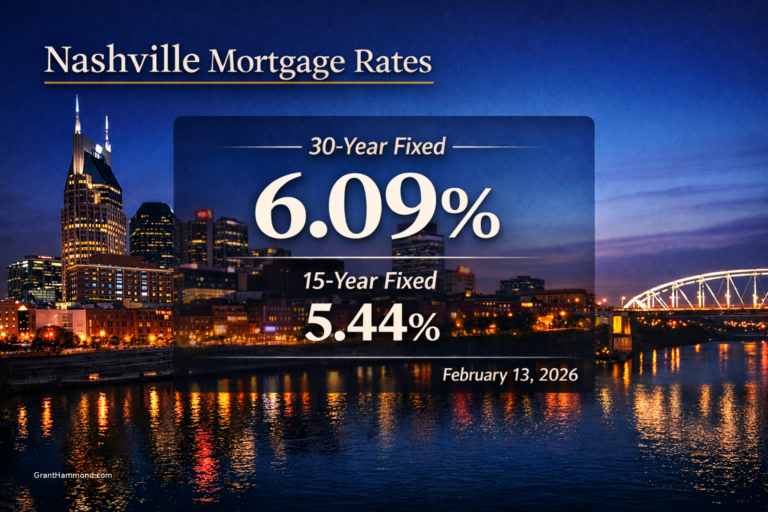
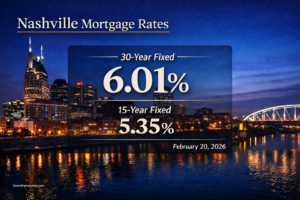
 Nashville mortgage rates averaged 6.01% for the 30-year fixed during February 16 to 20, 2026, reflecting modest downward movement as bond markets stabilized. The 10-year Treasury yield held near 4.08%, providing continued support for long-term mortgage pricing across Middle Tennessee. Mortgage spreads compressed slightly, allowing borrower rates to improve even without significant Treasury volatility. While Federal Reserve policy remains restrictive, liquidity conditions in fixed income markets remain orderly. For buyers and sellers in Davidson County and Williamson County, the rate environment continues to modestly improve affordability compared to late 2025 levels.
Market Summary
• Nashville 30-year fixed mortgage rate averaged 6.01% during February 16 to February 20, 2026.
• Nashville 15-year fixed mortgage rate averaged 5.35% across Middle Tennessee.
• FHA 30-year mortgage rates held near 5.99% for qualified borrowers, according to the MBA survey.
• The 10-year Treasury yield remained near 4.08%, supporting long-term mortgage pricing.
• Mortgage spreads remained near 1.93%, reflecting modest distance between Treasury yields and mortgage pricing.
Mortgage Rate Dashboard
What Is Driving Mortgage Rates Right Now?
Mortgage rates continue to track the trajectory of the 10-year Treasury yield, which remained near 4.08% this week and helped support lower mortgage averages. Softer long-term yields may reflect modest easing of inflation pressures and a cautious fixed-income market stance, bolstering mortgage rate declines. The Supreme Court’s recent tariff decision did not significantly move bond yields, suggesting investors view it as structurally important but not immediately inflationary. Federal Reserve policy remains restrictive, and weekly H.4.1 data show ongoing large holdings of agency debt and mortgage-backed securities that underpin market liquidity. While outright MBS operations have been muted recently, reinvestment policies and balance sheet support continue to signal steady liquidity conditions.
Macro Snapshot | February 20, 2026
Strategic Borrower Considerations in Today’s Market
Borrowers in Middle Tennessee may find slightly improved affordability due to the recent decline in average rates, but the fixed cost of credit remains relatively high by historical standards. Refinance activity increased this week as lower rates encouraged some homeowners to explore reducing monthly payments. For prospective buyers, the decision between adjustable and fixed rates should balance expectations for future rate volatility against the desire for long-term payment certainty.
Refinance Threshold
Most borrowers require an improvement of approximately 0.75% to 1.00% to justify closing costs. Recent modest rate declines have reopened selective refinance opportunities, but widespread refinancing remains limited.
Adjustable vs Fixed Strategy
With 30-year rates in the low 6% range, some buyers are evaluating shorter-term fixed products. Payment structure decisions should reflect time horizon, risk tolerance, and expectations for rate volatility rather than short-term headlines.
What This Means for Nashville and Middle Tennessee
Slightly softer mortgage averages provide incremental affordability support as early spring activity builds. In neighborhoods such as East Nashville, Green Hills, Brentwood, and Franklin, small rate shifts continue to influence negotiation leverage and payment planning. Stability in Treasury markets remains more important than daily headlines for understanding the direction of Nashville mortgage rates.
For ongoing context and historical comparisons, visit Nashville Mortgage Rates Today.
What to Watch Next Week
• Freddie Mac PMMS release
• MBA Weekly Applications Survey
• Treasury auction demand
• Inflation data releases