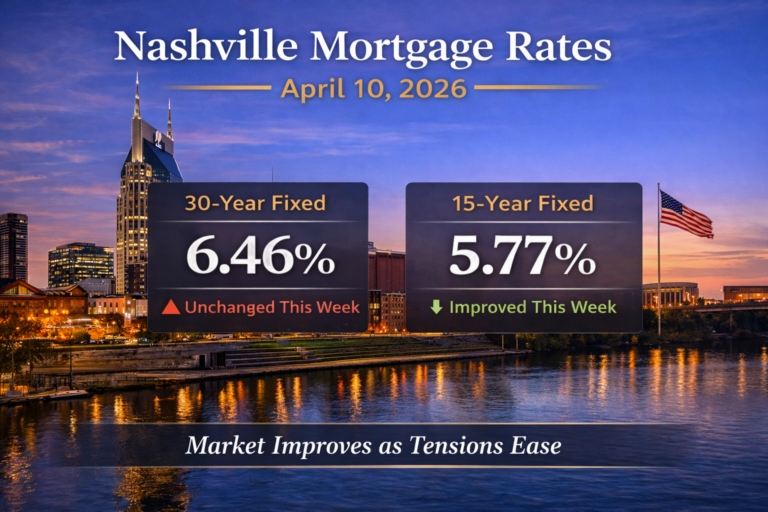
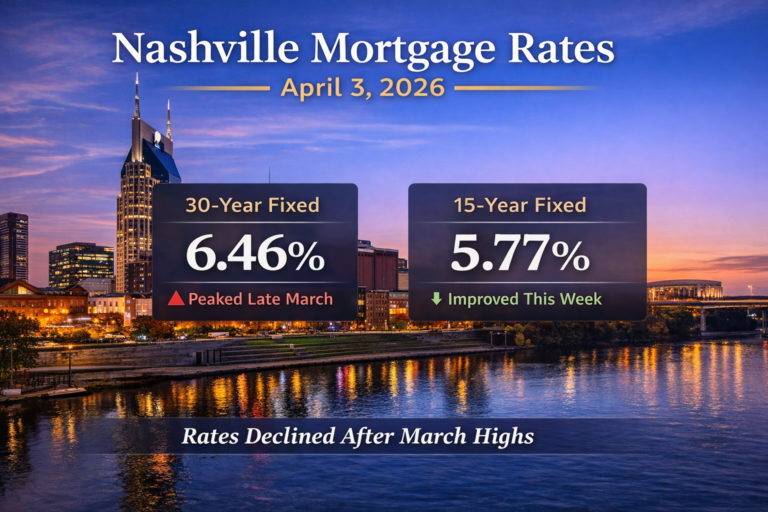
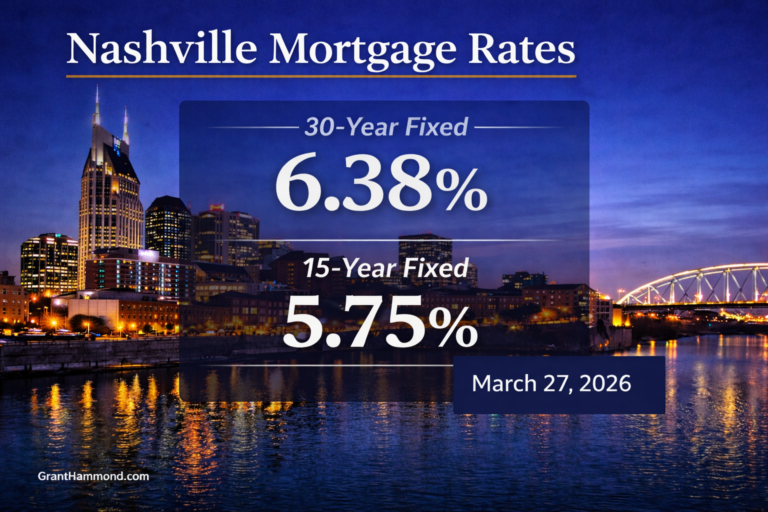
Mortgage rates declined for the third consecutive week, continuing a short-term downward trend in borrowing costs.
According to Freddie Mac, the 30-year fixed mortgage rate fell to 6.35%, down from 6.40% the prior week. The 15-year fixed rate declined to 5.90%, while adjustable-rate products also moved lower, with the five-year ARM dropping to 5.97% and the one-year ARM falling to 5.15%.
A Continued Decline in Rates
The steady decline in mortgage rates over multiple weeks suggests a shift in investor sentiment.
Mortgage rates are closely tied to movements in the bond market, particularly U.S. Treasury yields. When investors move toward safer assets or adjust expectations around economic growth and inflation, borrowing costs often follow.
This type of multi-week decline typically reflects broader financial market adjustments rather than isolated weekly changes.
Market Conditions in Nashville
At the same time, the Nashville housing market was continuing to navigate a slower environment.
Transaction volume had declined compared to prior years, and inventory levels remained elevated. While lower mortgage rates can improve affordability, they do not always translate into immediate increases in buyer activity, particularly when broader economic uncertainty is present.
In this type of market, financing conditions are only one factor influencing overall demand.
Historical Context
This update was originally published during the late-2000s housing downturn, when mortgage rates were moving in response to significant financial system stress and government intervention in the housing sector.
During this period, actions involving institutions such as Fannie Mae and Freddie Mac were influencing investor confidence and liquidity in mortgage markets. These shifts contributed to periods of declining rates, even as housing activity remained subdued.
Nashville experienced similar trends, although its underlying fundamentals helped moderate the overall impact compared to more volatile markets.
Tracking Mortgage Rate Trends
Mortgage rates are influenced by inflation expectations, bond market movements, and broader economic conditions.
Understanding these drivers provides important context for both short-term fluctuations and long-term trends. To compare these historical levels with today’s market, you can follow Nashville mortgage rates today.