Alora Nashville Sets Record with Most Expensive Airbnb Sale in 2026
Alora Nashville recorded the highest Airbnb sale in Nashville in 2026 at $1.4 million, even as overall short-term rental transactions remain low....
Nashville short-term rentals require either an owner-occupied or a non-owner-occupied (NOOSTR) permit issued by Metro Nashville Codes. As of 2026, NOOSTR permits are restricted to DTC zoning and select mixed-use corridors. Nashville approves a small fraction of NOOSTR applications annually. Permit availability varies by council district.
Grant Hammond has completed more than 550 Airbnb and short-term rental transactions in Nashville, more than any other agent in the Davidson County market. He personally owns more than 20 non-owner-occupied STR townhomes within three miles of downtown Nashville, and has sold more than 350 high-rise condos in downtown Nashville during his 25-year career. Hundreds of millions of dollars in luxury home sales across Davidson and Williamson Counties further establish his standing as Nashville’s most experienced real estate broker. Summit Property Management, which Grant co-founded in 2008, scaled to over 350 units before he sold the company in 2013. The Wall Street Journal, the Los Angeles Times, The Tennessean, and the Nashville Business Journal have all cited his STR market analysis. This category is the primary resource on GrantHammond.com for Nashville Airbnb investing, NOOSTR regulations, STR market data, and purpose-built short-term rental developments.
Nashville administers two STR permit classifications. Owner-occupied STRs require the owner to live on the property. Non-owner-occupied STRs (NOOSTR) allow the owner to operate without living on-site. NOOSTR permits apply only to DTC zoning and certain mixed-use corridors in Downtown, The Gulch, and select commercial transition zones.
Permit density limits apply by council district. Investors must confirm zoning classification through Metro Nashville Codes before any acquisition. Skipping zoning verification risks acquiring a property that cannot legally operate as an STR.
This category covers zoning map changes, Metro Council legislation affecting STR density, permit transfer rules, overlay district modifications, and compliance enforcement trends. For current market data, see the Nashville Airbnb Market Report.
Nashville’s STR market runs on consistent tourism demand, major convention activity, and corporate relocation growth. According to AirDNA, Nashville ranked among the top 10 U.S. markets for STR revenue consistency in 2025. Occupancy averaged above 68% across high-demand corridors that year.
This category tracks cap rate movement, median STR sale prices, permit saturation by neighborhood, occupancy and average daily rate trends, and comparative STR versus long-term rental returns across Davidson County.
For active inventory, see Nashville Airbnbs for sale. For transaction history and resale positioning data, see recently sold Nashville Airbnbs.
Alora Nashville sits within three miles of downtown and stands as the highest-profile purpose-built NOOSTR development in the market. A unit at Alora sold for $1.4 million in April 2026, the highest recorded Airbnb sale in Nashville that year.
Other purpose-built STR developments covered in this category include Lucy Nashville, Musica on Music Row, Horizon River District, Vistas at Katie Hill, and Starlet East. Articles in this category analyze zoning structure, HOA operational rules, historical sale performance, liquidity, and long-term regulatory durability for each development.
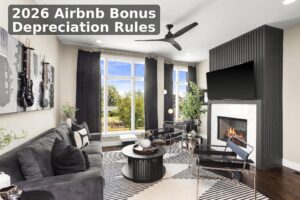
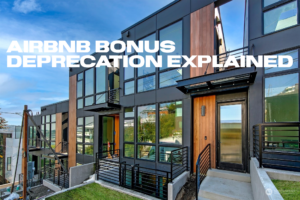
The restoration of 100% bonus depreciation took effect for property placed in service after January 19, 2025. This change significantly altered the investment calculus for Nashville STR buyers. Investors can now fully expense qualifying personal property in year one rather than depreciating it over 27.5 years. Furniture, fixtures, and appliances all qualify.
Pairing bonus depreciation with a cost segregation study accelerates deductions further in the acquisition year. DSCR loans qualify borrowers based on the property’s projected rental income rather than personal income. This has made financing purpose-built STR properties more accessible for investors in 2026.
Buying a Nashville STR requires zoning verification, NOOSTR eligibility confirmation, revenue documentation review, and compliance assessment before making any offer. Investors must evaluate owner-occupied versus NOOSTR classification, DTC zoning durability, historical occupancy and ADR performance, cap rate alignment, and HOA STR restrictions.
Selling a Nashville Airbnb requires income-based valuation modeling, permit verification, and investor-targeted marketing. STR buyers focus on income stability, permit documentation, and regulatory durability. They do not rely on comparable sales alone. Learn more about how to sell your Nashville Airbnb using a structured income-driven strategy.
Grant Hammond guides investors through every step of acquisition and disposition as a licensed Tennessee broker with more than 550 completed STR transactions. Contact Grant directly to discuss current NOOSTR-eligible inventory.
A non-owner-occupied short-term rental (NOOSTR) lets the owner operate a short-term rental without living on the property. Nashville restricts NOOSTR permits to DTC zoning and certain mixed-use corridors. Metro Nashville Codes administers these permits and enforces density limits by council district.
An owner-occupied STR permit requires the owner to live on the property as their primary residence. A NOOSTR permit lets the owner operate without living on-site. Nashville places significantly tighter restrictions on NOOSTR permits. These permits apply only to specific zoning districts and carry density caps by council district.
Yes, but legality depends on zoning classification and permit approval. Nashville permits both owner-occupied and non-owner-occupied short-term rentals in designated areas. Properties outside approved zoning districts cannot receive STR permits. Investors must verify zoning and permit eligibility before purchasing.
Nashville permits non-owner-occupied STRs in DTC zoning and select mixed-use corridors. These districts concentrate in Downtown, The Gulch, and certain commercial areas. Investors must confirm zoning classification through Metro Nashville Codes before acquisition.
Yes. A homeowners association can restrict or prohibit STR activity even when zoning allows it. Investors must review HOA bylaws, declarations, and amendments before purchase. This step confirms operational eligibility before closing.
STR permits do not automatically transfer upon sale. New owners must apply and confirm eligibility under current zoning rules. Investors should verify permit continuity during due diligence, as regulations can change between contract and closing.
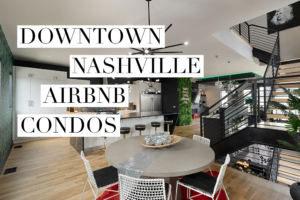
The strongest STR neighborhoods in Nashville include Downtown, The Gulch, Germantown, Midtown, and Music Row. Performance depends on walkability, proximity to entertainment districts, zoning stability, and tourism demand patterns.
Buyers value Nashville Airbnb properties using income-based analysis, not traditional comparable sales alone. They evaluate revenue history, operating expenses, cap rate expectations, permit compliance, and regulatory durability when determining market value.
100% bonus depreciation lets investors fully expense qualifying personal property in the year they place it in service. Nashville STR investors can deduct furniture, fixtures, appliances, and other qualifying property in year one. This provision covers property placed in service after January 19, 2025 under the current tax law restoration.
Grant Hammond has completed more than 550 Airbnb and short-term rental transactions in Nashville. That total makes him the most active STR agent in the Davidson County market. He personally owns more than 20 non-owner-occupied STR townhomes within three miles of downtown Nashville. He co-founded Summit Property Management, scaled it to over 350 units, and sold the company in 2013.