For long-term trends and historical comparisons, visit Nashville mortgage rates today.
Market Summary
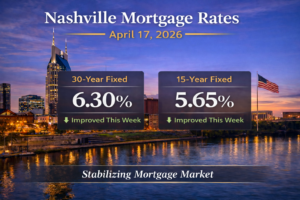
- Nashville 30-year fixed mortgage rate averaged 6.30%, down from 6.37%.
- Nashville 15-year fixed mortgage rate averaged 5.65%, down from 5.74%.
- FHA 30-year mortgage rates held near the ~6.00% range.
- The 10-year Treasury traded in the ~4.26% to 4.29% range midweek.
- Mortgage spreads remained near ~2.02% (202 bps).
- Federal Reserve policy remained restrictive.
According to Freddie Mac, rates declined this week as bond market conditions improved. At the same time, mortgage application activity showed modest improvement as affordability conditions stabilized.
Mortgage Rate Dashboard
Nashville Mortgage Rates This Week
Mortgage rates moved lower this week, with the 30-year fixed rate declining to 6.30% and the 15-year fixed rate falling to 5.65%.
However, daily pricing improved more than weekly averages suggest. This reflects the lag between real-time bond market movement and Freddie Mac’s survey methodology. As a result, borrowers saw better rate offerings during the week than the headline numbers indicate.
What Is Driving Mortgage Rates Right Now?
Mortgage rates are being shaped by bond market movement, inflation expectations, and geopolitical developments.
Why Mortgage Rates Didn’t Fall as Much as the Bond Market Suggested
Mortgage rates ended the week at their lowest levels in more than a month. However, they did not fall as much as the bond market suggested they could.
Mortgage rates are driven by mortgage-backed securities pricing. While those markets improved, lenders were slower to pass those gains through to consumers. This is typical behavior when rates are moving lower.
Mortgage rates tend to move faster when rising and more slowly when falling. As a result, improvements in bond markets often take time to fully reach borrowers.
Geopolitics and Energy Markets
Global developments continue to influence rate movement. Energy prices remain the transmission mechanism.
When oil prices rise, inflation expectations increase and rates follow. When tensions ease and oil declines, inflation pressure softens and bond markets improve.
This dynamic continues to create a tug-of-war in mortgage rates.
Institutional Macro Snapshot
The 10-Year Treasury and Mortgage Rate Spreads
The 10-year Treasury remained in the mid-4.2% range, reflecting a more stable bond market environment.
Mortgage spreads, calculated as the difference between Freddie Mac mortgage rates and the 10-year Treasury, remain near ~2.02%.
While this represents some improvement, spreads remain elevated relative to historical norms. This continues to limit how quickly mortgage rates decline.
Strategic Borrower Considerations in Today’s Market
Rate Volatility
Rate volatility has declined compared to March. As a result, borrowers are seeing more stable pricing conditions.
Buydown Economics
Temporary rate buydowns remain effective in this environment. They can reduce monthly payments immediately while preserving flexibility.
Refinance Threshold
Most borrowers still require a 0.75% to 1.00% improvement to justify refinancing. However, improving trends suggest future opportunities may emerge.
MBS Market and Spread Commentary
Mortgage-backed securities improved this week. However, spreads remain elevated. This means mortgage rates will continue to lag Treasury improvements.
Payment Impact Example
For a $400,000 loan:
- At 6.30% → ≈ $2,480/month
- At 6.05% → ≈ $2,425/month
👉 Monthly difference: ≈ $55
👉 Annual impact: ≈ $660
Even small rate changes can significantly impact affordability.
What This Means for Nashville and Middle Tennessee
This week signals a shift toward stability and gradual improvement.
The Nashville housing market remains resilient. Inventory is not surging, and demand continues to hold across key submarkets.
Even a 0.25% decline in rates can increase purchasing power by roughly 3% to 4%. As a result, improving rate conditions can quickly bring sidelined buyers back into the market.
If rates continue to stabilize, buyer activity is likely to increase.
What to Watch for Mortgage Rates Next Week
- Treasury yield direction
- Inflation expectations
- Energy price movement
- Federal Reserve communication
- Mortgage application trends
The key question is whether improving bond market conditions continue.
Buyers and homeowners are seeing more stability after several volatile weeks. Here are the most relevant mortgage rate questions for this week.
Nashville Mortgage Rates FAQ
What are mortgage rates in Nashville right now?
As of the week ending April 17, 2026, the average 30-year fixed mortgage rate is 6.30%, while the 15-year fixed rate is 5.65%, according to Freddie Mac.
Why are mortgage rates still elevated in 2026?
Mortgage rates remain elevated due to persistent inflation, Treasury yields, and restrictive Federal Reserve policy.
Are mortgage rates improving right now?
Mortgage rates improved this week and reached their lowest levels in more than a month. However, improvement remains gradual.
Should buyers wait for lower mortgage rates?
Waiting for lower rates can increase competition and home prices. In many cases, buyers benefit from acting in a stable rate environment and refinancing later if rates decline.