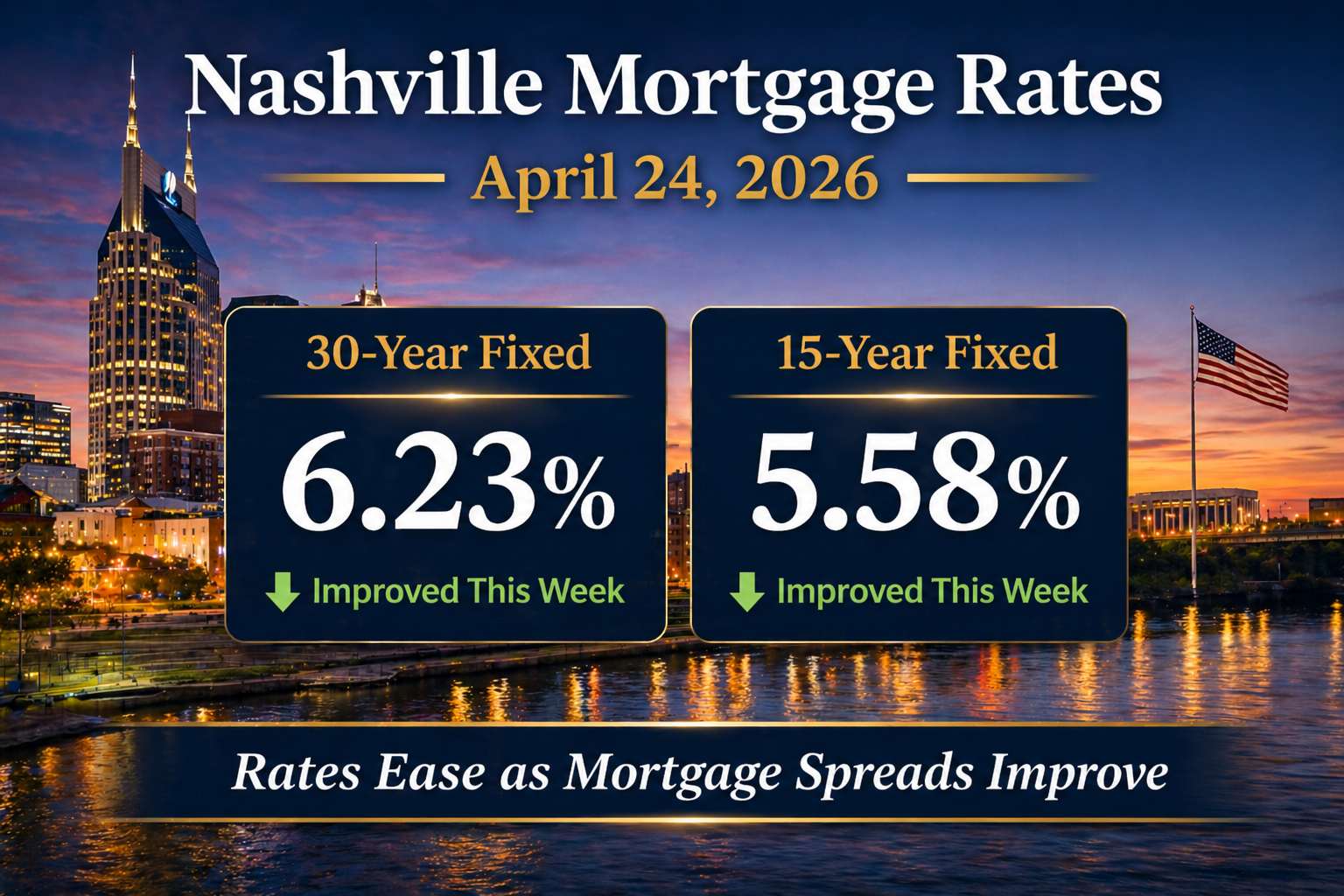
Nashville mortgage rates averaged 6.23% for the 30-year fixed and 5.58% for the 15-year fixed for the week ending April 24, 2026, according to Freddie Mac PMMS. Rates declined for the second straight week as mortgage spreads tightened and purchase applications rose.
The move reflects a more constructive mortgage market. Freddie Mac rates declined, mortgage spreads tightened, and purchase applications rose sharply as buyers responded to better borrowing conditions.
For Nashville and Middle Tennessee buyers, this does not mean affordability pressure has disappeared. However, it does suggest that financing conditions are improving from the more volatile rate environment seen earlier this spring. For longer-term context, visit latest Nashville mortgage rate updates.
Market Summary
- Nashville 30-year fixed mortgage rate averaged 6.23%, down from 6.30% last week.
- Nashville 15-year fixed mortgage rate averaged 5.58%, down from 5.65% last week.
- FHA 30-year mortgage rates were near 6.10%.
- The 10-year Treasury yield ended near 4.31%.
- Mortgage spreads were near 1.92%, or 192 bps.
- Federal Reserve policy remained restrictive.
- MBA mortgage applications rose 7.9%, while purchase applications rose 10%.
According to Freddie Mac PMMS, the 30-year fixed mortgage rate declined again this week and is now at its lowest level in the last three spring homebuying seasons.
Mortgage Rate Dashboard
The April 24, 2026 mortgage rate dashboard shows a 6.23% 30-year fixed rate, a 5.58% 15-year fixed rate, an FHA 30-year rate near 6.10%, a 10-year Treasury yield near 4.31%, and a mortgage spread near 1.92%.
Nashville Mortgage Rates This Week
Nashville mortgage rates declined for the second straight week. The 30-year fixed mortgage rate moved from 6.30% to 6.23%, while the 15-year fixed mortgage rate moved from 5.65% to 5.58%.
The year-over-year comparison is also improving. One year ago, the 30-year fixed rate averaged 6.81%, which means today’s Freddie Mac benchmark is 58 bps lower than the same point last spring.
That matters locally because Nashville buyers are highly sensitive to monthly payment changes. Even small rate improvements can bring sidelined buyers back into the market, especially below $1 million where financing costs drive more decisions.
Institutional Macro Snapshot
What Is Driving Mortgage Rates Right Now?
Mortgage rates are being driven by the interaction between Treasury yields, mortgage spreads, inflation, and Federal Reserve policy. This week, the clearest improvement came from the mortgage side of the equation rather than a major drop in Treasury yields.
1. Treasury yields are setting the base rate
The 10-year Treasury yield ended the week near 4.31%. That remains elevated, which keeps a meaningful floor under mortgage rates even as consumer mortgage pricing improves.
2. Mortgage spreads are shaping borrower pricing
The spread between the Freddie Mac 30-year mortgage rate and the 10-year Treasury tightened to roughly 1.92%. That is a constructive signal because borrowers can benefit from tighter spreads even when Treasury yields do not fall.
This follows a similar pattern to last week’s Nashville mortgage rate update, when spreads also began improving.
3. Federal Reserve policy is keeping the rate floor elevated
The Federal Reserve remains restrictive while inflation stays above its long-term target. Core CPI rose 2.6% year over year in March, which supports gradual improvement rather than a rapid collapse in mortgage rates.
The 10-Year Treasury and Mortgage Rate Spreads
The 10-year Treasury is the primary benchmark for long-term mortgage rate direction. However, the mortgage rate borrowers receive also depends on the spread between mortgage rates and Treasury yields.
This week, the spread was approximately 1.92%, based on a 6.23% Freddie Mac 30-year fixed rate and a 4.31% 10-year Treasury yield.
That spread matters because it measures how efficiently the mortgage market is pricing borrower risk. When spreads tighten, mortgage rates can improve even if Treasury yields remain relatively stable.
Payment Impact for Nashville Buyers
For a $500,000 home purchase with 20% down, the loan amount is $400,000. Using a standard 30-year fixed mortgage amortization formula, this week’s rate improvement creates a measurable payment change.
- At 6.30%, principal and interest are approximately $2,476 per month.
- At 6.23%, principal and interest are approximately $2,458 per month.
- The monthly payment improvement is approximately $18.
- Over 30 years, that equals roughly $6,560, before taxes, insurance, HOA dues, closing costs, or refinancing.
The weekly change is modest by itself. However, if mortgage rates continue easing over several weeks, the cumulative affordability impact becomes more meaningful for Nashville buyers.
Strategic Borrower Considerations This Week
Borrowers should view this week’s rate decline as a stabilization signal, not a guarantee that rates will fall quickly. The more important shift is that mortgage pricing is becoming more efficient while purchase demand is beginning to respond.
- Buyers may want to revisit affordability if they paused during higher-rate weeks earlier this spring.
- Sellers should watch showing activity closely because lower rates can quickly improve buyer confidence.
- Investors should monitor spreads because tighter mortgage pricing can improve debt-service coverage.
- Move-up buyers should compare the benefit of waiting against the risk of stronger summer competition.
Grant Hammond has more than 20 years of Nashville real estate experience, has sold hundreds of millions of dollars in residential property across Davidson and Williamson Counties, and has completed more than 550 short-term rental transactions where financing structures, including DSCR loans and rate-sensitive investor purchases, were central to the deal.
In past rate cycles, buyer demand often began improving before the broader market fully recognized the shift.
Nashville Real Estate Market Outlook
The Nashville real estate market is entering a more constructive financing window. Rates remain elevated compared with the pandemic-era market, but they are now moving in a better direction for buyers.
If mortgage rates remain near the low 6% range, demand should continue improving in the most payment-sensitive segments of the market. That includes many homes under $1 million, where monthly payment changes have an immediate effect on buyer behavior.
If Treasury yields rise again, mortgage rates could give back some of this improvement. However, if spreads continue tightening, borrowers may still see better pricing even without a major Treasury rally.
For a broader comparison, review the April 10 Nashville mortgage rate update to see how Freddie Mac rate data has changed over the last few weeks.
For more local financing updates, explore the Mortgage Rates and Financing section.
Nashville Mortgage Rates FAQ
What are Nashville mortgage rates today?
Nashville mortgage rates averaged 6.23% for a 30-year fixed mortgage and 5.58% for a 15-year fixed mortgage for the week ending April 24, 2026. These figures are based on Freddie Mac PMMS data and interpreted for buyers across Nashville and Middle Tennessee.
Did mortgage rates go up or down this week?
Mortgage rates went down this week. The 30-year fixed rate fell from 6.30% to 6.23%, while the 15-year fixed rate fell from 5.65% to 5.58%.
Why did mortgage rates move lower this week?
Mortgage rates moved lower because mortgage spreads tightened even as Treasury yields remained elevated. Stronger mortgage application activity also suggests that buyers responded to improved borrowing conditions.
How does the 10-year Treasury affect mortgage rates?
The 10-year Treasury is the main benchmark for long-term mortgage rate direction. Mortgage rates usually move with Treasury yields, but spreads determine how much borrowers pay above that benchmark.
Are Nashville mortgage rates expected to fall in 2026?
Nashville mortgage rates could gradually improve if inflation cools, Treasury yields stabilize, and mortgage spreads continue tightening. However, Federal Reserve policy remains restrictive, so the most likely path is gradual improvement rather than a sharp decline.
Should Nashville buyers wait for lower mortgage rates?
Waiting may help if rates continue falling, but it can also increase competition if more buyers return to the market. Buyers should compare the benefit of a lower rate against the risk of higher prices, fewer attractive listings, and stronger summer demand.
Sources and methodology
Rate data in this update reflects weekly averages from the Freddie Mac Primary Mortgage Market Survey (PMMS) for the week ending April 24, 2026. Daily lender pricing context is sourced from the Mortgage News Daily Mortgage Rate Index. Macro indicators including the 10-year Treasury yield reference Federal Reserve Economic Data (FRED) series DGS10. Spread analysis between mortgage rates and the 10-year Treasury uses the historical PMMS minus DGS10 series. Nashville-area builder buydown and concession observations reference active Middle Tennessee MLS data via the RealTracs system and conversations with local lenders. Year-over-year comparisons reference the same Freddie Mac PMMS week from the prior year.
- Freddie Mac Primary Mortgage Market Survey (PMMS): weekly 30-year and 15-year fixed rate benchmarks
- FRED DGS10: 10-year Treasury Constant Maturity Rate
- Mortgage News Daily Rate Index: daily lender pricing observations
- Federal Reserve FOMC Calendar: meeting dates and policy context
Important mortgage rate disclaimer
Rates and figures on this page are educational and reflect the data sources cited. They are not an offer, commitment to lend, or rate lock. Mortgage rates change daily and depend on individual credit profile, loan-to-value, property type, occupancy, and lender. For a pre-qualification and personalized rate quote, contact a licensed mortgage lender (NMLS-registered). Past rate movements do not predict future rates.