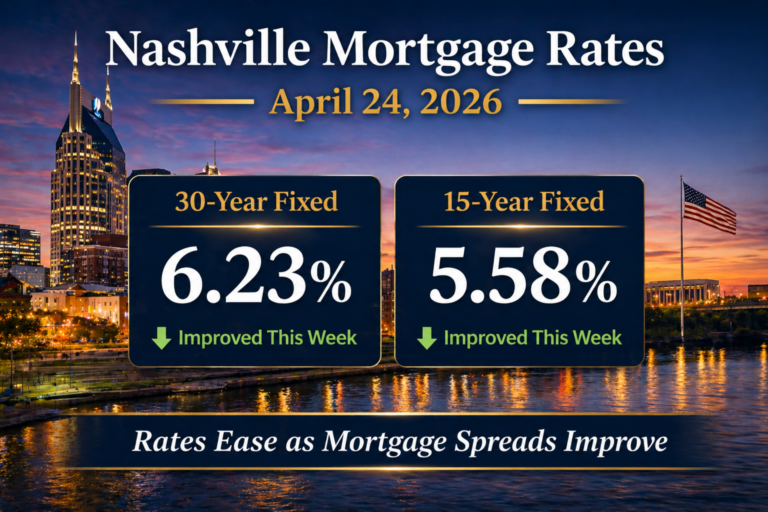
 Nashville mortgage rates rose modestly this week. According to Freddie Mac PMMS, the 30-year fixed averaged 6.30% and the 15-year fixed averaged 5.64% for the week ending May 1, 2026. Both rates moved up roughly seven basis points. Previously, the 30-year had bottomed at 6.23% the prior week. The shift followed a Federal Reserve hold. Notably, the meeting produced the largest internal dissent since 1992. As a result, Treasury yields lifted fractionally. However, mortgage spreads stayed essentially flat.
For Nashville and Middle Tennessee buyers, the move is small in basis-point terms but informative. Several factors point in the same direction. The Fed’s vote split was unusually wide. Additionally, Core CPI ticked up to 2.6% in March. Meanwhile, the 10-year Treasury closed at 4.39%. Together, these signals suggest the rate floor remains elevated until inflation eases meaningfully. Therefore, buyers tracking week-to-week movement can review our latest Nashville mortgage rate updates for ongoing context.
Nashville’s most payment-sensitive segments include entry-level homes under $500,000 and the $500,000 to $1 million band. Notably, these buyers feel a seven-basis-point shift in monthly affordability immediately. The headline number sounds modest, however, the local impact is real. Below is this week’s full data set. Specifically, it covers the Mortgage Rate Dashboard, the Institutional Macro Snapshot, payment impact tables, and an outlook for the weeks ahead.
Market Summary
- Nashville 30-year fixed mortgage rate averaged 6.30%, up from 6.23% last week.
- Nashville 15-year fixed mortgage rate averaged 5.64%, up from 5.58% last week.
- FHA 30-year mortgage rates were near 6.10%.
- The 10-year Treasury yield ended near 4.39%.
- Mortgage spreads were near 1.91%, or 191 bps.
- Federal Reserve policy remained restrictive, with hawkish dissent at the April 29 FOMC meeting producing a four-vote split, the largest since 1992.
- MBA mortgage applications fell 1.6% in the week ending April 24, while purchase applications ran 21% above the same week one year ago.
According to Freddie Mac PMMS, the 30-year fixed mortgage rate edged up after a multi-week decline that had carried the headline as low as 6.23% the prior week.
Mortgage Rate Dashboard
The May 1, 2026 mortgage rate dashboard shows a 6.30% 30-year fixed rate, a 5.64% 15-year fixed rate, an FHA 30-year rate near 6.10%, a 10-year Treasury yield near 4.39%, and a mortgage spread near 1.91%.
Nashville Mortgage Rates This Week
For the week ending May 1, 2026, the 30-year fixed averaged 6.30% and the 15-year fixed averaged 5.64%. Both rose roughly seven basis points week over week. This reversed a multi-week decline. Previously, the 30-year had fallen as low as 6.23%. Year over year, however, the picture remains favorable. The 30-year sits 46 basis points below last year’s 6.76% reading. Similarly, the 15-year is 28 basis points below last year’s 5.92%.
Two related events drove the move. The April 29 FOMC meeting produced four dissenting votes. Notably, this was the largest split since 1992. Three officials pushed to remove “easing bias” language from the policy statement. As a result, Treasury yields lifted. The 10-year closed the week at 4.39%, up about eight basis points. Meanwhile, mortgage spreads stayed essentially flat at 191 basis points. Consequently, the entire move flowed through directly from Treasuries to mortgage rates.
For Middle Tennessee buyers, this week’s tick up does not reverse the broader trend. Rates remain well below year-ago levels. Additionally, MBA purchase application activity sits 21% above the same week in 2025. Meanwhile, Nashville’s spring inventory has been building. The week’s small move matters more for what it signals about Fed posture. In contrast, the impact on monthly payments is minor.
Institutional Macro Snapshot
What Is Driving Mortgage Rates Right Now?
1. Treasury yields are setting the base rate
The 10-year Treasury closed the week at 4.39%. That marks an increase of roughly eight basis points from the prior week. Two threads lifted Treasuries. First, the April 29 FOMC meeting featured hawkish dissent. Second, geopolitical pressure on energy prices continued, tied to the Iran conflict. Importantly, mortgage pricing tracks the 10-year much more closely than the federal funds rate. Therefore, even modest moves in Treasury yields translate quickly into the rates Nashville buyers see at lock.
2. Mortgage spreads are shaping borrower pricing
The spread between the 30-year fixed and the 10-year Treasury held at 191 basis points this week. That is essentially unchanged from 192 basis points the prior week. Importantly, this stability matters. Spreads had widened to historically elevated levels through 2023 and 2024. However, spreads have gradually normalized toward 175 to 200 basis points. For borrowers, this has been one of the cleanest pieces of good news over the last year.
This week’s flat reading carries a clear message. The entire move in the headline rate came from Treasuries. In contrast, mortgage market efficiency did not deteriorate. For broader spread context across recent weeks, our April 24 Nashville mortgage rate update walks through the mechanics in detail.
3. Federal Reserve policy is keeping the rate floor elevated
The April 29 FOMC meeting held the federal funds rate at 3.50% to 3.75%. This was the third consecutive hold. However, the vote split was the most contentious in decades. Eight officials voted to hold, and four dissented. Three of the dissenters wanted to drop “easing bias” language from the policy statement. In effect, they no longer view the next move as definitively a cut. Only one dissenter wanted an immediate rate cut.
Meanwhile, inflation remains sticky. Core CPI ran at 2.6% year over year in March. Additionally, Core PCE ran at 3.2%. Both readings sit meaningfully above the Fed’s 2.0% target. As a result, the Fed has limited room to ease without compromising its inflation mandate.
The 10-Year Treasury and Mortgage Rate Spreads
The 10-year Treasury is the primary benchmark for long-term mortgage rate direction. However, the mortgage rate borrowers receive also depends on the spread between mortgage rates and Treasury yields.
This week, the mortgage spread was approximately 1.91%. The calculation reflects a 6.30% Freddie Mac 30-year fixed rate and a 4.39% 10-year Treasury yield. That figure is essentially unchanged from 192 bps the prior week. However, it remains roughly 30 to 50 basis points wider than the long-run pre-2022 average. Historically, that average sat between 150 and 170 basis points.
The spread has two drivers worth understanding. The first is interest-rate volatility. When the bond market becomes choppier, mortgage-backed securities investors demand a wider spread. This compensates them for prepayment risk and duration uncertainty. The second driver is institutional demand. Recently, mortgage-backed securities option-adjusted spreads narrowed to roughly 7 bps in mid-April. However, they widened back to 11 bps by month-end. This shift partly reflected a slight rebound in implied volatility, tied to Iran-related oil pressure.
For Nashville borrowers, the practical implication is straightforward. Further rate improvement requires one of two changes. First, a meaningful drop in Treasury yields, which depends on inflation cooling. Alternatively, another leg of spread tightening, which depends on volatility easing. Neither lever moved in borrowers’ favor this week. However, neither moved sharply against them either.
Payment Impact for Nashville Buyers
This week’s rate increased from 6.23% to 6.30%. Below are the resulting monthly principal and interest changes for three representative Nashville loan sizes. All calculations assume a 30-year fixed-rate amortization. Additionally, the year-over-year comparison versus the 6.76% rate from one year ago is far more meaningful. Specifically, it matters most for buyers who paused their search in 2025.
Entry-level: $400,000 loan (typical $500,000 home with 20% down)
- At 6.30%, principal and interest are approximately $2,476 per month.
- At 6.23% last week, principal and interest were approximately $2,458 per month.
- The week-over-week payment change is approximately $18 higher per month.
- Versus 6.76% one year ago, the same buyer pays approximately $121 less per month.
- Annualized, this represents roughly $1,452 less per year.
Mid-market: $750,000 loan (typical $937,500 home with 20% down)
- At 6.30%, principal and interest are approximately $4,643 per month.
- The week-over-week payment change is approximately $33 higher per month.
- Versus 6.76% one year ago, the same buyer pays approximately $227 less per month.
- Annualized, this represents roughly $2,724 less per year.
Luxury entry: $1,000,000 loan (typical $1,250,000 home with 20% down)
- At 6.30%, principal and interest are approximately $6,190 per month.
- The week-over-week payment change is approximately $44 higher per month.
- Versus 6.76% one year ago, the same buyer pays approximately $303 less per month.
- Annualized, this represents roughly $3,636 less per year.
Calculations cover principal and interest only. Property taxes, homeowner’s insurance, HOA dues, and PMI are excluded. Locally, this matters because Nashville buyers are highly sensitive to monthly payment changes. Specifically, the under-$500,000 segment is most affected. There, qualified buyers often operate at or near their debt-to-income ceiling. Overall, the week’s tick up is small in absolute terms. However, the year-over-year improvement is substantial.
Strategic Borrower Considerations in Today’s Market
Borrowers should view this week’s rate uptick as a small reversal, not a new direction. The Fed’s hawkish dissent suggests near-term volatility may push rates higher rather than lower. However, the underlying improvement of recent weeks is still intact.
- Buyers who have identified the right property should not wait for a meaningful rate retracement. It may not arrive within the lock window.
- Sellers in the under-$1 million band should price to current market conditions. Notably, roughly 35% of listings nationally have taken at least one price reduction.
- Investors should run cash flow at current rate levels rather than projecting a meaningful decline. Currently, the 191-basis-point spread keeps DSCR loan pricing competitive with primary-residence financing.
- Move-up buyers should weigh today’s lower payment against the risk of stronger summer competition. Meanwhile, inventory continues to churn in the low-6% rate band.
Grant Hammond has 25 years of Nashville real estate experience. Over his career, he has closed more than $1 billion in sales across Davidson and Williamson Counties. This includes more than 100 luxury transactions above $1.5 million. Additionally, he has completed more than 350 downtown Nashville high-rise condominium transactions. He has also closed more than 550 short-term rental transactions, where DSCR loans and rate-sensitive investor purchases were central to the deal.
In Grant’s experience across multiple Nashville rate cycles, the earliest signals of a shifting borrower environment show up first in mortgage spreads and purchase application activity. Notably, these signals appear before the headline Freddie Mac rate moves. This week’s flat spread and 21% year-over-year purchase index strength fit that pattern.
Nashville Real Estate Market Outlook
Base case for the next four to six weeks
The base case for Nashville mortgage rates is range-bound. Specifically, the 30-year fixed will likely trade between 6.20% and 6.45%. This projection assumes two conditions. First, the 10-year Treasury holds in a 4.30% to 4.50% band. Second, mortgage spreads remain near current levels of 185 to 195 basis points. However, a material change in either input would shift the range.
If the Fed follows through on the March dot plot
The Federal Reserve’s March 2026 dot plot indicated a 25-basis-point reduction this year. However, the timing remains highly uncertain. The path forward depends largely on inflation. If Core CPI continues to ease toward the 2.0% target, the 30-year fixed could settle in a favorable range. Specifically, between 6.00% and 6.25% by late summer.
If inflation reaccelerates
Alternatively, Core CPI could accelerate. Iran-related energy pressure has already hinted at this risk. In that scenario, the band would likely shift higher to 6.30% to 6.55% over the same horizon. Therefore, buyers should consider both paths when planning timing.
Nashville segment sensitivity
For Nashville specifically, two segments remain most rate-sensitive. These include entry-level homes under $500,000 and the $500,000 to $1 million band. Both segments would see the largest activity response to a 25 to 50 basis point rate improvement. Conversely, they would see the largest activity drag from a comparable move higher.
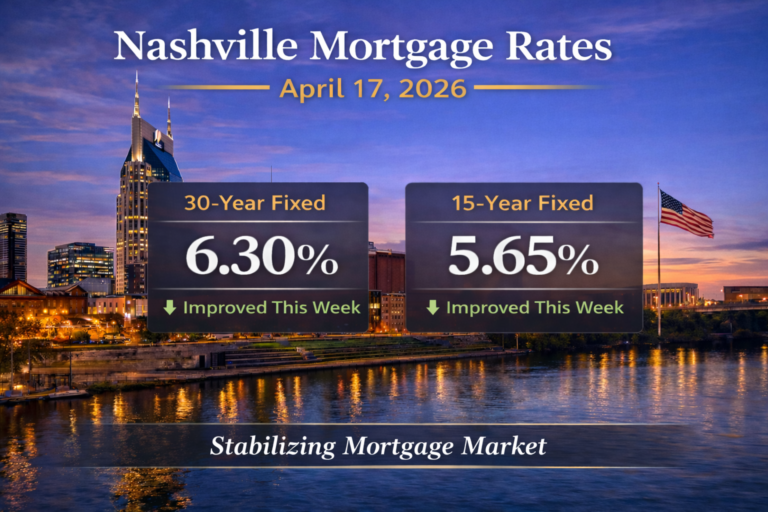
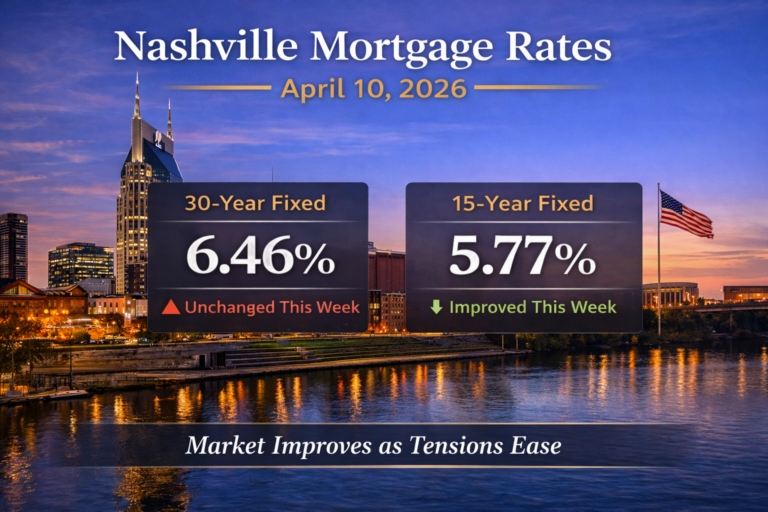
In contrast, the luxury market above $1.5 million is far less rate-sensitive. Cash buyers, jumbo financing relationships, and non-traditional structures dominate that segment. Furthermore, Nashville luxury inventory has held its pricing power. This has remained true even as broader inventory has loosened. For a sense of how quickly the rate picture can change, review our April 17 Nashville mortgage rate update. It tracks the multi-week descent that ended with this week’s modest reversal.
Forward-looking statements in this post reflect current data, cited forecasts, and the BDG Partners team’s interpretation of market conditions as of May 1, 2026. Future performance may differ materially. This is not investment advice. Grant Hammond is a Tennessee-licensed broker (#261980) at Compass RE.
Nashville Mortgage Rates FAQ
What are Nashville mortgage rates today?
For the week ending May 1, 2026, Nashville mortgage rates averaged 6.30% for the 30-year fixed and 5.64% for the 15-year fixed. These figures come from the Freddie Mac PMMS benchmark. Both rates rose roughly seven basis points week over week. However, they remain well below year-ago levels of 6.76% and 5.92%. Additionally, these figures apply to conventional, conforming home purchase loans for borrowers with strong credit and 20% down.
Did mortgage rates go up or down this week?
Nashville mortgage rates rose modestly this week. Previously, a multi-week decline had carried the 30-year fixed as low as 6.23%. Specifically, the 30-year ticked up by 0.07 percentage points. The 15-year rose by 0.06 percentage points. However, both rates remain meaningfully lower than they were one year ago.
Why did mortgage rates move this week?
The April 29 FOMC meeting produced four dissenting votes, the largest split since 1992. Three officials pushed to remove “easing bias” language from the policy statement. As a result, Treasury yields rose. Specifically, the 10-year closed the week at 4.39%. Meanwhile, mortgage spreads stayed essentially flat at 191 basis points. Therefore, the move carried through directly to mortgage pricing.
How does the 10-year Treasury affect mortgage rates?
The 10-year Treasury is the primary benchmark for 30-year fixed mortgage pricing. Specifically, mortgage-backed securities investors price relative to it. Currently, the spread between the 30-year mortgage and the 10-year Treasury is 191 basis points. When Treasury yields rise, mortgage rates typically rise by a similar amount. Conversely, when Treasuries fall, mortgage rates usually follow lower within a few business days.
Are Nashville mortgage rates expected to fall in 2026?
The Federal Reserve’s March 2026 dot plot indicated a tilt toward a 25-basis-point reduction this year. However, the timing remains highly uncertain. The path forward depends largely on inflation. If Core CPI continues to ease toward the 2.0% target, the 30-year fixed could settle in a favorable range. Specifically, between 6.00% and 6.25% by late summer. Conversely, if inflation reaccelerates, the projected band shifts higher. Ultimately, no outcome is guaranteed.
Should Nashville buyers wait for lower mortgage rates?
For some buyers, waiting carries meaningful opportunity cost. Specifically, those who have identified the right home and can pencil the monthly payment at current rates should consider acting. Nashville’s persistent inventory constraints reinforce this, particularly in desirable submarkets. However, buyers with flexibility on timing have options. They can monitor the next several Freddie Mac PMMS releases. Additionally, the May 8 jobs report offers directional signals. Ultimately, the decision is rarely about rate alone. Rather, it combines rate with the specific property, the specific neighborhood, and the buyer’s longer-term horizon.