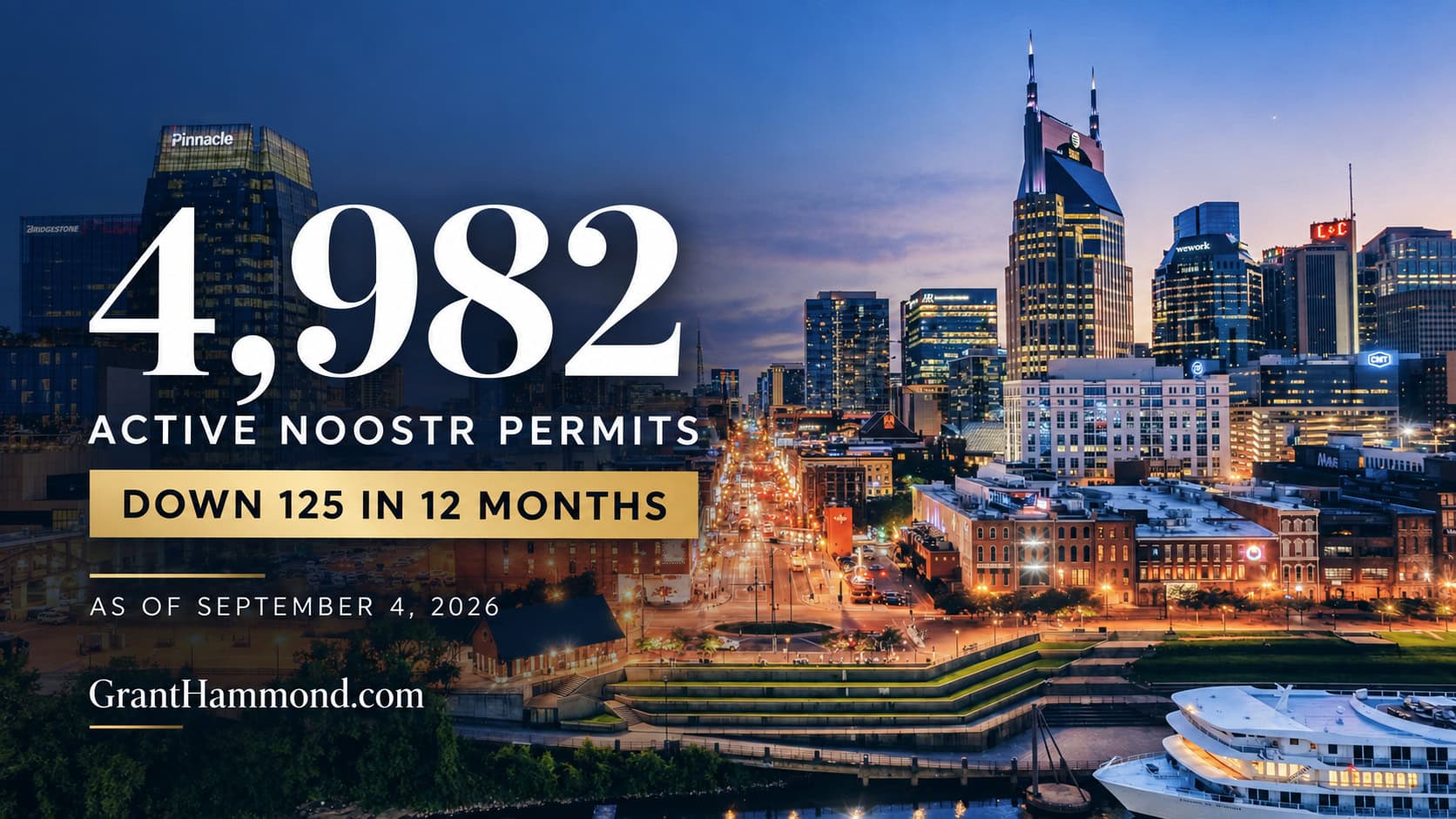
Nashville had 4,982 active NOOSTR permits, the non-owner occupied investor class, on September 4, 2026, inside a citywide total of 7,008 active short-term rental permits, per Metro Nashville open data. Nashville NOOSTR permits are down a net 125 over the trailing 12 months. Investors ask me for the citywide total, and it is the least useful number on the board, because the figure that decides deals is which direction the non-owner occupied class is moving.
I track Nashville NOOSTR permits weekly on my Nashville short-term rental permit tracker, because Metro publishes the raw records and no running total, which means somebody has to add them up. This is the September read behind that number: what moved, what did not, and the one week of data I would not build a thesis on. Every figure below carries its date, because a count without a date is a number nobody can check.
Is the Nashville NOOSTR permit count growing or shrinking?
Shrinking, and the direction matters far more than the level. Metro issued 429 new Nashville NOOSTR permits over the trailing 12 months, an average of 35.8 a month, and the class still finished down 125, which means roughly 554 permits lapsed without being renewed. The calendar year tells the same story from a different angle: 298 issued against 370 expired, a net of minus 72. Only one other year on record has finished negative, and that was 2020, when nobody was traveling.
Most investors still treat the permit as paperwork, something you file once the deal closes, and until fairly recently that was a reasonable way to think about it. In 2022 Metro issued 1,546 new NOOSTR permits against 344 expirations, a net gain of 1,202 in a single year, and the binding question then was whether you wanted in, not whether your address allowed it. That has reversed. The house is no longer the scarce half of the transaction. The permit is.
How often do Nashville NOOSTR permits come up for renewal?
If you read one number in this post, read this one. Nashville NOOSTR permits renew annually, and over the trailing 12 months 4,761 renewals came due against an active base of 4,982. That is 95.6% of the class having to decide, inside a single year, whether it wants to still be in this business.
Which tells you where the contraction is actually coming from. It is not the front door, where new issuance runs small and steady at 35.8 a month. It is the back door, and nobody sends out a notice when they walk through it. An operator looks at a year of nightly rates, cleaning costs and an association fee that went up again, and simply does not file the renewal. That is why I watch renewals before I watch new permits: new issuance tells you what Metro is willing to allow, and renewals tell you what the people already doing this believe about next year.
How many Nashville NOOSTR permits are still active?
Metro has issued 11,263 Nashville NOOSTR permits all time and 4,982 are still standing, which means more than half of every permit this city has ever written is gone. The owner-occupied side held up worse, at 6,277 issued against 2,026 active.
The year by year breakdown is the more useful stat, and it will mislead you if you read it quickly. Permits issued in 2025 are 88.5% still active and 2026 permits sit at 99.3%, which looks like durability and is really just youth, because a permit issued this year has not yet had the chance to lapse. Look instead at the years that have been tested. The 2021 through 2024 group clusters between 62.1% and 67.7%, while 2016 sits at 18.4% and 2017 at 15.9%. What separates those two groups is the 2018 phase-out under BL2017-608, still visible in the data 8 years later, and Metro keeps the full legislative history if you would rather read the ordinance than my summary of it.
So the number I would underwrite with is roughly 2/3, drawn from the years that have actually aged, and not the 99.3% the current year prints.
Why did the count jump 76 in one week?
The weekly series sat between 6,928 and 6,941 for 8 straight weeks, from July 3, 2026 through August 21, 2026, drifting down by 9 across the whole stretch. Then, in the single week to August 28, the total rose 76, and every one of those 76 landed in the non-owner occupied class while the owner-occupied count did not move at all.
Against a trailing average of 35.8 new permits a month, that is more than 2 months of issuance landing inside 7 days, in a class that is otherwise shrinking. 76 investors did not independently decide that late August was their moment.
What this usually is, and I have watched it happen in downtown buildings before, is a single apartment owner sitting on unleased inventory and permitting units in bulk. One owner, one address, dozens of permits filed together. That is not 76 new investors entering the market. That is one landlord deciding what a building is going to be, and it says more about the apartment lease up market than it does about short term rental demand.
Who actually holds Nashville NOOSTR permits?
Business entities hold 3,606 of the 4,982 active Nashville NOOSTR permits against 1,376 held by individuals, and those permits sit across 2,759 distinct owners at an average of 1.8 each. This is not a hobbyist market anymore, and it has not been one for a while.
That ownership structure matters more than it first appears, because a Metro short term rental permit does not transfer with the property. Buy a house that has an active permit on it and you have bought a house. Where an entity holds the permit, the permit can transfer with the entity, which is precisely why so much of these permits sit inside an LLC. So the question worth asking, in writing and before you write the offer, is not whether the property has a permit. It is who holds it, in what structure, and what actually conveys at closing. Ask that during diligence instead and you are negotiating from behind.
Where are the permits concentrated?
Council District 19 holds 1,880 active permits on its own, 26.8% of the citywide total, with Districts 17, 5 and 21 following at 946, 804 and 758. Those 4 districts together account for 4,388 of the 7,008 active permits, or 62.6% of the city.
I watch that concentration because it changes what a comparable actually means. A permitted unit in District 19 is competing for the same guest as 1,879 others, while the same unit in a district carrying 111 permits is barely competing with anyone. Concentration then shows up twice in your numbers: in your nightly rate on the way in, and in the size of your buyer pool on the way out.
How much does a Nashville short term rental permit cost?
$313.00 for both initial applications and annual renewals.
The fee has also never been the number that made or broke a short term rental purchase in my files. Carrying cost is, and on a condominium the association fee is both the larger number and the more volatile one: see what a rising association fee does to a hold. Building rules bind at least as tightly as city rules, and how investment and STR rules apply inside condo buildings is where I would look well before the fee schedule.
What should you check before you write an offer?
Put the pieces together and the shape of this market is clearer than the headline count suggests. Metro has not stopped issuing non-owner occupied permits. What has happened is that far fewer properties can qualify for one, and the RM-zoning change took a large pool of candidates off the table in a single stroke. At the same time, borrowing costs have thinned the field of investors willing to buy a short term rental at all, and most of the buyers I still see are underwriting the purchase around bonus depreciation rather than around nightly yield. Whether that treatment applies to you is a question for your CPA and not a call I can make for you.
So the permit is scarce for one reason and the buyer pool is thin for another, and those two facts pull in opposite directions on price. That is the tension worth understanding before you write anything.
Buyers. Confirm eligibility at the parcel before anything else, because the citywide count of 7,008 tells you nothing about your address. BL2019-1633 stopped Metro issuing new non-owner occupied permits in RM zoning, and the earlier BL2017-608 phase-out had already narrowed them to select non-residential zones, with permits already in force grandfathered in both cases. That grandfathering is the whole reason 4,982 remain active while the pool of addresses that can still qualify keeps narrowing. Run the address through Metro’s own Short Term Rental Property Search, which reports whether a permit can be issued at that location, then check whether a new NOOSTR permit is still available at that address and read the RM-zoning ordinance itself rather than a summary of it. Zoning is the gate, and the permit is only what you receive once the gate opens.
Buyers of already-permitted property. Ask who holds the permit and in what structure, in writing, before the offer goes out. An individual-held permit does not come with the house, and whether an entity-held permit can move to you is a legal question for your attorney that changes what you are actually buying.
Sellers. Your permit renews annually, so renew before you list. A lapsed permit is not a paperwork problem you fix later; it is the difference between selling an income generating asset and selling a house.
Investors modeling a hold. Use the 62.1% to 67.7% from the years that have aged rather than the 99.3% a permit issued this year shows, and remember that both terms sit at the top of the short term rental acronyms buyers run into first. A short term rental is still a house with a mortgage on it, so read all of this against what the wider Middle Tennessee market is doing.
If you want my read on whether a specific address qualifies before you write an offer, that is a 15 minute call. I would rather tell you a property does not qualify in September than watch you find out in December.
Frequently asked questions
How many short term rental permits does Nashville have?
Nashville short term rental permits totaled 7,008 active on September 4, 2026, compiled from the Metro Nashville open data permit dataset: 4,982 non-owner-occupied and 2,026 owner-occupied. Metro publishes the raw permit records but no running total, so this count is compiled weekly on my permit tracker, which carries its own observation date.
Are Nashville NOOSTR permits increasing or decreasing?
Decreasing, in the class most investors want. Nashville NOOSTR permits fell by a net 125 over the trailing 12 months to September 4, 2026, on 429 new permits issued against roughly 554 lapsed. Calendar year 2026 is running 298 new against 370 expired, a net of minus 72, only the second negative year since 2015; the other was 2020.
How many Nashville short term rental permits are owner-occupied versus non-owner-occupied?
On September 4, 2026, 4,982 of Nashville’s 7,008 active permits were non-owner-occupied, or NOOSTR, and 2,026 were owner-occupied, or OOSTR. That is 71% in the non-owner-occupied class, measured from Metro Nashville open data.
Does a Nashville short term rental permit transfer when the property sells?
No. A Metro short term rental permit does not transfer with the property, so buying a home that carries an active permit does not convey the permit to you. Business entities held 3,606 of the 4,982 active non-owner-occupied permits on September 4, 2026, or 72.4%. Where an entity holds the permit, it can move with the owning entity, which is a legal question for your attorney.
Can I Airbnb my house in Nashville?
It depends on the zoning at your specific parcel, not on the citywide count of 7,008 permits. BL2019-1633 stopped Metro issuing new non-owner-occupied permits in RM zoning, and BL2017-608 had already narrowed new non-owner-occupied permits to select non-residential zones. Permits in force before those changes were grandfathered. So the question is not whether others hold one nearby. It is whether a permit can still be issued at your address. Metro Codes publishes a property search that answers exactly that, and its legislative history page carries both ordinances in full.
What are the restrictions on short-term rental property in Tennessee?
In Nashville and Davidson County the binding restrictions are local and zoning-based. BL2017-608 narrowed new non-owner-occupied permits to select non-residential zones, and BL2019-1633 stopped Metro issuing new non-owner-occupied permits in RM zoning. Permits in force before those changes were grandfathered, which is why 4,982 non-owner-occupied permits remain active. Permits are tied to a specific property, renew annually, and do not transfer on a sale. Rules differ elsewhere in Tennessee, so confirm your own jurisdiction with its codes department.
How do I find out if my property is eligible for a short term rental permit in Nashville?
Run the address through Metro Codes’ Short Term Rental Property Search, which reports whether a permit can be issued at that location. Eligibility is decided by zoning at the parcel, not by the citywide count of 7,008 active permits and not by whether nearby owners hold one. The check takes a few minutes and settles the question before you write an offer rather than after.
Sources, methodology, and disclosure
Source. Metro Nashville open data short term rental permit dataset, compiled weekly on my permit tracker, linked above. Figures read September 4, 2026; the tracker refreshes on its own and supersedes anything written here.
Method. Active permits are the ones Metro shows as active at compilation. A permit is not a property in operation. No revenue, nightly rate or occupancy figure appears here, because I do not hold that data. Counts are aggregates by city, permit class, district and owner structure, and no owner name appears on this page or in its structured data.
Disclosures. Broker fees are not set by law and are fully negotiable; discuss commission and buyer-agency terms before contract. Zoning, permit eligibility and transferability are Metro determinations at the parcel level and are legal questions. Confirm any property with Metro Codes and your attorney.