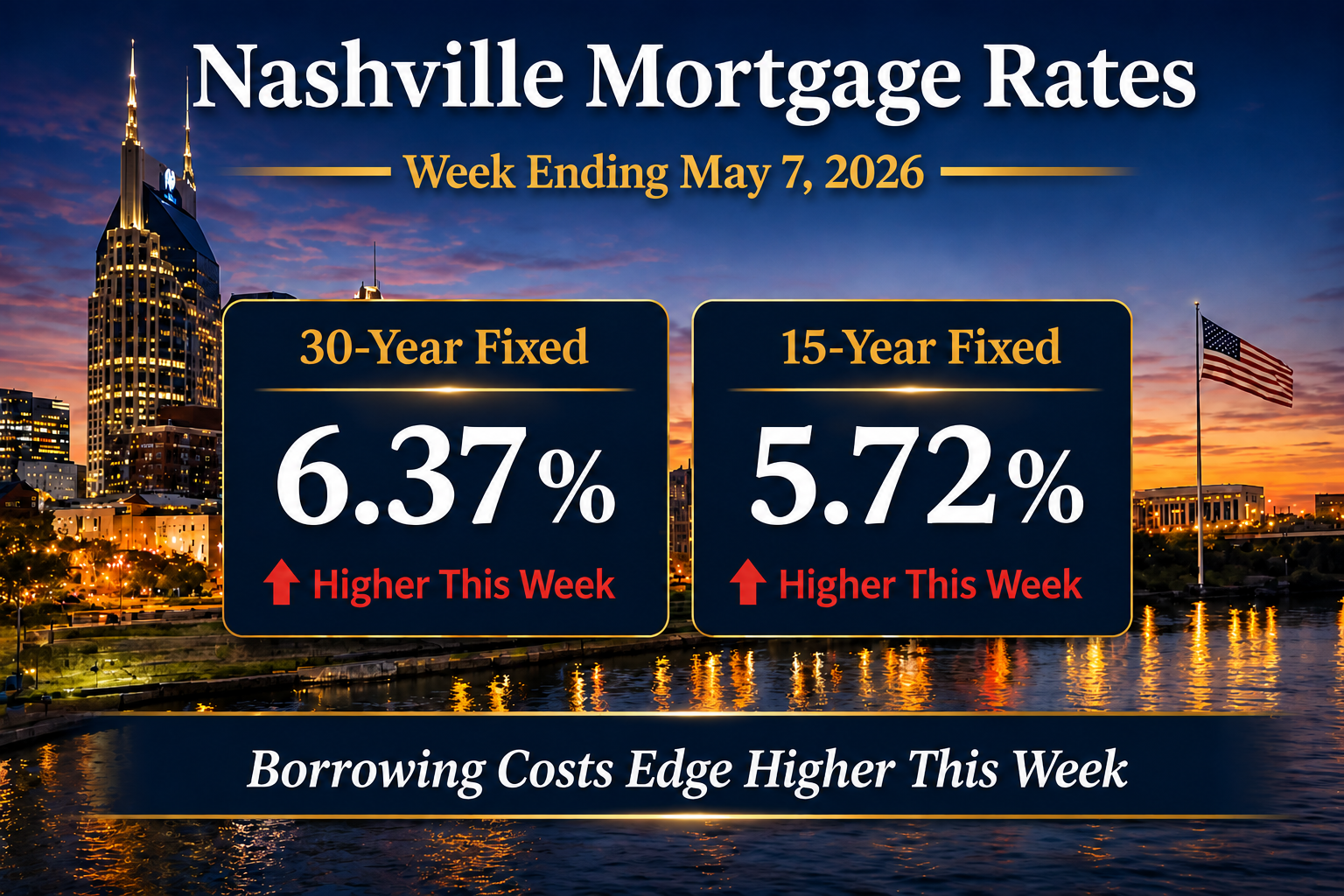
Nashville mortgage rates averaged 6.37% for the 30-year fixed and 5.72% for the 15-year fixed for the week ending May 7, 2026, per Freddie Mac PMMS. Rates rose for the second straight week. Mortgage spreads widened. The Federal Reserve transition and the U.S.-Iran conflict kept pressure on bond yields.
The headline weekly print rose 7 basis points on the 30-year and 8 basis points on the 15-year. The daily picture was more constructive. Rate indexes improved sharply mid-week as Iran ceasefire negotiation headlines pushed oil and Treasury yields lower. The Freddie Mac survey captures earlier-week readings. It did not fully reflect that mid-week pivot. For Nashville and Middle Tennessee buyers, the rate environment is more nuanced than the headline suggests. Lock timing remains the variable that matters most.
This week’s update continues our latest Nashville mortgage rate updates series. We track Freddie Mac PMMS data, the 10-year Treasury yield, mortgage spreads, and Federal Reserve policy each week. Year over year, the 30-year fixed remains 39 basis points below its May 2025 level of 6.76%. The 15-year fixed remains 17 basis points below its year-ago level of 5.89%. Affordability has improved on a 12-month basis. The trend within the last few weeks has turned slightly higher.
Market Summary
- Nashville 30-year fixed mortgage rate averaged 6.37%, up from 6.30% the prior week and down from 6.76% one year ago.
- Nashville 15-year fixed mortgage rate averaged 5.72%, up from 5.64% the prior week and down from 5.89% one year ago.
- FHA 30-year mortgage rates were near ~6.24%, tracking just below the conventional benchmark.
- The 10-year Treasury yield ended near ~4.38%, essentially flat on the week after a sharp mid-week decline on Iran ceasefire headlines.
- Mortgage spreads were near ~1.96%, or 196 bps, widening 4 bps on the week as the bond rally outpaced the mortgage market.
- Federal Reserve policy remained restrictive, with the FOMC holding the federal funds rate at 3.50%-3.75% on April 29, 2026, on an 8-4 vote, the first time four members dissented since October 1992.
- MBA Purchase Applications Payment Index rose 3.4% month over month in March 2026, but remains down 5.6% year over year as wage growth has outpaced payment increases.
This data is sourced from Freddie Mac PMMS, the U.S. Treasury, the Bureau of Labor Statistics, the Federal Reserve, and the Mortgage Bankers Association. Freddie Mac’s survey reflects rates collected from thousands of loan applications, with the May 7, 2026 release marking the second consecutive weekly increase.
Mortgage Rate Dashboard
The mortgage rate dashboard shows a 6.37% 30-year fixed rate, a 5.72% 15-year fixed rate, an FHA 30-year rate near 6.24%, a 10-year Treasury yield near 4.38%, and a mortgage spread near 1.96%.
Nashville Mortgage Rates This Week
Nashville mortgage rates rose for the second straight week. The 30-year fixed climbed 7 basis points to 6.37%. The 15-year fixed climbed 8 basis points to 5.72%. Three forces drove the increase: elevated headline inflation, U.S.-Iran geopolitical risk, and uncertainty around the Federal Reserve leadership transition. Chair Jerome Powell’s term ends May 15.
The May 7 Freddie Mac PMMS release confirmed the second consecutive weekly uptick. Rates had declined for several weeks earlier this spring. Nashville and Middle Tennessee buyers in payment-sensitive segments will feel this most directly. That includes entry-level and first-move-up bands across Davidson and Williamson Counties. A typical Davidson or Williamson County purchase carries roughly $18 more per month at this week’s rate.
Year over year, the comparison remains constructive. The 30-year fixed sits 39 basis points below the May 2025 level of 6.76%. The 15-year fixed sits 17 basis points below the year-ago 5.89%. For buyers who paused last spring, the financing math is meaningfully better today. The week-over-week move is a reminder that the path is not linear. The second-half outlook depends on three variables: energy markets, the May 12 inflation release, and the Senate’s vote on Powell’s successor.
Institutional Macro Snapshot
What Is Driving Mortgage Rates Right Now?
Three forces are setting the direction of Nashville mortgage rates this week. The U.S.-Iran conflict, the inflation feed-through into Treasury yields, and the pending Federal Reserve leadership transition each carry independent weight. Each has moved the rate market in the past five trading days. The interaction among them is the reason daily rate volatility has been higher than the weekly Freddie Mac print suggests.
1. The Iran Energy Shock and Treasury Yields
The U.S.-Iran conflict, ongoing since late February, has been the dominant driver of mortgage rate volatility in 2026. Higher oil prices have pushed headline CPI to 3.3% year over year in the March release. That’s the fastest pace since April 2024, per the Bureau of Labor Statistics. Energy alone contributed roughly three quarters of the March monthly increase. Higher inflation pushes Treasury yields higher, and higher Treasury yields push mortgage rates higher.
This week, the dynamic worked in reverse mid-week. Headlines about a possible one-page memo to end the conflict triggered a sharp mid-week rally in oil and Treasuries. Daily mortgage rate indexes returned to the prior Friday’s levels by Wednesday. The weekly Freddie Mac PMMS captures readings collected earlier in the survey window. It did not fully reflect that mid-week improvement. The directional message is simple. Every step toward de-escalation translates quickly into lower rates. Every step away pushes rates higher.
2. Mortgage Spreads Widened on the Week
The mortgage spread is the gap between the 30-year fixed and the 10-year Treasury. It widened to roughly 1.96% or 196 basis points this week, up from 1.91% or 191 bps the prior week. Wider spreads mean borrowers don’t capture the full benefit of a Treasury rally. Tighter spreads mean borrowers benefit more than the bond move alone would suggest. Spreads tend to widen during periods of elevated mortgage-backed securities volatility, which is exactly what the cross-currents above produce.
For context, since Freddie Mac changed the PMMS methodology in November 2022 the spread has averaged 246 basis points, so a 196 basis point spread is well inside that. That means structural room for rates to fall faster than Treasuries if MBS volatility settles. Last week’s May 1 Nashville mortgage rate update covered the prior week’s spread reading and the same compression-potential thesis.
3. Federal Reserve Policy and the Powell-to-Warsh Transition
The Federal Open Market Committee held the federal funds rate target at 3.50% to 3.75% on April 29, 2026. That was the third consecutive hold this year. Members voted 8 to 4. That was the first FOMC decision with four dissents since October 1992. Some wanted to signal future cuts. Others wanted to hold the line on inflation. The April statement explicitly cited Middle East developments as a source of elevated outlook uncertainty.
This was likely Chair Jerome Powell’s final FOMC meeting. His term as Chair expires May 15, 2026. Trump’s nominee Kevin Warsh, a former Fed Governor, advanced from the Senate Banking Committee on April 29. The vote was 13 to 11 along party lines. Full Senate confirmation could happen as early as May 11. Markets are pricing zero rate moves through year-end and one possible 25 basis point cut later. The leadership transition itself is a variable. New Fed chairs have historically moved markets through tone before any vote, simply by signaling a different framework.
The 10-Year Treasury and Mortgage Rate Spreads
The 10-year Treasury yield ended the week near 4.38%, essentially flat versus the prior week’s ~4.39%. Intraweek volatility was significant. The 10-year tested above 4.41% earlier in the week before retreating on Iran ceasefire headlines. Traders watched the 4.35% pivot as the key technical reference. A sustained break below 4.35% would open a path toward 4.20%. A sustained break above 4.45% would point toward 4.50%.
The mortgage spread widened to roughly 1.96%, or 196 bps, from 1.91%, or 191 bps, the prior week. The 30-year fixed of 6.37% minus the 10-year Treasury of 4.38% produces the 1.96% spread. That’s an 8 bps weekly widening. That widening is why mortgage rates rose this week even though Treasuries did not. When MBS investors demand more yield to absorb prepayment and duration risk, the cushion above Treasuries grows. Borrowers feel that directly.
Since Freddie Mac changed the PMMS methodology in November 2022 the spread has averaged 246 bps. A 196 bps reading sits well inside that. If MBS volatility settles, further spread compression remains a source of potential mortgage rate improvement. It can deliver lower rates without any help from the Treasury market. Resolution in Iran and the Fed transition are the triggers.
Payment Impact for Nashville Buyers
To translate the weekly rate change into Nashville buyer reality, we use locked assumptions. The base case is a $500,000 purchase, 20% down, $400,000 loan, 30-year fixed. This profile reflects a typical Davidson County entry-level or first-move-up purchase and a more affordable Williamson County or Brentwood transaction. Taxes, insurance, HOA, and closing costs are excluded so the calculation isolates the rate impact alone.
- Prior week (6.30%): monthly principal and interest of $2,476
- Current week (6.37%): monthly principal and interest of $2,494
- Monthly difference: +$18 per month at the new rate
- 30-year cumulative difference: +$6,480 over the life of the loan
For Nashville buyers comparing properties or running pre-approval scenarios, an $18 monthly delta is small in isolation. It compounds across the loan term. For a $750,000 purchase with the same 20% down structure, the delta scales to roughly $27 per month. That’s about $9,720 over 30 years. The takeaway: small weekly rate moves matter most for buyers actively shopping. Lock timing within a 7- to 14-day window can capture or miss the difference between this week’s rate and the next.
Strategic Borrower Considerations This Week
This week’s modest rate increase, paired with widening spreads and the Fed leadership transition, creates different positioning windows by borrower profile. Locking versus floating, payment sensitivity, and segment liquidity all matter more this week than before the Iran conflict began. The right move depends on which segment the borrower is operating in.
How Each Segment Should Position
- Buyers in the under $500K and $500K to $1M bands across Davidson and Williamson Counties face a 7 bps higher rate this week. Weigh that against pre-approval rate-lock policies. Most lenders allow a 30- to 60-day lock with one float-down option. With the May 12 CPI release pending and the Iran situation fluid, locking sooner protects against upside. The float-down preserves the option if conditions improve.
- Sellers in Brentwood, Franklin, Belle Meade, and Green Hills should expect buyer payment sensitivity to remain front of mind. The 39 bps year-over-year improvement on the 30-year is the right anchor for buyer conversations. The 7 bps weekly uptick matters less. Listing strategy should emphasize the broader affordability improvement that has occurred since spring 2025.
- Investors evaluating Nashville short-term rental and traditional rental properties should focus on the spread story, not the headline rate. DSCR loans, which Nashville investors increasingly use for non-owner-occupied financing, price off MBS movement and credit pricing. The headline 30-year benchmark matters less here. With spreads at 196 bps, there is meaningful improvement potential if MBS volatility settles, separate from any Treasury rally.
- Move-up buyers in Nashville’s $750K to $1.5M band face the most direct trade-off between locking and waiting. This is the segment with the most active rate-decision behavior. Most move-up buyers carry an existing mortgage at a meaningfully lower rate. The new payment math is the variable that drives or stalls the transaction. For this segment, a defined trigger is more useful than a vague preference for “lower rates.” Often that trigger sits at 6.10% to 6.20% on the 30-year.
Nashville Context and Authority
Grant Hammond has 25 years of Nashville real estate experience. He has closed over $1 billion in career sales across Davidson and Williamson Counties. His track record includes more than 100 luxury transactions above $1.5 million. It also includes more than 350 downtown Nashville high-rise condominium transactions and more than 550 short-term rental transactions. DSCR loans and rate-sensitive investor purchases were central to many of those STR deals.
In Grant’s experience across Nashville rate cycles, the move-up buyer segment is the leading indicator for broader market activity. When Nashville move-up buyers begin to act, the entry-level and luxury segments typically follow within a quarter. The current week’s small uptick is unlikely to stall move-up activity already in motion. It does extend the decision timeline for move-up buyers who were still on the fence two weeks ago.
Nashville Real Estate Market Outlook
The Nashville real estate market enters mid-May 2026 with an unusual combination of macro signals. Headline mortgage rates rose modestly, but daily rate volatility has been substantial. The Federal Reserve is transitioning leadership. The Iran conflict remains the dominant risk factor for energy prices and inflation. Local demand signals remain mixed, with new construction posting strong activity and existing home sale velocity holding closer to seasonal norms.
If rates stabilize or improve from here
The Mortgage Bankers Association’s recent forecast projects 30-year rates in a 6.0% to 6.4% range by year-end 2026. The forecast assumes continued core inflation moderation and Fed policy normalization. If rates hold below 6.40% through the next two FOMC meetings, Nashville inventory absorption would likely accelerate. That includes the under $1M and $1M to $1.5M bands as move-up activity unlocks. The Nashville new construction pipeline, particularly in Williamson County and East Nashville, is positioned to absorb this demand.
If Treasury yields rise again
If the 10-year Treasury breaks above 4.45% on a sustained basis, mortgage rates would likely test the 6.50% to 6.60% range. The move would play out over two to four weeks. That move would extend the decision cycle for move-up buyers most directly. Luxury segments above $2.5M would see less direct impact. Cash and portfolio financing buffer the rate sensitivity at that level. The 10-year above 4.45% would be the trigger to watch.
Nashville segment-specific positioning
The most payment-sensitive Nashville segments remain the sub-$750K bands across Davidson County and the entry-level Williamson County market. These segments respond most directly to weekly rate moves and are where lock timing matters most. The luxury and downtown high-rise condominium segments behave more as portfolio decisions than rate-driven transactions. That includes The Gulch and SoBro.
For broader context, see the April 24 Nashville mortgage rate update and our ongoing Mortgage Rates and Financing coverage. Three inflection points matter near-term: CPI on May 12, the Warsh Senate vote, and the Iran ceasefire posture.
Nashville Mortgage Rates FAQ
What are Nashville mortgage rates today?
Nashville mortgage rates averaged 6.37% (30-year) and 5.72% (15-year) for the week ending May 7, 2026. These figures come from Freddie Mac’s PMMS, which surveys thousands of loan applications nationwide. Local Nashville lender quotes for strong-credit borrowers typically track within 10 to 15 basis points of these benchmarks.
Did mortgage rates go up or down this week?
Mortgage rates rose this week. The 30-year fixed climbed 7 basis points to 6.37%. The 15-year fixed climbed 8 basis points to 5.72%. This is the second consecutive weekly increase. Daily rate indexes did improve mid-week on Iran ceasefire headlines. The weekly Freddie Mac survey captured higher readings from earlier in the window.
Why did mortgage rates move this week?
Mortgage rates moved higher this week primarily because mortgage spreads widened. They widened 8 basis points to roughly 1.96%, even as Treasury yields held essentially flat. The widening reflects MBS market stress. Inflation pressure from the Iran energy shock and uncertainty around the Fed transition are driving it.
How does the 10-year Treasury affect mortgage rates?
The 10-year Treasury is the primary benchmark for 30-year mortgage rates. Mortgage-backed securities pricing tracks Treasury yields with a spread on top. This week the 10-year ended near 4.38%, with the mortgage spread sitting at roughly 196 basis points. When Treasury yields rise, mortgage rates typically rise with them. When Treasuries rally, mortgage rates usually follow with a lag and a spread adjustment.
Are Nashville mortgage rates expected to fall in 2026?
The Mortgage Bankers Association forecasts 30-year rates in a 6.0% to 6.4% range through year-end 2026. That forecast assumes continued core inflation moderation and Federal Reserve policy normalization. The current 6.37% reading sits at the upper end of that projected range. Materially lower rates would require three things: energy price stabilization, a Fed rate cut path, and continued spread compression.
Should Nashville buyers wait for lower mortgage rates?
Most Nashville buyers should not condition a purchase decision on a specific rate forecast. The 30-year fixed is currently 39 basis points below its May 2025 reading. That’s meaningful affordability improvement on a 12-month basis. Buyers ready to transact should focus on lock timing and float-down options. Waiting for a specific rate level may not arrive in the planning window.
Forward-Looking Statement Disclosure
Forward-looking statements in this post reflect current data and cited forecasts. They also reflect the team’s interpretation of market conditions as of May 8, 2026. Future performance may differ materially. This is not investment advice. Grant Hammond is a Tennessee-licensed broker (#261980) at Compass RE.
Sources and methodology
Rate data in this update reflects weekly averages from the Freddie Mac Primary Mortgage Market Survey (PMMS) for the week ending May 7, 2026. Daily lender pricing context is sourced from the Mortgage News Daily Mortgage Rate Index. Macro indicators including the 10-year Treasury yield reference Federal Reserve Economic Data (FRED) series DGS10. Spread analysis between mortgage rates and the 10-year Treasury uses the historical PMMS minus DGS10 series. Nashville-area builder buydown and concession observations reference active Middle Tennessee MLS data via the RealTracs system and conversations with local lenders. Year-over-year comparisons reference the same Freddie Mac PMMS week from the prior year.
- Freddie Mac Primary Mortgage Market Survey (PMMS): weekly 30-year and 15-year fixed rate benchmarks
- FRED DGS10: 10-year Treasury Constant Maturity Rate
- Mortgage News Daily Rate Index: daily lender pricing observations
- Federal Reserve FOMC Calendar: meeting dates and policy context
Important mortgage rate disclaimer
Rates and figures on this page are educational and reflect the data sources cited. They are not an offer, commitment to lend, or rate lock. Mortgage rates change daily and depend on individual credit profile, loan-to-value, property type, occupancy, and lender. For a pre-qualification and personalized rate quote, contact a licensed mortgage lender (NMLS-registered). Past rate movements do not predict future rates.