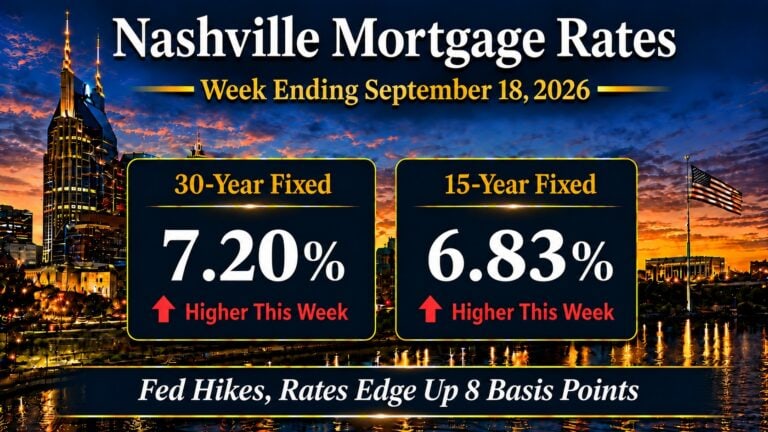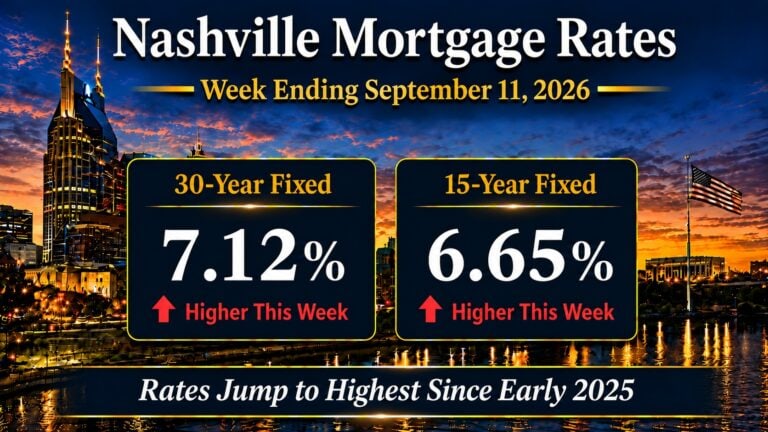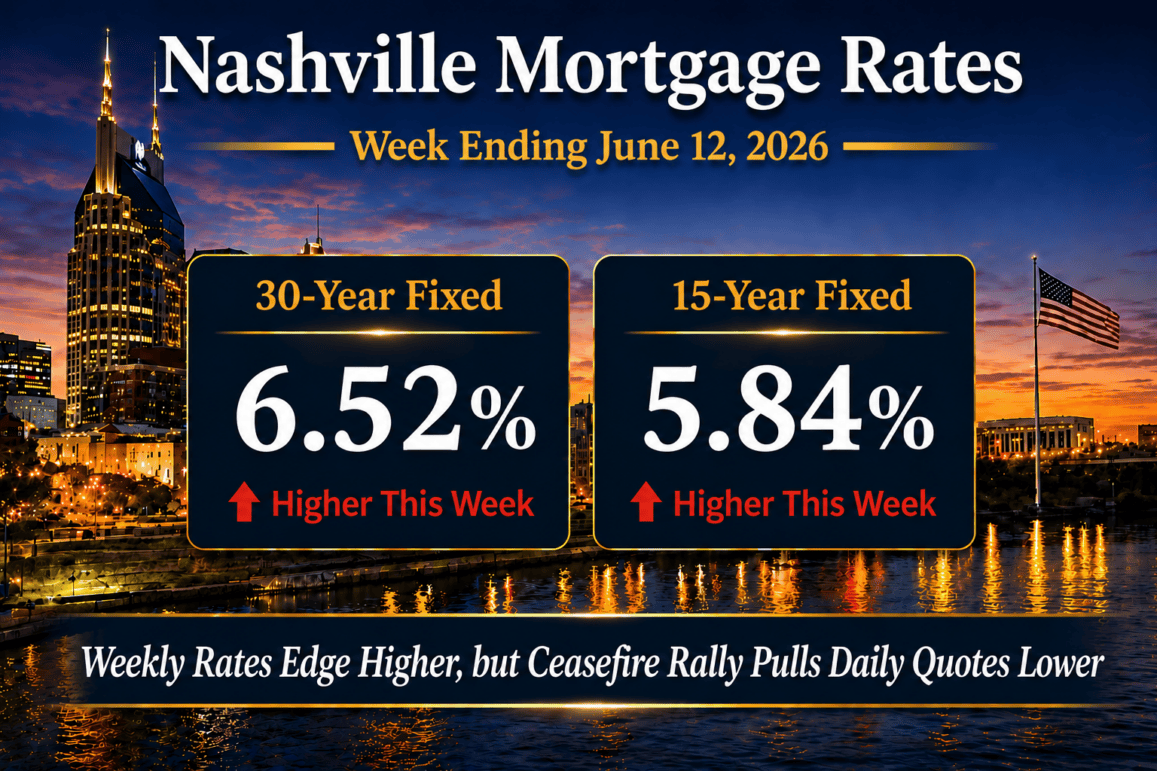
Nashville mortgage rates averaged 6.52% on the 30-year fixed and 5.84% on the 15-year fixed for the week ending June 12, 2026, according to Freddie Mac PMMS. Both benchmarks edged higher week over week, the 30-year up 4 basis points and the 15-year up 5 basis points, even as daily Treasury pricing turned sharply lower at the end of the week.
The survey captured a small rise. The within-week story was the Thursday rally. The 10-year Treasury closed June 11 at 4.475%, down 5.9 basis points on the day after President Trump called off new military strikes on Iran and reports surfaced that the United States and Iran were close to a deal to end the war. The May 2026 Core CPI release on June 10 reinforced the move, with Core inflation up just 0.2% month over month, below expectations and welcomed by the bond market even as headline CPI hit a multi-year high on elevated energy prices. The combination sets up an unusually consequential FOMC meeting on June 16 to 17, Kevin Warsh’s first as Chair, with an updated Summary of Economic Projections that markets will price against.
For the running read on where pricing sits between these weekly updates, I keep the Nashville mortgage rate tracker current for buyers and Airbnb investors across Davidson and Williamson Counties. This post is the Friday close on the week that was.
In this report
Market Summary
- Nashville 30-year fixed mortgage rate averaged 6.52%, up from 6.48% the prior week (+4 bps); 32 bps below the 6.84% June 2025 year-ago print.
- Nashville 15-year fixed mortgage rate averaged 5.84%, up from 5.79% the prior week (+5 bps).
- FHA 30-year mortgage rates were near 6.12% on daily lender pricing.
- The 10-year Treasury yield closed June 11 at 4.475%, down 5.9 basis points on the day after Trump called off Iran strikes; the 10Y remains 13 basis points below the 4.60% technical ceiling that has capped yields for more than 15 years.
- Mortgage spreads were near 2.01%, or 201 bps, about 4 bps wider than the prior week.
- May 2026 Core CPI rose 0.2% month over month and 2.9% year over year, below expectations on the monthly print; headline CPI hit a multi-year high at 4.2% YoY on elevated energy prices.
- Federal Reserve policy remained restrictive, with the federal funds rate at 3.50% to 3.75% ahead of Kevin Warsh’s first FOMC meeting on June 16 to 17, his first since being sworn in as the 17th Chair on May 22, 2026.
The 30-year and 15-year figures above are the Freddie Mac weekly averages published by the Freddie Mac PMMS. For the full archive of these Friday updates, see the weekly Nashville mortgage analysis archive.
Mortgage Rate Dashboard
The mortgage rate dashboard shows a 6.52% 30-year fixed rate, a 5.84% 15-year fixed rate, an FHA 30-year rate near 6.12%, a 10-year Treasury yield near 4.47%, and a mortgage spread near 2.01%.
Nashville Mortgage Rates This Week
The 30-year averaged 6.52%, up 4 basis points from 6.48%, and the 15-year averaged 5.84%, up 5 basis points from 5.79%, for the week ending June 12, 2026. The headline number was a small survey rise. The within-week story was a sharp daily Treasury reversal on Thursday as geopolitical de-escalation accelerated and a softer Core CPI print converged in the bond market.
Place this week inside the 12-month band: the 30-year is 32 basis points below where it sat a year ago and the 15-year is 15 basis points below. The 52-week PMMS range on the 30-year runs roughly 5.98% to 6.84%. This week’s 6.52% prints in the middle of that band, neither cycle high nor cycle low, but the technical setup underneath is the most constructive we have seen in over a month.
For Middle Tennessee buyers, the practical read this week is that the survey rise is already stale information. The Thursday daily move means Friday locks are likely sharper than what the headline 6.52% suggests, particularly for borrowers who have been sitting on the sidelines waiting for a 6-handle to feel real. I have several Davidson and Williamson County clients who quietly took the late-week dip as their lock signal.
Institutional Macro Snapshot
What Is Driving Mortgage Rates Right Now?
Three forces shaped pricing this week: a Treasury market that rallied sharply on Thursday as geopolitical de-escalation accelerated, an inflation report that split into a hot energy-driven headline and a soft core, and a Federal Reserve positioning for Kevin Warsh’s first meeting as Chair. Each fed into the survey-versus-daily divergence Nashville borrowers are watching.
1. Treasury yields are setting the base rate
The 10-year Treasury closed June 11 at 4.475%, down 5.9 basis points on the day, after President Trump announced he had called off new military strikes on Iran following earlier threats of escalation, and reports surfaced that the United States and Iran were close to a deal to end their war. The Thursday rally is what reset daily lender pricing into Friday locks, even though the Freddie Mac weekly survey caught only the earlier, higher-yield prints. This follows the pattern from last week’s Nashville mortgage rate update, when a strong jobs report pushed yields the other way.
2. Mortgage spreads are shaping borrower pricing
The spread between the 30-year fixed and the 10-year Treasury widened about 2 basis points to 201 basis points. MBS investors did not pass through the full benefit of the Thursday Treasury rally, which is why borrower pricing has not yet improved as fast as the bond move suggests. On a $500,000 Middle Tennessee loan, that 4 basis point spread widening costs roughly $11 per month at the survey rate. If spreads tightened back to 175 basis points without any further Treasury move, the 30-year would trade near 6.22%, a 30 basis point improvement on the same underlying yield.
3. The 4.60% ceiling is the structural rate story
One of the most encouraging developments this week came from the auction calendar. The Treasury sold a significant amount of debt and investor demand remained solid, which puts a ceiling on how high long-term yields can run. A 15-year pattern worth knowing: every time the 10-year Treasury has moved above 4.60%, it has failed to remain there three months later. Earlier this spring, the 10-year touched 4.69% and tested that ceiling once more. With the 10Y now at 4.47%, the longer rates stay below the 4.60% line, the more likely the historical pattern stays intact. No indicator is perfect, but the technical setup supports the view that we may be near the upper end of this rate cycle.
The 10-Year Treasury and Mortgage Rate Spreads
This week, the spread was approximately 2.01%, or 201 bps, based on a 6.52% Freddie Mac 30-year fixed rate and a 4.47% 10-year Treasury yield. That is about 4 basis points wider than the prior week’s 201 bps. The widening is the gap between the bond market’s Thursday relief rally and the MBS market’s slower adjustment to it.
A flat weekly close on the 10-year hides material intra-week volatility. Yields opened the week above 4.55%, climbed slightly on the headline May CPI print Tuesday, then reversed sharply on Thursday as Treasuries rallied 5.9 basis points on the Iran de-escalation news. For borrowers, the practical translation of a 201 basis point spread on a $500,000 loan is about $342 per month above what the same loan would cost if spreads were back at 175 basis points. The MBS market is still pricing risk that has little to do with the underlying Treasury.
Nashville rates can fall from here even if the 10-year holds at 4.47%, simply through spread compression back toward the long-run average. The combination of a constructive Treasury setup, the 4.60% ceiling holding, and Iran de-escalation actively in progress is the cleanest near-term setup for a small rate improvement we have seen in three weeks. The wildcard is Wednesday’s FOMC; if Warsh signals a more hawkish posture than markets expect, both pieces can reverse at once.
Payment Impact for Nashville Buyers
At this week’s 6.52% 30-year fixed rate, principal and interest run about $3,167 per month on a $500,000 loan and about $6,334 per month on a $1,000,000 loan, before taxes, insurance, and any HOA dues. Those are the two loan tiers most of my Middle Tennessee buyers are underwriting against right now.
The 4 basis point weekly rise translates to roughly $13 per month more on the $500,000 loan and $26 per month more on the $1,000,000 loan compared to last Friday’s survey rate. Those are not numbers that change behavior. The bigger story for buyers running pro formas this week is what a return to the 175 basis point long-run spread would do: at today’s 4.47% Treasury, a 6.22% 30-year saves roughly $82 per month on the $500,000 loan and $164 per month on the $1,000,000 loan. That is the real prize sitting in the spread.
For investors weighing Davidson and Williamson County deals on financed math, the Thursday rally always opens a small window this kind of week. The reverse can be true when daily pricing runs ahead of the survey to the upside. East Nashville homes, Green Hills properties, and the broader Middle Tennessee investor pipeline both benefit when financing costs compress, even modestly, because the cap rate math improves at the offer stage.
Strategic Borrower Considerations in Today’s Market
Buyers staring down the June 16 to 17 FOMC meeting have a real lock-versus-float decision this week, not a procedural one. A first-meeting Chair with a fresh SEP can move markets in either direction on language alone. My read for clients with rate locks expiring before June 20: take the Thursday rally as a gift and lock now. For clients with longer horizons or contingent closes, floating into the meeting is defensible, but build in a hard ceiling at 6.65% for re-pricing decisions.
Sellers and move-up buyers should keep watching the band rather than the headline. The 30-year has lived between 6.30% and 6.65% for most of the second quarter. Pricing your listing to the middle of that range, not the floor, keeps you out of stale comps territory. Move-up buyers benefit from the same logic on the buy side, because there is no quiet week that breaks the band by 50 basis points without a Fed action.
Investors running DSCR or jumbo structures have a cleaner setup this week than they did in April. DSCR pricing tracks the 5-year and 7-year Treasury, both of which moved in tandem with the 10-year on Thursday. Jumbo spreads have tightened slightly against conforming for prime-credit borrowers as banks compete for deposit relationships. If you are within 30 days of close on a downtown high-rise or a Brentwood second home, this is the right week to re-quote the lender pool.
Nashville Real Estate Market Outlook
The June 16 to 17 FOMC meeting is the dominant near-term catalyst, and the agenda is unusually full. Markets are pricing a hold on the funds rate, so the action will be in three places: the dot plot and SEP revisions, the language on Quantitative Tightening, and Warsh’s communications philosophy. He has publicly favored reducing the Fed’s reliance on forward guidance, so this meeting may be the first signal of how that translates into actual policy communication. The next Employment Situation report (June data) releases July 2, 2026, and the next CPI print follows in mid-July.
Locally, the Middle Tennessee market continues to show the pattern we have seen since March: rate-sensitive segments waiting for a 6-handle to feel committed, cash and equity-rich segments transacting at normal pace, and STR investor activity picking up as June pro formas pencil better than April’s. Nationally, consumer confidence has had a rough spring and that is showing up in delisting data; roughly 5.8% of national listings were pulled in April, with Atlanta leading at 10%, San Jose near 9%, and Los Angeles, Dallas, and Seattle all clustered around 7.7% to 7.8%. Nashville has not appeared in the top delisting markets, which I read as a sign of continued market depth here even as national sentiment softens. The broader Middle Tennessee market conditions from May give the wider context.
My read for buyers and sellers heading into next week: this is a week to be ready, not impulsive. Have your lock criteria written down before Wednesday afternoon. Sellers, refresh your CMA against the past two weeks of closed comps so you are pricing against current rate conditions, not late-spring memory. If the Iran de-escalation holds and the 4.60% ceiling continues to cap Treasury yields, the back half of June should be slightly busier than the front half.
Nashville Mortgage Rates FAQ
What are Nashville mortgage rates this week?
For the week ending June 12, 2026, the Freddie Mac 30-year fixed averaged 6.52% and the 15-year fixed averaged 5.84%. Both rose modestly week over week, the 30-year up 4 basis points and the 15-year up 5 basis points. Daily Treasury yields fell sharply on June 11 after President Trump called off new strikes on Iran, which moved daily lender quotes lower into Friday.
Did Nashville mortgage rates go up or down this week?
The weekly Freddie Mac survey averages rose slightly, with the 30-year up 4 basis points to 6.52%. However, the 10-year Treasury closed Thursday June 11 down 5.9 basis points on Iran de-escalation news, which means daily lender pricing reversed lower at the end of the week. If you are tracking Friday locks rather than the Thursday survey print, the practical answer is the week ended lower than it started.
What is the current 10-year Treasury yield and mortgage spread?
The 10-year Treasury yield closed June 11 at 4.475%, down 5.9 basis points on the day. The mortgage spread, the gap between the 30-year fixed and the 10-year Treasury, was about 2.01% or 201 basis points, roughly 4 basis points wider than the prior week. The 10Y remains 13 basis points below the 4.60% technical ceiling that has capped yields for more than 15 years.
How much would a $500,000 mortgage cost per month at this week’s rate?
At a 6.52% 30-year fixed rate, principal and interest on a $500,000 loan run about $3,167 per month, and about $6,334 per month on a $1,000,000 loan. These figures exclude property taxes, homeowners insurance, and any HOA dues, which vary by property and county.
When is the next Federal Reserve meeting?
The next FOMC meeting is scheduled for June 16 to 17, 2026, the first chaired by Kevin Warsh after his May 22 swearing-in as the 17th Chair, and includes an updated Summary of Economic Projections. The federal funds rate currently sits at 3.50% to 3.75%. Markets are pricing a hold on the rate, with the language, dot plot, and any signals on Quantitative Tightening doing the work.
Will mortgage rates fall in Nashville soon?
The cleanest near-term path lower is a further drop in Treasury yields, since the spread already sits well inside its 246 basis point average for the period since Freddie Mac changed the PMMS methodology in November 2022. If the 10-year holds below the 4.60% technical ceiling and the FOMC reads as steady, Nashville 30-year quotes can trade closer to 6.45% within two weeks without any change in underlying rates. A 6.20% floor that buyers keep asking about requires either a confirmed Fed easing cycle or a sustained spread compression to 175 basis points, neither of which is the base case for Q3. Iran de-escalation holding through the FOMC is the cleanest catalyst for meaningful improvement.
Sources and methodology
Rate data in this update reflects weekly averages from the Freddie Mac Primary Mortgage Market Survey (PMMS) for the week ending June 12, 2026. Daily lender pricing context is sourced from the Mortgage News Daily Mortgage Rate Index. Macro indicators including the 10-year Treasury yield reference Federal Reserve H.15 data for June 11, 2026 and FRED series DGS10. Spread analysis between mortgage rates and the 10-year Treasury uses the historical PMMS minus DGS10 series. May 2026 Core CPI and headline CPI figures are from the Bureau of Labor Statistics Consumer Price Index release dated June 10, 2026. Geopolitical context references public reporting on US-Iran developments on June 11 and June 12, 2026. Consumer confidence and delisting data reference Redfin’s April 2026 national housing report. Nashville-area observations reference active Middle Tennessee MLS data via the RealTracs system and conversations with local lenders.
- Freddie Mac Primary Mortgage Market Survey (PMMS), freddiemac.com/pmms. Retrieved June 12, 2026.
- Federal Reserve H.15 Selected Interest Rates, federalreserve.gov/releases/h15. Retrieved June 12, 2026.
- FRED DGS10, 10-Year Treasury Constant Maturity Rate, fred.stlouisfed.org/series/DGS10. Retrieved June 12, 2026.
- Mortgage News Daily Rate Index, mortgagenewsdaily.com/mortgage-rates. Retrieved June 12, 2026.
- Federal Reserve FOMC Calendar, federalreserve.gov/monetarypolicy/fomccalendars.htm. Retrieved June 12, 2026.
- BLS Consumer Price Index (Core CPI), May 2026 release dated June 10, 2026, bls.gov/cpi. Retrieved June 12, 2026.
- RealTracs MLS, Middle Tennessee active and closed data, realtracs.com. Retrieved June 12, 2026.
Verified broker authority used by Grant Hammond: 350+ downtown Nashville high-rise condo transactions, 550+ short-term rental transactions, 25 years of Middle Tennessee brokerage, and over $1 billion in career closings at Compass RE with the BDG Partners team.
Broker fees are not set by law and are fully negotiable. All commission and buyer-agency details should be discussed before contract.
Mortgage rates change daily. The rates referenced above are the Freddie Mac PMMS weekly average for the week ending June 12, 2026. Daily lender quotes will differ based on credit profile, loan size, property type, and lock period. Nothing in this analysis constitutes a rate lock guarantee or a commitment to lend. Speak with a licensed mortgage professional for personalized pricing.
Forward-looking statement. This analysis contains forward-looking statements about interest rates, Federal Reserve policy, and Nashville real estate conditions. These statements rest on current data and reasonable assumptions, but they are not guarantees and actual outcomes may differ. Nothing here is investment, legal, or tax advice.