Licensed Tennessee real estate broker (TN #261980), specializing in Nashville short-term rentals, downtown high-rise condos, luxury, and new construction.
The three biggest Nashville real estate stories this week run straight through a $23 million patch of land next to the zoo, a new 40% green-space rule in Brentwood, and a 30-year mortgage rate that just climbed to 6.66%. Metro Council is moving to seize the Grassmere Park parcel where DC Blox wants to build a data center, Brentwood tightened what you can build on its largest residential lots, and financing got more expensive for the third week running. The leopards, it turns out, have opinions about server farms. I track the Nashville real estate stories that move Middle Tennessee values every Sunday, and this is the August 2 edition.
Quick Takeaways: Nashville Real Estate Stories This Week
- Zoo data-center fight: Metro Council passed the county’s first data-center rules plus a permit moratorium, and a bill to seize the $23 million DC Blox site by eminent domain heads to a final vote August 4.
- Brentwood green-space rule: The city now requires a minimum 40% green space on properties in its AR, R-1, and R-2 residential districts, approved unanimously on final reading July 28.
- Rates at a one-year high: The Freddie Mac 30-year fixed averaged 6.66%, up from 6.58% a week earlier and the highest in just over a year, pushed by an oil-driven inflation scare.
- Bonus, STR supply holds: Nashville sits at 6,939 active short-term-rental permits, with the investor-class non-owner-occupied permits still capped per census block.
1. Metro Moves to Seize the $23 Million Grassmere Park Data-Center Site as a Moratorium Freezes New Projects
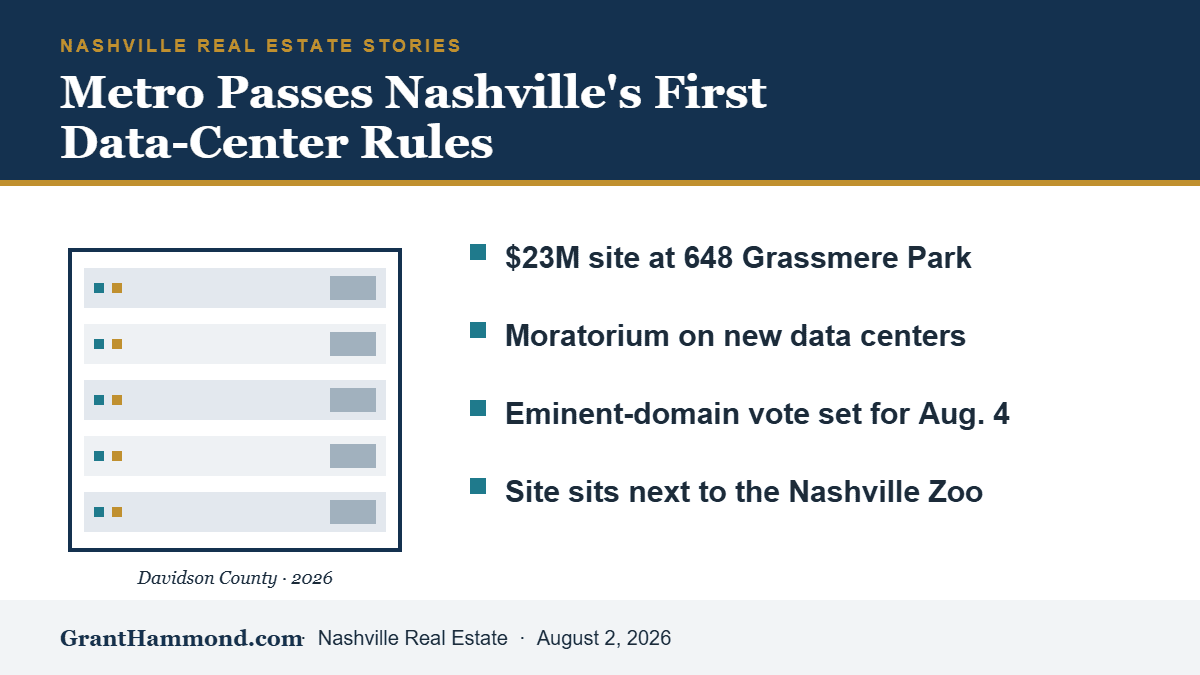
Nashville’s Metro Council had its busiest land-use week of the summer. In a single session the council unanimously approved the county’s first comprehensive data-center zoning framework and a temporary moratorium that pauses new data-center permits through December 1, according to the Nashville Banner. The rules set the first real guardrails on an asset class that has been buying up large, power-adjacent parcels across the region.
The louder fight is over one specific site. DC Blox closed on the roughly 23-acre parcel at 648 Grassmere Park for $23 million, directly next to the Nashville Zoo, and applied for permits before the zoning bill passed, which likely exempts that project from the new rules. So Mayor Freddie O’Connell filed separate legislation to condemn and purchase the land outright through eminent domain, citing the need to relocate Metro facilities tied to the Nashville International Airport runway expansion. That bill advanced on a 27 to 3 vote with five abstentions and is set for its final reading August 4, per WSMV.
Strip away the zoo animals and the story is about how Nashville rations its scarce industrial and power-served land. Data centers compete for the same large parcels that developers want for housing, mixed-use, and the downtown high-rise pipeline, and they pay cash. When the city signals it will use zoning and even condemnation to steer that competition, every land buyer in Davidson County recalculates.
Why does the data-center fight matter for Nashville land values?
It puts Metro on record that it will actively shape which projects win the region’s biggest parcels, and that changes the risk math on any large land play near the airport or downtown. For investors, the moratorium is a pause button on a fast-moving asset class, and it tells you the near-airport corridor is now politically contested ground. For sellers of large tracts, the DC Blox price of $23 million for 23 acres is a real data point on what power-adjacent land commands, even if this particular deal ends up unwound. Having closed more than 350 high-rise condo sales downtown, I watch large-parcel land demand closely because it feeds directly into the downtown high-rise pipeline. When data-center buyers and residential developers chase the same dirt, the residential projects that do get built tend to skew higher-density and higher-priced to justify the land basis.
2. Brentwood Now Requires 40% Green Space on Its Largest Residential Lots
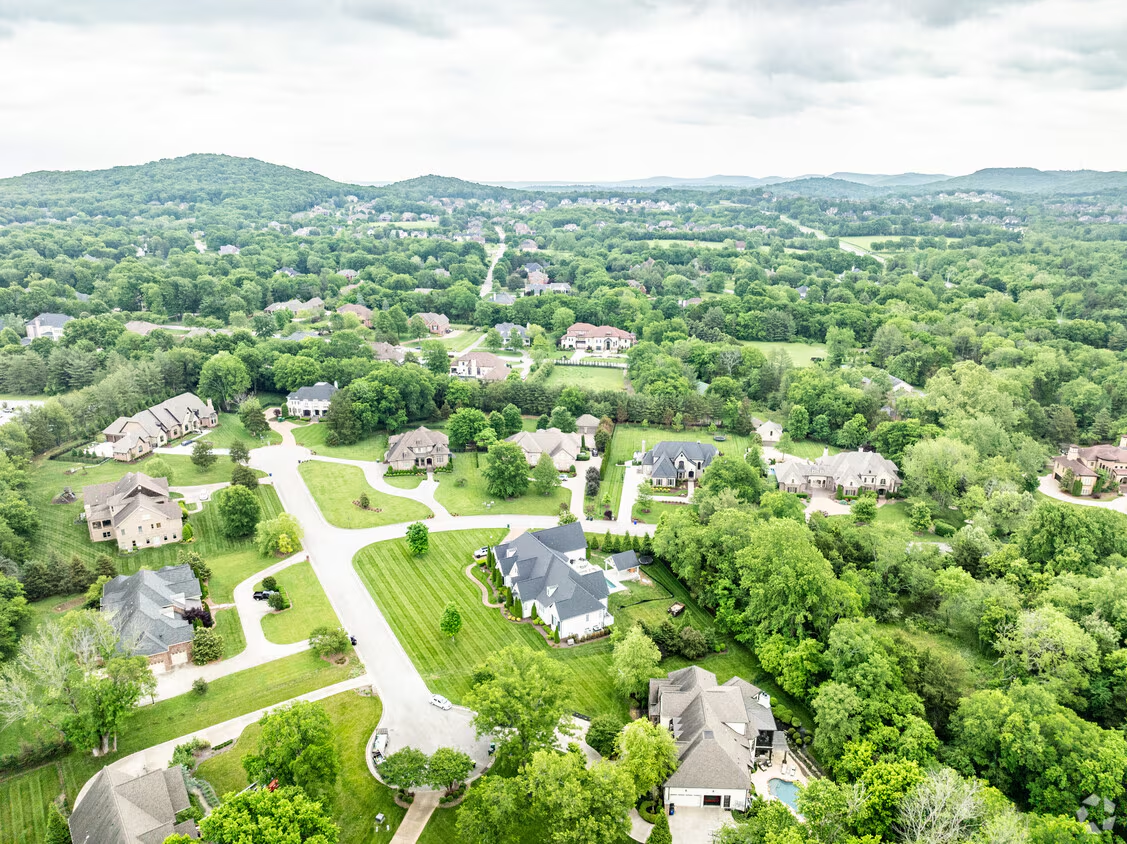
On Monday, July 28, the Brentwood City Commission unanimously approved an update to its residential zoning ordinance on final reading, according to the Williamson Herald. The change requires properties in the Agricultural Residential Estate (AR), Large Lot Residential (R-1), and Suburban Residential (R-2) districts to maintain a minimum of 40% green space.
Brentwood has spent years protecting its low-density character, and this is the next turn of that screw. A 40% green-space floor limits how much of a lot can be covered by the house, driveway, and hardscape combined. For teardown-and-rebuild activity, which has been a steady engine in Brentwood, that ceiling on buildable coverage directly caps the size of the home a builder can put back on a given lot.
This lands during a broader Williamson County rezoning conversation, where Franklin, Nolensville, Fairview, Spring Hill, and Thompson’s Station are all redrawing urban growth boundaries. Brentwood’s move is the first concrete ordinance to come out of that wave, and it sets a template the neighboring municipalities can copy. It is the quietest change of the week and, for Williamson County, possibly the most consequential.
Why does Brentwood’s green-space rule matter for Williamson County lot values?
It tightens supply of buildable square footage on exactly the large lots that command the county’s highest prices, which supports existing-home values while raising the cost basis on new builds. If a builder can cover less of the lot, the maximum home size shrinks, and scarcity of large new-construction product tends to push buyers toward existing luxury inventory. Sellers of established Brentwood estates gain a modest scarcity tailwind. Builders and land buyers need to re-underwrite deals in the AR, R-1, and R-2 districts before they close, because the pro forma that pencils at 60% coverage may not pencil at the new 40% green-space floor. This is the kind of quiet land-use change that reshapes a submarket long before it shows up in the median price.
3. Nashville Mortgage Rates Climb to 6.66%, a One-Year High

Financing got more expensive again. The Freddie Mac Primary Mortgage Market Survey put the 30-year fixed at 6.66% for the week, up from 6.58% the prior week and the highest level in just over a year, per Freddie Mac. That is the third straight weekly increase. The move traces back to a jump in crude oil toward roughly $90 a barrel, which revived inflation concerns and fed straight into the bond market that mortgage rates follow.
The timing matters because Nashville is already carrying a multi-year high in active inventory, with more sellers than buyers actively shopping across much of the metro. Higher rates on top of ample supply is a combination that keeps negotiating leverage on the buyer’s side of the table, especially on existing homes where sellers cannot buy down a rate the way production builders can. Financing is the through-line running under this week’s Nashville real estate stories.
Why does a 6.66% rate matter for Nashville buyers right now?
Because the payment math just got harder in the same week that inventory gives buyers more room to negotiate, and those two forces point in opposite directions. A move from 6.58% to 6.66% is small on its own, but it compounds against a metro where supply already favors the buyer. Buyers should price the higher rate into their monthly budget, then use the deep inventory to negotiate on price, closing costs, or a seller-paid rate buydown. Sellers of existing homes need to sharpen pricing, because they are competing with new construction that can offer financing incentives they cannot match. I update Nashville mortgage rates weekly for exactly this reason, since an eighth of a point can quietly move what a buyer qualifies for.
Bonus Insight: Nashville’s Short-Term-Rental Permits Hold at 6,939

Nashville’s short-term-rental market is holding steady at 6,939 active permits, split between 4,897 non-owner-occupied (NOOSTR) and 2,042 owner-occupied (OOSTR). The NOOSTR class, which is what most investors rely on, makes up 71% of all active permits and remains capped per census block, which keeps waitlists alive in the strongest neighborhoods. With more than 550 short-term-rental transactions behind me, my read is that the cap is the whole ballgame: a permit attached to a compliant property is a scarce, transferable asset, and that scarcity is precisely what supports value in the Nashville Airbnb investment market. Investors underwriting a purchase this quarter should confirm permit status first and price second. You can watch the running count on my short-term-rental permit tracker.
Nashville Real Estate Market Outlook
Forward-Looking Signals From the Week’s Nashville Real Estate Stories
Taken together, these three stories describe a market where land and money are both getting tighter while housing supply stays loose. Watch these signals over the next 30 to 90 days:
- The August 4 eminent-domain vote. A yes sets a precedent that Metro will intervene in large-parcel land use, which ripples out to every big development site near the airport and downtown.
- Whether other Williamson municipalities copy Brentwood. If Franklin or Nolensville adopts a similar green-space floor, the buildable-supply squeeze on large lots spreads county-wide.
- The next few Freddie Mac prints. A fourth straight weekly increase would confirm the oil-driven rate move is sticky rather than a one-week blip.
- Inventory absorption. With supply at multi-year highs, the question is how quickly the deep listing pool clears at these rates.
What This Means for Buyers, Sellers, and Investors
Buyers: lean into the leverage. Deep inventory plus higher rates means you can negotiate price and financing concessions, so budget for 6.66% and let the seller help close the gap. See the 2026 Nashville housing market outlook for the fuller picture.
Sellers: price to the current market, not last year’s. You are competing with new construction that can buy down a buyer’s rate, so condition, staging, and a realistic number matter more than they did in the boom.
Investors: large-parcel land near the airport is now politically contested, so underwrite policy risk. On the short-term-rental side, the per-census-block cap keeps permitted properties scarce, which is a durable value support if you buy compliant.
FAQ: Nashville Real Estate Stories This Week
What are the biggest Nashville real estate stories this week?
Three stories lead the week of August 2, 2026: Metro Council passed Nashville’s first data-center rules and a permit moratorium while moving to seize the $23 million DC Blox site next to the zoo by eminent domain, Brentwood approved a 40% green-space requirement for its AR, R-1, and R-2 residential districts, and the Freddie Mac 30-year mortgage rate climbed to a one-year high of 6.66%. A short-term-rental note rounds out the week, with Nashville holding 6,939 active permits.
What is happening with the Nashville Zoo data center?
Data-center developer DC Blox closed on a roughly 23-acre parcel at 648 Grassmere Park for $23 million, directly next to the Nashville Zoo, and applied for permits before the city’s new data-center zoning passed. Mayor Freddie O’Connell filed legislation to condemn and buy the land through eminent domain, citing Metro facility relocation tied to the airport runway expansion. That bill advanced 27 to 3 with five abstentions and is set for a final vote on August 4, 2026.
What did Brentwood change about its residential zoning?
On July 28, 2026, the Brentwood City Commission unanimously approved, on final reading, a requirement that properties in the Agricultural Residential Estate (AR), Large Lot Residential (R-1), and Suburban Residential (R-2) districts maintain a minimum of 40% green space. The rule limits how much of a lot can be covered by structures and hardscape, which caps the maximum home size on those large lots.
What are Nashville mortgage rates right now?
For the most recent week, the Freddie Mac Primary Mortgage Market Survey put the 30-year fixed at 6.66%, up from 6.58% the prior week and the highest level in just over a year. It was the third straight weekly increase, driven by a rise in crude oil toward roughly $90 a barrel that revived inflation concerns in the bond market.
How many short-term-rental permits does Nashville have?
Davidson County has 6,939 active short-term-rental permits, split between 4,897 non-owner-occupied (NOOSTR) and 2,042 owner-occupied (OOSTR). The non-owner-occupied class, which most investors rely on, is 71% of active permits and remains capped per census block, which keeps waitlists in place in the most in-demand neighborhoods.
Forward-Looking Statement Disclosure
This post reflects conditions as of August 2, 2026 and includes forward-looking observations about the Nashville and Middle Tennessee real estate market. Forward-looking statements are based on current market data and public reporting and are not guarantees of future results. Market conditions, mortgage rates, zoning outcomes, and pending legislation can change. Nothing here is legal, tax, or investment advice. Verify current figures and consult the appropriate professional before making a real estate decision.