Licensed Tennessee real estate broker (TN #261980), specializing in Nashville short-term rentals, downtown high-rise condos, luxury, and new construction.
Three stories this week show where Nashville’s real estate ecosystem is under structural stress: listing distribution control between Realtracs and Zillow, downtown’s tax-funded public realm hitting political resistance, and apartment landlords offering concessions that signal a soft rental market. Each one shifts the ground under specific buyer, seller, and investor decisions being made right now.
Quick Takeaways: Nashville Real Estate Stories This Week
The three Nashville real estate stories below trace where buyer, seller, and investor decisions get harder this week. Each one carries a concrete action you can take right now.
- Realtracs and Zillow listing dispute extends past June 8: Negotiations continue between Tennessee’s largest MLS and Zillow over how broker-created listing data is displayed, used, and monetized. Nashville buyers can still see Zillow listings for now.
- Metro Council rejects downtown CBID budget by one vote: The $9 million Central Business Improvement District spending plan failed on June 2, with several councilmembers citing pedestrian safety and accountability concerns about the Nashville Downtown Partnership.
- Free rent and concessions are widely available across Nashville apartments: Landlords offering one to two months free, waived fees, and other incentives reveal a rental market where supply now sits ahead of demand, with implications for buy-and-hold investors and short-term rental operators considering long-term-rental fallbacks.
- Bonus: Nashville mortgage rates pulled back from a nine-month high. Freddie Mac PMMS closed the week ending June 5 at 6.48% on the 30-year fixed and 5.79% on the 15-year fixed, with daily lender quotes spiking mid-week before recovering by Friday.
The first of these Nashville real estate stories reflects a structural shift in how listing data flows between Tennessee’s MLS and the consumer real estate portals most buyers use to find homes.
1. Realtracs extends Zillow suspension deadline past June 8 as listing-data dispute continues
Realtracs and Zillow are negotiating new licensing terms for Tennessee MLS listing data display. The dispute centers on broker ownership of listing content.
If you have been searching for homes on Zillow in the last week and wondering whether the listings are about to disappear, the answer this week is: not yet, and possibly not at all on June 8.
Realtracs, Tennessee’s largest multiple listing service, sent its members an email on May 27 warning that Zillow was in violation of new display rules and would lose access to the MLS data feed if it did not comply by May 31. The original June 1 cutoff came and went without disruption. June 8 was the next visible deadline, the expiration of Zillow’s current Realtracs license agreement. Then on Friday, Realtracs sent a second update: discussions remain active and productive, listing distribution will continue uninterrupted, and negotiations will continue beyond the June 8 timeline.
The friction is not about technology. It is about who owns listing data. Realtracs CEO Stuart White said the dispute is about ensuring “transparency, choice, and respect for broker-created content.” Today, third-party platforms, AI systems, lead-generation tools, and consumer marketplaces have built large businesses on data created by brokers and agents. From Realtracs’ position, listing data is the product of broker work and investment. Therefore, the framework that lets outside companies use, retain, modify, and monetize that data needs updating.
Compass Real Estate, where I work as a broker, is directly cited in this story. Kristy Hairston, Compass regional vice president, told the Business Journal that Zillow’s display policies penalize sellers and agents. Specifically, those who try to soft-launch a listing before broad portal syndication get pushed down in search results. “We believe that homeowners should have a choice in how they market homes,” she said. Zillow’s communications director Matt Kreamer pushed back: “We are not backing off of our stance. We think it’s worth fighting for.”
Why the Realtracs and Zillow standoff matters for Nashville buyers and sellers
I tell clients searching for Nashville homes about my IDX search powered through dsidxpress. Notably, it connects directly to Realtracs. As a result, the listings on my site come straight from Middle Tennessee’s MLS without the portal-layer intermediation that drives this entire dispute. Regardless of how the Realtracs-Zillow negotiations resolve, my IDX shows current Nashville and Middle Tennessee inventory. The reason is simple. It is fed from the same data source brokers and agents use to write contracts.
For sellers, the practical takeaway is clear. Even if Zillow loses Realtracs feed access, your listing remains visible on Homes.com, Realtor.com, Redfin, and every brokerage IDX in the region. The Realtracs email noted one important detail. Brokers retain the ability to submit listings directly to Zillow through GRID’s Broker Only Export program. Portals do not sell houses. Listings find buyers through multiple channels, and a strong listing agent uses all of them.
For buyers, my read is to search where the data is freshest. The Nashville home search on my site updates on a Realtracs cadence. National portals sometimes show stale status, outdated price reductions, or properties already under contract. The reason: their pipelines re-syndicate on different schedules. If you are watching a specific neighborhood and timing matters, the closer your search is to the MLS, the better your information. Of the three Nashville real estate stories this week, this is the one that touches the most home shoppers immediately.
2. Metro Council rejects downtown CBID budget by one vote, signaling pressure on Downtown Partnership
Update, August 16, 2026: The CBID budget was resubmitted with a $1 change and approved by Metro Council on June 16, 2026, ahead of the June 30 deadline for the 2027 fiscal year. The story below reflects the situation as it stood on June 7, after the June 2 rejection.
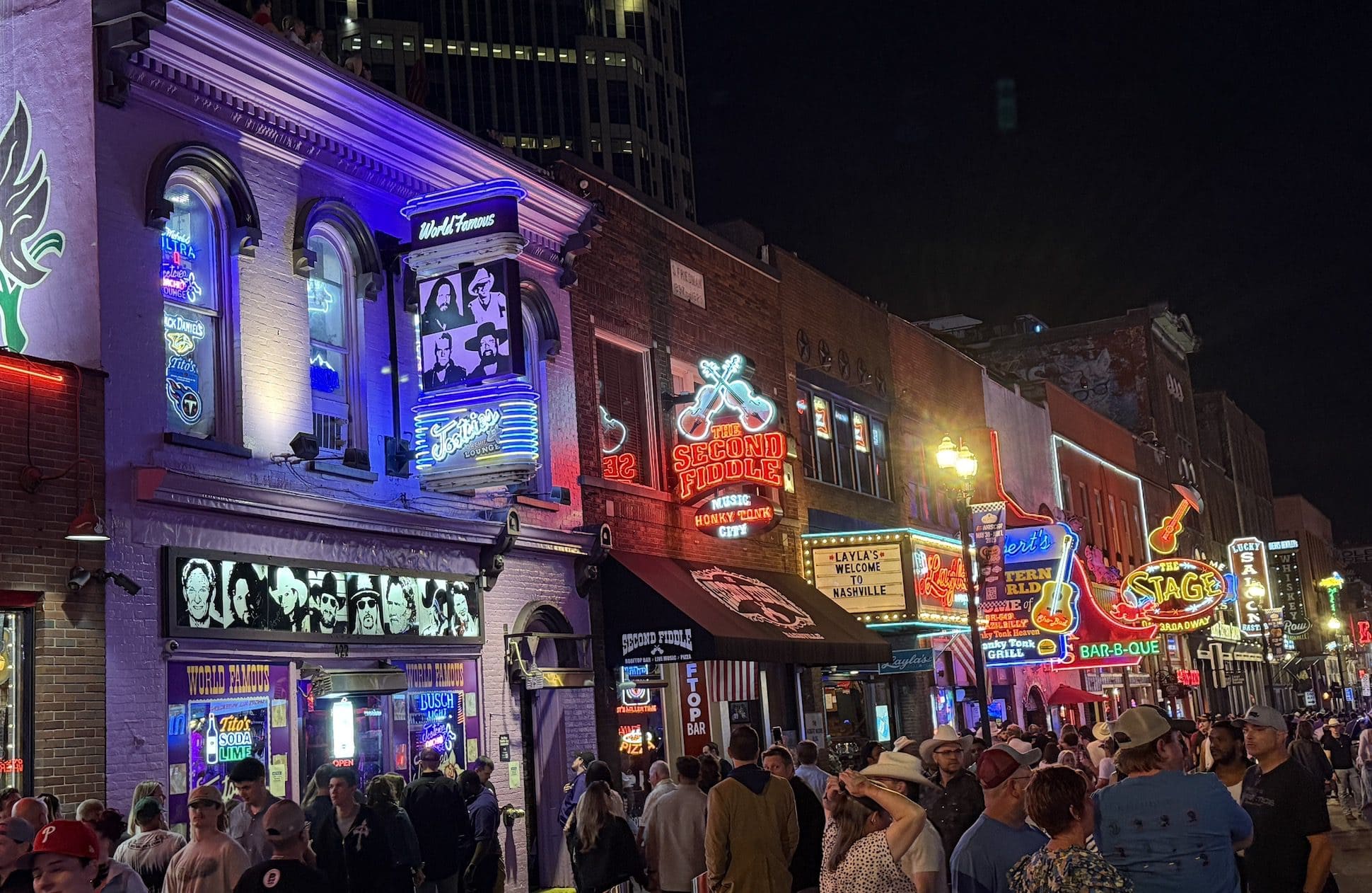
The Metro Council narrowly voted to reject the proposed budget for downtown’s Central Business Improvement District on June 2. Twenty councilmembers voted in favor, short of the threshold required. Ten members were absent from the meeting. The $9 million CBID spending plan funds litter and trash removal, landscaping, and safety patrols across downtown. All of these services run through the Nashville Downtown Partnership. Property owners inside the district pay an extra tax plus a 0.25 percent fee on certain retail transactions to fund the district’s services.
The rejection was driven by frustration. Councilmember Evans Segall said that “clean and safe” should mean more than picking up trash and funding officers. She pointed to a 2026 spike in pedestrian and roadway deaths reported by WPLN. In her view, the Downtown Partnership has a narrow definition of safety. Councilmember Sean Parker added that NDP has “a habit” of impeding the deployment of safer street infrastructure. The Partnership has also taken heat over hiring private security firm Civicity to handle downtown patrols.
Councilmember Jordan Huffman defended NDP on the floor. He urged colleagues to recognize the Partnership as a partner to the city. Specifically, he reminded them of Nashville’s reliance on tourism revenue generated downtown. Councilmember Jacob Kupin, whose District 19 includes the CBID, expects the same budget proposal to come back at the council’s June 16 meeting. Because the failure was by one vote and ten members were absent, Kupin believes the budget likely passes on the second pass.
Why the CBID vote matters for Downtown Nashville condo values
I have walked enough downtown buildings to know that the CBID is not just a line item on a budget. It funds the day-to-day quality of downtown’s public realm: cleanliness, landscaping, security patrols, event coordination. Property values inside the district are influenced by what happens on the sidewalks outside the buildings, and the council vote is a political signal that the current framework is not satisfying the people who write the checks.
If you own or are considering a Downtown Nashville condo, watch the June 16 re-vote. Also, watch what conditions get attached if the budget passes. Improvements in pedestrian infrastructure (which Councilmember Parker flagged) and clearer accountability around safety outcomes would be material wins for property values in 37201, 37203, and 37219. A weaker budget, or one passed without changes, leaves the same gaps that drove the no votes the first time.
For short-term rental investors in downtown buildings, the same logic applies in reverse. In my experience underwriting Nashville Airbnb investments, one pattern repeats. Guests who feel unsafe on downtown sidewalks leave bad reviews. Buildings near streets with poor pedestrian infrastructure command lower nightly rates than buildings near well-lit, well-maintained corridors. The CBID’s effectiveness shows up in your investment revenue numbers indirectly but persistently. Across all three Nashville real estate stories, this one most directly affects long-term downtown property values.
3. Free rent and apartment concessions widely available across Nashville rental market

The Tennessean reported this week that free rent and other concessions are widely available across Nashville apartment communities, with landlords offering incentives that range from one or two months free to waived application and administrative fees to upgraded units at lower prices. The pattern is broad enough that it is not a single property struggling. It is a market signal.
Concessions show up when supply runs ahead of demand. Specifically, Nashville absorbed years of multifamily construction during the 2021 through 2024 development cycle. As a result, a lot of those units are now competing for the same renters. When a landlord offers two months free on a twelve-month lease, the effective rent is roughly seventeen percent below the stated rent. That gap matters for any underwriting model that uses listing rents as inputs.
For renters, this is a window. Lease negotiation has room it did not have during the 2022 peak. Even properties that do not advertise concessions are often willing to discuss them on signed leases at the manager level.
Why apartment concessions matter for buy-and-hold investors
In my underwriting work with investors modeling Nashville condo or single-family rental purchases, one factor matters. The concession environment changes the math. The economic rent on a unit is the asking rent minus the value of concessions amortized across the lease. A unit listed at $2,400 with two months free is economically renting at roughly $2,000. Pro formas that pencil to a strong return at $2,400 lose meaningful margin at $2,000.
The same applies to short-term rental investors thinking about the long-term-rental fallback scenario. One thesis I have underwritten in this market: if STR regulations tighten or revenue softens, convert to LTR and hold. That LTR fallback now has a softer floor than it did eighteen months ago. If you are modeling a Nashville Airbnb financing decision with an LTR exit ramp, apply one adjustment. Specifically, discount the LTR rents you find on listing sites by the prevailing concession spread to get to a realistic floor.
None of this means the rental market is broken. It means underwriting has to reflect where the market actually is, not where it was. For sellers considering the buy-and-hold-versus-sell decision on a current rental property, the concession environment is one more data point in favor of evaluating both paths honestly. This makes it the most actionable of the three Nashville real estate stories for active investors.
Bonus Insight: Nashville mortgage rates pulled back from a nine-month high
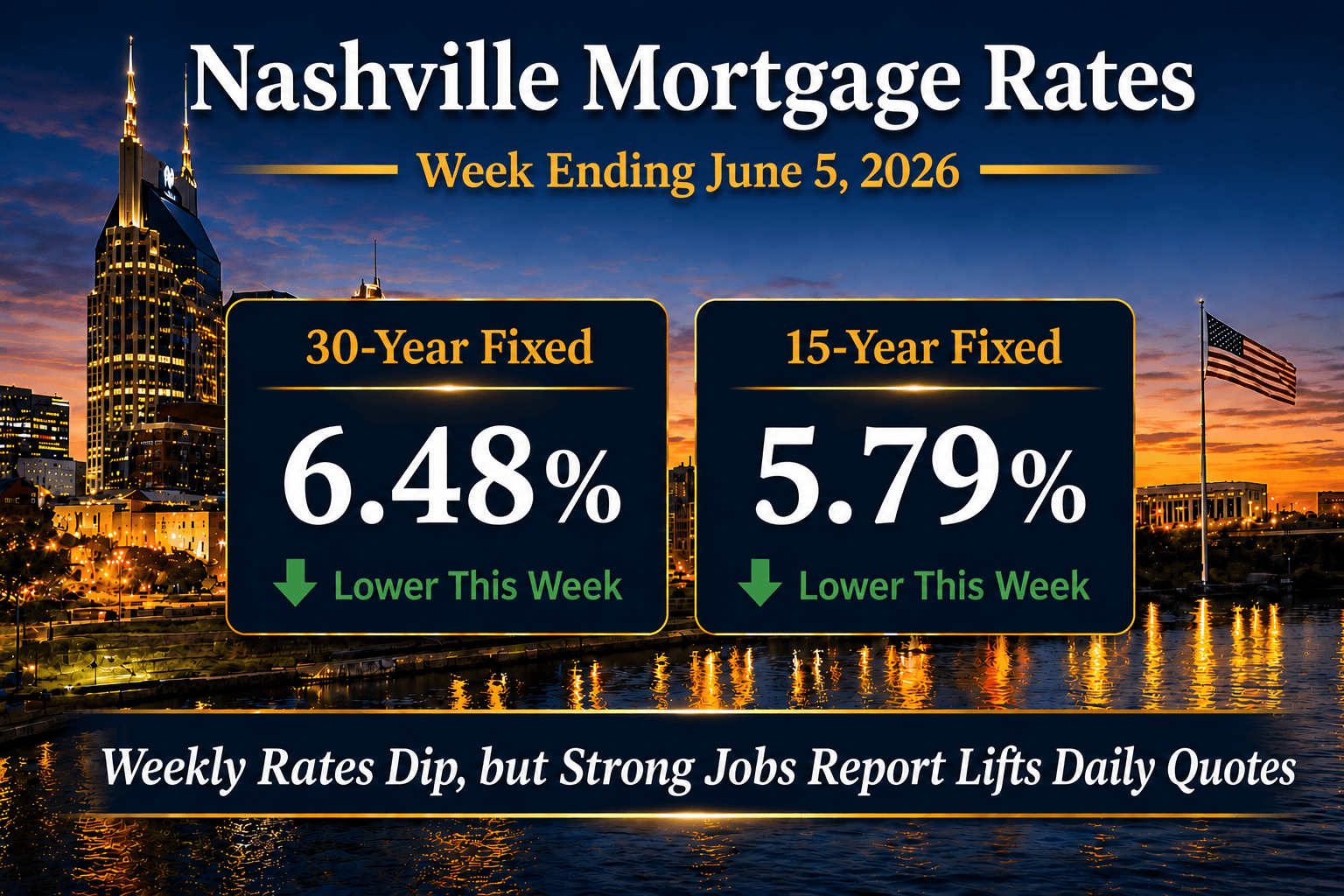
Nashville mortgage rates week ending June 5, 2026: 30-year fixed at 6.48% (down 5 bps), 15-year fixed at 5.79% (down 8 bps). Source: Freddie Mac PMMS.
Beyond this week’s three Nashville real estate stories, the mortgage read matters because financing conditions touch every decision the three stories above influence. I track Nashville mortgage rates weekly. The Freddie Mac Primary Mortgage Market Survey closed the week ending June 5, 2026 at 6.48% on the 30-year fixed and 5.79% on the 15-year fixed. Daily lender quotes spiked to a nine-month high on Tuesday. Then they recovered modestly by Friday’s close. If you are inside thirty days of closing and the current rate works for your payment, the call is clear. Locking right now removes near-term risk without giving up much. If you are still in shopping mode, my Nashville mortgage rates tracker updates weekly with the current PMMS values and a Nashville-specific read on what they mean for buyers across Davidson, Williamson, Wilson, and Rutherford Counties.
What’s the Nashville real estate market outlook for June 2026?
Forward-Looking Signals to Watch Over the Next 30 Days
Three signals will tell us how these Nashville real estate stories resolve over the next month:
- June 16 Metro Council vote on the resubmitted CBID budget. A pass with substantive amendments around pedestrian safety would be the strongest outcome for downtown property values. A pass without changes leaves the friction in place. A second rejection would be a real warning sign.
- Whether Realtracs and Zillow reach a new licensing agreement and on what terms. The deeper question: do other large MLSs across the country adopt similar broker-ownership frameworks? If they do, the entire portal-to-MLS data relationship shifts in favor of broker-created content.
- Whether apartment concessions deepen or stabilize through the summer leasing season. June through August is when the largest share of annual leases roll over. If concessions widen rather than tighten, the supply imbalance is structural, not seasonal.
What This Means for Buyers, Sellers, and Investors
Buyers: Across all three of these Nashville real estate stories, the buyer takeaway is the same: search where the data is freshest. National portals do not pick winners or losers in this dispute, but listing freshness matters. A Realtracs-direct search like mine gets you the same data agents use to write contracts.
Sellers: The seller takeaway from this week’s Nashville real estate stories is simple. Your agent’s marketing toolkit matters more than any single portal. Multi-channel distribution, professional media, and direct buyer outreach all matter. Together, they do the work portals get credit for. If your home is on the market right now and your agent’s plan starts and ends with “we will put it on Zillow,” ask harder questions.
Investors: Adjust your underwriting. STR economics are still strong in the right buildings and the right zoning categories. However, LTR fallback assumptions need a haircut. The Nashville real estate research archive has the closed-sale data and submarket breakdowns to ground those models in actual transactions, not theoretical rents.
FAQ: Nashville Real Estate Stories This Week
Common questions about the three Nashville real estate stories above, with direct answers for buyers, sellers, and investors making decisions in Middle Tennessee right now.
What happens if Realtracs cuts off Zillow’s MLS feed access?
Nashville listings would no longer automatically appear on Zillow through the standard Realtracs feed. Brokers retain the ability to submit listings directly to Zillow through GRID’s Broker Only Export program. As of June 6, 2026, Realtracs and Zillow are still negotiating beyond the original June 8 timeline, and listing distribution continues uninterrupted.
Why did Metro Council reject the downtown CBID budget?
The $9 million CBID budget failed by one vote on June 2, 2026 because several councilmembers raised concerns about the Nashville Downtown Partnership’s response to pedestrian and roadway safety, its accountability practices, and its hiring of private security firm Civicity. The same budget is expected to be reconsidered at the council’s June 16 meeting.
How widespread are apartment concessions in Nashville right now?
The Tennessean reported on May 29, 2026 that free rent and other concessions are broadly available across Nashville apartment communities. Common offers include one to two months free, waived application fees, and unit upgrades. Notably, two months free on a twelve-month lease reduces the effective rent by roughly seventeen percent.
Where do Nashville mortgage rates stand as of June 5, 2026?
Freddie Mac PMMS closed the week at 6.48% on the 30-year fixed and 5.79% on the 15-year fixed. Daily lender quotes spiked to a nine-month high on Tuesday. Then they recovered modestly by Friday’s close. The Nashville mortgage rates tracker on this site updates weekly with the current week’s values and Middle Tennessee-specific context.
What links these three Nashville real estate stories together?
Each story reveals a structural pressure point in Nashville’s real estate ecosystem: how listing data gets distributed, how downtown’s public realm gets funded, and how the rental market is absorbing the construction wave from 2021 through 2024. Each one shifts the math for specific buyer, seller, and investor decisions being made right now.
Sources & Citations
How I assemble these stories. For primary reporting, I read the Nashville Business Journal, Nashville Post, and The Tennessean. When politics is the lead, I also review Metro Council records directly. For the market math, I pull MLS data straight from Realtracs and verify with brokers and developers on my team. Every figure is cited inline. The forward-looking reads, however, are my interpretation, clearly labeled so you can separate fact from take without playing archaeologist. Finally, when I cite MLS data, I name the export date so anyone can pull the same query and audit me.
Primary news sources
- Nashville Business Journal, June 2, 2026: Realtracs extends Zillow suspension deadline past June 8 is my primary source for the Realtracs and Zillow listing-data dispute.
- Nashville Post, June 3, 2026: What’s next after rejection of downtown tax district’s budget proposal is my source for the Metro Council CBID vote and Downtown Partnership response.
- The Tennessean, May 29, 2026: Free rent and apartment concessions widely available across Nashville is my primary source for the rental concession reporting.
Data and records
- Realtracs MLS data, retrieved June 6, 2026 is what I used for active inventory, days-on-market, and price-per-square-foot context.
- Mortgage rate observations: weekly Friday post. Nashville Mortgage Rates Today, June 5, 2026.
- Metro Council vote records and Central Business Improvement District filings, Metro Nashville Davidson County.
Forward-Looking Statement Disclosure
The forward-looking statements in these Nashville real estate stories about market direction, the outcome of the Realtracs-Zillow negotiations, the June 16 CBID re-vote, and the trajectory of apartment concessions are based on current market conditions and publicly reported information. They are not guarantees, predictions, or investment advice. Real estate market conditions can shift quickly, and individual decisions should be made with the help of a licensed broker, mortgage professional, and tax advisor. Broker fees are not set by law and are fully negotiable.
Past performance does not predict future performance. Each of the Nashville real estate stories above is reported as of June 7, 2026 and the underlying conditions can shift quickly. Mortgage rates and apartment concession levels referenced in this post reflect the data sources cited and may differ from current pricing by the time you read this. For current Nashville mortgage rates, see the Nashville mortgage rates tracker.
Investors comparing Nashville to other top US Airbnb markets should read my analysis on why Nashville outperforms Kissimmee, Gatlinburg, and other high-volume markets.
Newer edition: 3 biggest Nashville Real Estate Stories: July 26, 2026.