Green Hills Homes for Sale: A Year-Over-Year Market Report (2026)
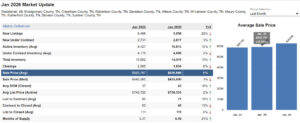
Green Hills and Forest Hills sit roughly four to six miles southwest of downtown Nashville, largely inside zip 37215. Source: RealTracs MLS,...
Nashville inventory levels coverage from Grant Hammond, broker at Compass RE with 25 years of continuous Middle Tennessee market reporting. This archive collects every Nashville inventory levels post, organized chronologically. Each post covers current inventory data, months of supply, and the inventory-versus-demand balance shaping Nashville buyer and seller leverage. Additionally, every post tracks the same fundamental signals: active listings, pending sales, and new listings entering the market.
This archive is the historical reference for Nashville inventory tracking. Inventory levels are the single most reliable indicator of which way the Nashville market is shifting.
Every Nashville inventory levels post covers the same data points consistently. It provides current active listing count and months of supply. Then it analyzes year-over-year change. Additionally, every post features new listing pace versus absorption rate. Furthermore, every analysis closes with implications for Nashville buyer and seller leverage.
Nashville inventory levels matter because inventory dictates price direction more directly than any other metric. Specifically, the 4-to-6 month supply threshold separates buyer and seller markets. These factors include new construction completions, existing home turnover, and investor selling behavior. Additionally, inventory cycles in Nashville run differently than Sun Belt comparables.
Every Nashville inventory levels post covers Davidson and Williamson Counties. Specifically, the coverage includes Brentwood, Franklin, Belle Meade, Green Hills, East Nashville, The Gulch, Downtown Nashville, Germantown, Hendersonville, and Spring Hill. Additionally, the analysis tracks inventory across multiple price bands from entry-level under $400K through luxury above $2.5M.
Grant Hammond is a Nashville real estate broker at Compass RE. He has 25 years of experience and over $1 billion in career sales, including 350+ downtown high-rise condo transactions and 550+ Davidson County Airbnb and short-term rental transactions. Furthermore, his market analysis appears regularly in major publications. These include the Wall Street Journal, the Los Angeles Times, The Tennessean, and the Nashville Business Journal. Grant Hammond holds Tennessee Real Estate Broker License #261980.