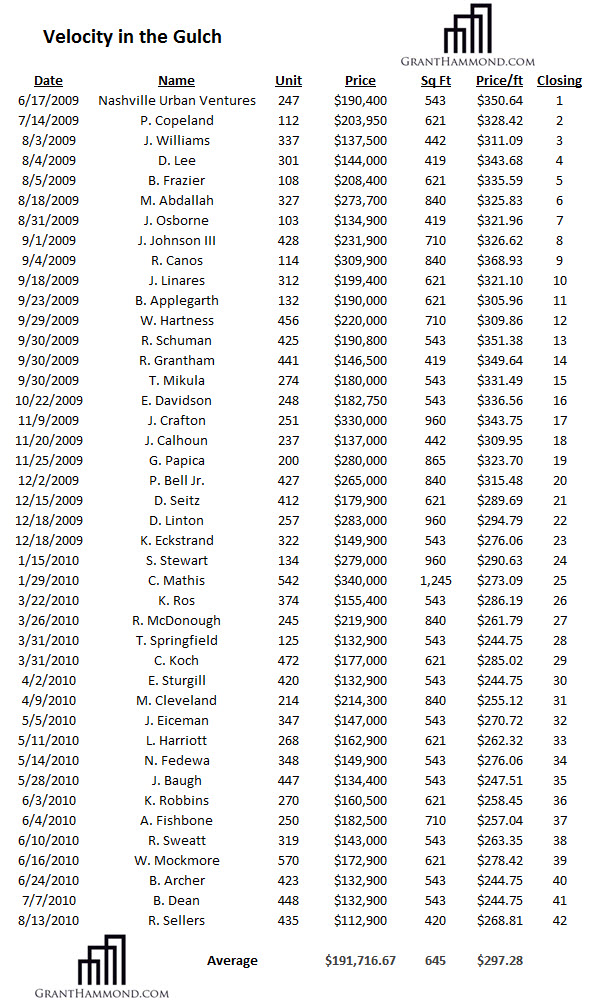
As promised to a reporter who called today, here is the current list of sold condos for the Velocity in the Gulch. Clearly, the momentum has vanished in this project as a result of the ownership restructuring and loss of high LTV financing options for new buyers. The rumor mills continue to churn as other large projects like Rolling Mill Hill and 5th & Main fall. Personally, I am not advising any of my clients to purchase in this project at this time as I sense the winds of change gaining energy. However, I still believe Velocity in the Gulch to be an excellent entry level condo community that can thrive in the future given the correct circumstances.
What’s next for the Velocity Development
Rather than speculate at this time, I am going to sit this one out and diligently observe.
Note: I have been told that I am missing 1 sale. I will verify when I hand pull deeds at the end of the month.
See all condos for sale in the Velocity in the Gulch


September 5, 2010, 2:22 pm
Two months ago, when the developers of Velocity turned the project over to its lender, I commented:
“My point is this: developers/bankers will not want to hold these units long-term, they’re not selling now in sufficient volume in an environment of historically low interest rates, and they weren’t selling in sufficient volume in an environment of slightly higher rates and government incentives. Simply put, if they couldn’t sell in those environments, how well do you think they’ll sell in an environment of higher interest rates and equally tight credit conditions?
With respect to residential ownership by the banks, I was not referring to absolute numbers but rather bank holdings as a percentage of total bank assets. I thought that was obvious. I should add: Banks are in the lending business, not the real estate/real estate management business.
Finally, do you really expect the developers/banks to announce a fire sale before they actually decide to hold one? I don’t; just look at Terrazzo’s announcement, which came out of the blue one morning on the front page of the Tennessean. Before a fire sale, I believe Velocity will lower its prices substantially, but I still don’t think enough units will sell to satisfy the bank. In the deflationary environment we have now, people defray purchases in the expectation prices will be lower later. That’s why deflation is so damaging–it brings the economy to a screeching halt. What the developers/banks need is rampant inflation, which causes people to buy now before the prices rise further. The problem, however, is that most won’t have the down payment banks are demanding (and should have been demanding the entire time), so they’ll have to finance under very tight credit conditions. I don’t see a way out for the developers/banks in lieu of a fire sale unless they are prepared to hold the unsold units for a decade or longer. If they choose that route, prices will eventually find a “sweet spot” and units will fetch more than they would in a fire sale. The bank will have to make a decision on the time value of money: do they want less now, but sooner, or would they rather have slightly more, spaced over a period of years? I’m putting my money on the former.
Here’s why I expect a fire sale: you have three (four, if you count Rhythm) in a confined area all selling essentially the same product. None are selling well now and the economic environment is not likely to improve soon. The first fire sale will command the most interest and the highest [prices]. I would expect one (or more) of the banks to want to cut its loses and move on. My guess is Velocity, but who knows. I could be wrong, but that’s my thinking.”
These are the facts: in a 265-unit development, 2 (or 3) sales in 2 months. 42 (or 43) units sold in 14 months. 223 (or 224) units remain. At the present rate of sales, the banks will have to hold these assets almost 20 years. That’s not going to happen. There are only two alternatives: cut the prices significantly (at least 25%) or hold an auction. I submit that what I predicted two months ago will be soon borne out. By soon, I mean before winter. Whichever development goes to auction first will generate the most interest and the highest prices. It will also liquidate most if not all of the remaining interest of those looking to buy in the Gulch at reasonable prices within the next 12-18 months. However, an auction of the Velocity units will undoubtedly effect prices at other projects, particularly Icon, also developed by the Bristol Group. I wonder if Compass Bank is also involved in financing Icon. If so, I can understand the reluctance to go to auction; if not, I don’t, given the abysmal sales of the last two months.
Take what I say with a grain of salt if you wish. I’m not involved in real estate in any respect, nor do I have any knowledge of any of the principals affiliated with any of these projects. I’m not a banker, but merely an amateur economist who follows different types of markets, be they stock, currency, commodities, or real estate. Regardless of the market, there is one abiding principle: something is worth only what someone is willing to pay. Price it right and it will sell. Price it too high and you’ll be selling one unit a month for the next twenty years.
September 5, 2010, 7:07 pm
Still Crazy – I think that you are correct in many respects, but you have left out one plausible solution: the banks (Compass and Wachovia are both construction lenders on Velocity) could sell the entire project to another group. They could sell just the note or they could sell the real asset.
To the best of my knowledge, Compass Bank is not involved in the financing of another other Nashville condo projects.
September 5, 2010, 8:11 pm
True, I hadn’t considered that possibility, but realistically who might have an interest in buying into this project in the current economic circumstances? Another financial institution? Other than possibly Wachovia (for reasons described below), I don’t think so. Another developer? Maybe, but only at a substantial discount, perhaps one even greater than the lender will take via an outright auction. If this in fact is Compass Bank’s only condo project, I’d think it would want to cut its losses and move on. If Wachovia is involved in the financing of Icon or other Nashville condo projects, I think it would be the logical choice to acquire Compass Bank’s interest.
September 6, 2010, 1:42 am
Wachovia is involved in quite a few condo developments in Nashville, but not in the Icon or the Terrazzo. The Icon is primarily Fifth Third with B of A and the Terrazzo is primarily B of A with the Canyon Johnson Urban Fund.
Under normal circumstances, I would agree that a bank led condo liquidation would be the most logical next step for Velocity, but the banking system is no longer acting logically. Banks are essentially being encouraged by the Fed to write down all of their bad loans. This encouragement is coming in the form of 0% interest on loans from the central bank. As such, I would expect that both Compass Bank and Wachovia/Wells Fargo are going to or already have written the original construction loans down to what the unsold condos would appraise for in 2010, perhaps even lower. This action now allows the banks to offload the asset quite easily to a REIT, opportunity fund or another developer without having to feel much additional pain.
The is exactly what happened with Rolling Mill Hill last year when Bank of Amercia essentially wrote the $21.4 million construction loan down to $7,286,500 on 9/24/2009: https://www.granthammond.com/2009/condos/rolling-mill-hill-foreclosure-auction
Soon after taking this action, B of A listed the entire project with Cushman and Wakefield’s Atlanta office, a office that specializes in multi-family REO. Now, this project is reportedly under contract with a local group that includes Taco Bell franchisee Farzin Ferdowsi and Uzi Yemen, CEO of Mapco parent Dalek U.S. Holdings.
Something tells me that this same course of action is not only possible at Velocity, but probable. My only fear is that should this happen, the project may be sold to an apartment group who would attempt to convert the Velocity condos into apartments. If I were an owner of a condo at the Velocity, I would be working the phones with the developer, the company who sold the condos as well as the agent who represented me to find out what they know.
As a matter of full disclosure, I did represent several of the buyers in the Velocity…and you can bet your bottom dollar that I am doing everything I can to protect their investment.
September 6, 2010, 2:38 am
Wachovia is involved in quite a few condo developments in Nashville, but not in the Icon or the Terrazzo. The Icon is primarily Fifth Third with B of A and the Terrazzo is primarily B of A with the Canyon Johnson Urban Fund.
Under normal circumstances, I would agree that a bank led condo liquidation would be the most logical next step for Velocity, but the banking system is no longer acting logically. Banks are essentially being encouraged by the Fed to write down all of their bad loans. This encouragement is coming in the form of 0% interest on loans from the central bank. As such, I would expect that both Compass Bank and Wachovia/Wells Fargo are going to or already have written the original construction loans down to what the unsold condos would appraise for in 2010, perhaps even lower. This action now allows the banks to offload the asset quite easily to a REIT, opportunity fund or another developer without having to feel much additional pain.
The is exactly what happened with Rolling Mill Hill last year when Bank of Amercia essentially wrote the $21.4 million construction loan down to $7,286,500 on 9/24/2009: https://www.granthammond.com/2009/condos/rolling-mill-hill-foreclosure-auction
Soon after taking this action, B of A listed the entire project with Cushman and Wakefield’s Atlanta office, a office that specializes in multi-family REO. Now, this project is reportedly under contract with a local group that includes Taco Bell franchisee Farzin Ferdowsi and Uzi Yemen, CEO of Mapco parent Dalek U.S. Holdings.
Something tells me that this same course of action is not only possible at Velocity, but probable. My only fear is that should this happen, the project may be sold to an apartment group who would attempt to convert the Velocity condos into apartments. If I were an owner of a condo at the Velocity, I would be working the phones with the developer, the company who sold the condos as well as the agent who represented me to find out what they know.
As a matter of full disclosure, I did represent a few buyers in the Velocity. I am concerned about their investments.
September 6, 2010, 4:58 pm
Realize that my opinion comes not as a realtor, investor, or banking professional, but rather as a local resident interested in the further development of all projects within The Gulch.
My perception is that through Market Street’s involvement with Velocity, they held the prices unreasonably high due the impact that lowering prices (per the downturn in the housing market) would have on the value of future Market Street projects. Their pitch has always been that they can offer the least expensive option to downtown living. However, today’s buyers are savvy enough to realize that Velocity has still been asking high-end luxury condo prices per square foot; they’re just offering smaller unit options.
When Terrazzo offered roughly 30 condos in the auction last December, they took a hit on price per sq. ft., but have since inched prices back up slightly. Terrazzo is now roughly 70% sold and has definitely seen the benefits of the partial auction. I don’t think Velocity needs offer an absolute fire sale and would certainly oppose restructuring the project to offer apartments. Rather, a new ownership group could greatly benefit by offering roughly 20% of their unsold units in an auction to determine the true value of their product and structure future pricing accordingly. By doing this, they are avoiding the impact of offering apartments in the property which would destroy the future opportunity for condo sales in the building.
I think Velocity is a great building with a lot to offer, especially to the entry-level buyers. The street-level retail space and large, central courtyard offer a unique setting for indoor/outdoor restaurants that could lead to Velocity being the host for any number of social events, in turn becoming an attractive draw for buyers. Given the right price, I think an investor could see a great return in this property due to the growth in popularity of The Gulch, its restaurants and other retail tenants.
September 6, 2010, 8:32 pm
The issue with any prospective buyer of the bank interests is this: what is the current FMV of the remaining units? The starting point would be an appraisal, but an appraisal is based primarily on past sales. Sales so far have averaged almost $300 PSF which far exceeds the current FMV, in my opinion. With few sales in the past two months and likely fewer at published prices over the next six months, how does one best determine FMV? Two methods come to mind: a prospective buyer could arbitrarily reduce its bid some percentage (25-30 percent, say) from the average PSF price, or the banks could offer a significant number of units at auction to establish current FMV. That’s precisely what Terrazzo did when it couldn’t sell any units at the prices it was originally charging (and I’m not talking about the ones sold preconstruction, where the prices were established by contract, but rather prospective buyers not under contract). I’m sure Terrazzo’s bank and developer were disappointed with the prices, but you have to say the auction achieved its purpose of establishing the FMV of the units there.
It appears to me that conversion to apartments could open a number of legal problems considering the fact you have 42 or 43 individual owners (out of 265 units). Don’t they have a say? Won’t any buyer be required to amend the condo docs, which undoubtedly requires approval of any action by a percentage specified in the condo docs. It may be that with less than 20 percent ownership, the individual owners will be unable to prevent a conversion, but any such action is likely be substantially decrease the FMV of their units. Do they have a cause of action? Against whom? Had I bought into this project, I would be steamed if it were converted into apartments. I’m sure this has been done in the past; how have developers handled the existing individual owners? How big a hit have existing owners taken on the value of their properties? Did Rolling Mill actually sell any units before the banks (apparently) unloaded it? It seems to me it’s a lot easier to convert multi-family residential housing from apartments to condos rather than vice-versa, at least from a legal standpoint, and that was all the rage years ago.
September 7, 2010, 10:00 pm
Been looking at the Gulch for over a year now. Really like the Velocity among other reasons because it is one of few downtown condos with reasonable monthly fees. Wouldn’t touch the velocity though for more than about $200 per SF. Who in their right mind would? Seems like some messy HOA issues in the future regardless of what happens. Anyone want to hire a lawyer just to check out the HOA on the 1 BR condo you’re looking at? I don’t. What happens to owners if it becomes an apartment? If it doesn’t become apartment, who pays HOA fees for all those vacant units for the years it will take to fill up? What happens to owner if their is significant litigation surrounding the development?
Love the Gulch but can’t believe what people have and are paying to live there. The gov has been very involved in propping up the housing market for decades. I can’t imagine this involvement can continue much longer.
September 7, 2010, 10:10 pm
I agree with your price point of $200 per SF. My wife and I were looking at a few places there and probably would have moved forward had they even considered an offer in that range. Instead, they held to their $275-$300 range per SF and look where they are now. It is a shame though, because I truly feel it is a good property that would have succeeded if purchase price was more in line with the lower HOA fees.
September 7, 2010, 10:30 pm
Rolling Mill Hill did not actually sell any of their condos prior to their construction lender taking possession. There is precedence recently in cities like Phoenix, Las Vegas and Miami where partially owned condo projects where sold to multi-family operators who then systematically attempted to buy back the sold condos in an effort to take a fractured condo project to full apartments. In some cases, these apartment groups will take over the HOA and make life very difficult for the current owners by raising dues, levying special assessments, cutting off access to amenities and so on. I would certainly hope that would not be the case with Velocity, but one never knows.
I do not know if the current owners would have a course of action once the project is sold, but I do believe they would have one prior to the sale. Perhaps this is something they should be looking into now.
September 28, 2010, 7:55 pm
Any news on the contract holders that have refused to close?
September 28, 2010, 9:18 pm
Any news on whether Velocity will be converted into apartments?
October 5, 2010, 9:26 am
hey tom, I’m a current owner and as far I know, no one here has rcvd any offers of buyout. I’d be lying if I said I’m not nervous. I’ve tried getting answers from the bldg mgmt as well as my (possibly former) realtor. Both just gave runaround answers. I have so many questions with no one willing to answer. I’ve been told by bldg mgmt that closings have been suspended and other employees around here have been giving tours to “investors”. As for what will happen to the current owners…I wish someone would tell me. Given how far my realtor is in Bristol’s pocket, I’m not surprised he doesn’t want to say anything. Who wants to bite the hand that feeds them? If anyone has any suggestions, please feel free.
October 7, 2010, 1:56 pm
There really is not any written evidence at the moment, but all empirical evidence points towards an apartment conversion within the next few months unless the current situation falls apart. There is a silver lining however. It is my understanding that the 20,000 square feet of retail space will develop almost immediately as a result.
October 7, 2010, 2:05 pm
Many multi-family/apartment investors have descended upon Nashville in the past several months as our apartment market has recovered faster than 90% of the country. Our rents are up, our occupancy rates are skyrocketing and there is not a ton of urban apartment product. As a result, these huge funds, REITs and private wealth investors have begun to look at our half empty condo projects as potential apartment conversions. This scenario has certainly played out at Rolling Mill Hill and 5th & Main. Now, it appears that it is playing out at the Velocity.
There are several routes an apartment conversion could go. The most likely is that the remaining 220 condos at Velocity will simply be turned into managed rentals and the 43 sold condos will be left alone. This hands off approach will actually allow the condos to degrade in value over the years and be sold for less in the future than now. While this approach initially sounds okay, the end result is a low sale price. I would be proactive and approach the new owner of the Velocity with my own offer. You must keep in mind that whoever the new owner is needs to convert about 90% of the project into apartments in order to be able to use an conventional financing to lever the property as apartments. My guess is they would want to acquire 20 condos or so rather quickly.
October 21, 2010, 3:33 pm
Any news on this? I’m also an owner at Velocity, and am mostly concerned about what a potential new owner of the project could do to existing unit owners.. as in, can they force us out in any way? Should we be consulting lawyers at this point?
October 22, 2010, 2:27 pm
Hey Jason,
From what they have told me, I’m an owner as well, we can’t be forced to sell but…the investors can sit back and wait for our property values to plummit and then offer to buy us out at a much cheaper price. One rumor that we’ve heard is that the investors are going to buy us all out at what we paid for our units. I hope, if thats how it happens, that we at least get what we paid for it.
On a different note, I’m not sure how Bristol is going to make their other property (vista germantown) work any better. I hope the folks over there don’t get screwed as well.
October 23, 2010, 7:00 am
Thanks for the info. I’m curious to know what would happen if we decided to stay in our unit, and not sell for the price we paid.
As fro Vista Germantown, my understanding is that it will be rental from the start – and Bristol now only has a small minority stake in the project anyway. chk out the nbj article:
http://www.bizjournals.com/nashville/stories/2010/09/27/daily25.html
November 1, 2010, 5:39 am
Jason,
I’m going down to speak with Kim today, hopefully she’ll have some kind of response.
November 1, 2010, 2:39 pm
Waldieccemtp – I would really like to know what you find out as well. I represented a couple of early clients in the building and feel a responsibility to tell them the news, good or bad. Thank you in advance!
November 3, 2010, 6:58 pm
I asked my realtor last week. He asked someone from Bristol, who told him basically nothing. They are not sure and the rental talk is just speculation right now. I suspect the only ones who really know what is going on are those working at the bank, along with the new owners of course.
December 10, 2010, 7:12 am
Hey Grant,
You had mentioned in another string that tenants for the commercial space had signed. What businesses were you referring to? We have heard that the entire commercial space was just sold to the same individual who owns the same space at the ICON
December 10, 2010, 2:18 pm
MarketStreet Enterprises has basically reacquired the 20,000 square foot retail space for $1.75 million. The reason I say reacquired is because it was always their intent to own the retail space under their agreement with the Bristol Group. Once both entities gave the project and construction debt back to Compass and Wachovia Banks, there was a bidding process for both the commercial space and 220 remaining residential units. While MarketStreet was not the highest bidder (there was a $2 million bid from another local group that was represented by Boult Cummings), the banks felt that MarketStreet knew the space better and would be able to fill it faster.
As far as tenants, I do not know the names of the interested tenants, but the two most interested are restaurants. My assumption is that one is an Asian fusion bistro and the other may be a Tapas concept from St. Louis. Again, no confirmation on either concepts other than they had been interested prior to the ‘friendly foreclosure’. Susan Gorney had been working on leasing this space for more than 2 years and will most likely be bringing back all of the tenants who had expressed interest in the past. I do believe that MarketStreet will be able to announce at least 2 tenants within the coming months and most likely have the space at least 70% occupied by the end of next year.
January 12, 2011, 12:33 am
Anything going on with Velocity in terms of changes at the development? If you search for velocity on real tracs, no active sales are showing up?
January 23, 2011, 11:47 pm
I purchased a unit on the first day they went on sale. A law firm representing Compass bank offered me 10% of my earnest money back. I turned them down. They approached me a few weeks later and offered 25%…I stalled another couple of weeks. I was finally able to get back 50% of the $10,000 earnest money that was put down. I was happy to get this resolved and was very worried I would never see anything. They need to acquire as many units as possible to make the building rentable. Good luck!