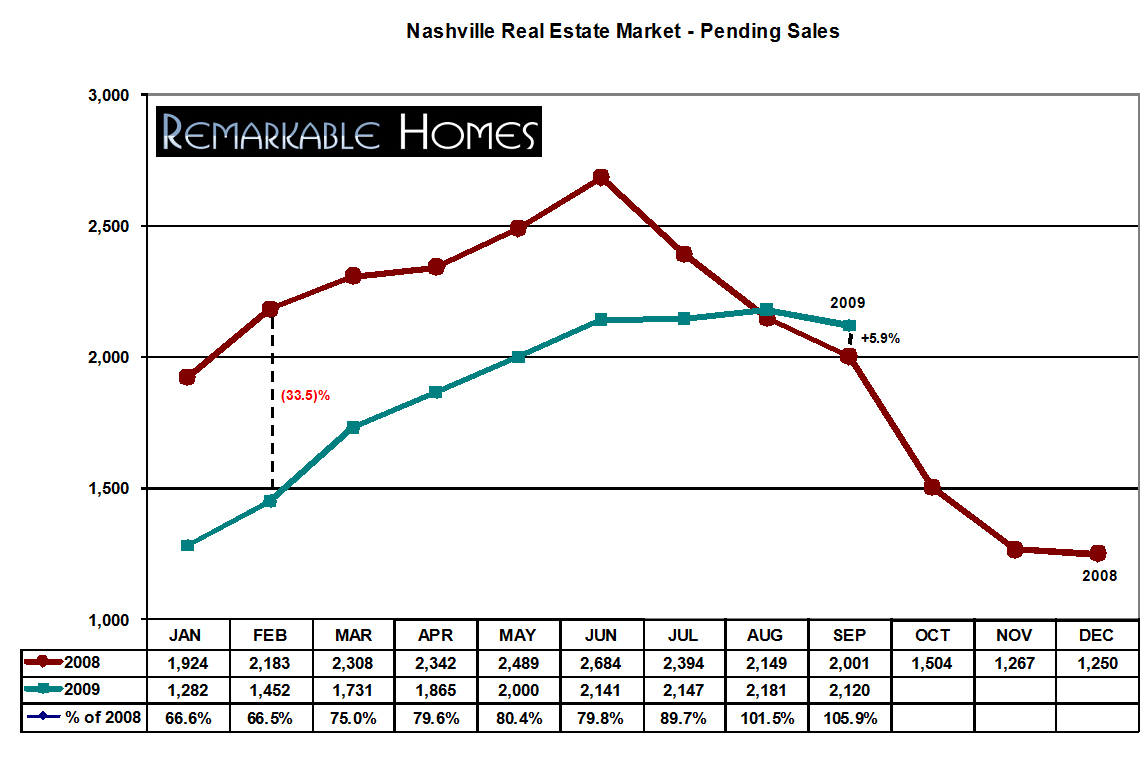
Nashville housing market turning the corner became a realistic discussion in late 2009 as pending sales data began to outperform prior year levels. This shift suggested improving confidence, but it also raised an important question: was the recovery real or driven by temporary incentives?
Pending sales are often a leading indicator of future closings. As those numbers improved, the Nashville real estate market began to show early signs of stabilization.
Nashville Housing Market Turning the Corner
In February 2009, pending sales were down 33.5% year over year. Over the following six months, that gap steadily narrowed. By August, pending sales exceeded prior year levels.
September confirmed that the August crossover was not a one-time event. Even with seasonal trends typically slowing activity, year over year gains remained intact.
This raised a key question: what was driving the improvement?
The Role of the First-Time Buyer Tax Credit
One major factor was the federal housing stimulus program. The first-time homebuyer tax credit provided a financial incentive that likely accelerated demand.
While it is difficult to quantify exactly how many buyers entered the market solely because of the credit, even a modest increase in demand can influence pending sales data.
This makes it important to separate organic recovery from policy-driven activity.
What Happens When the Incentive Expires
The tax credit was scheduled to expire on November 30. If the market was being supported by that incentive, a decline in pending sales would likely follow.
This effect would first appear in October data and become more visible in November and December.
However, if pending sales continued to outperform 2008 levels after the expiration, it would suggest a more durable recovery.
Distressed Inventory Still Matters
Another factor influencing the market was the handling of distressed inventory. Many banks had delayed taking back properties during the downturn.
Eventually, that inventory needed to be processed. When it entered the market, it was expected to increase transaction volume while putting pressure on pricing.
This dynamic aligns with broader housing market trends, where supply timing plays a critical role in price movement.
What Buyers Should Expect
As distressed properties entered the market, buyers were expected to respond quickly. Well-priced homes and condos were unlikely to sit for long.
However, this did not imply a prolonged period of deeply discounted opportunities. Nashville did not experience the same level of overbuilding seen in markets like Las Vegas or Phoenix.
As a result, distressed pricing opportunities were likely to be limited in duration.
Market Outlook
The Nashville housing market in late 2009 was positioned between two outcomes. One possibility was a true recovery driven by improving fundamentals. The other was a temporary boost created by government incentives.
At the same time, certain submarkets showed stronger performance. Areas such as Green Hills, Vanderbilt and West End, and Brentwood continued to attract demand.
Understanding how incentives, inventory, and buyer behavior interact is essential for evaluating these transitions. For more financing insights, explore Nashville mortgage rates and financing.



November 6, 2009, 4:24 pm
May 5, 2010, 2:55 pm