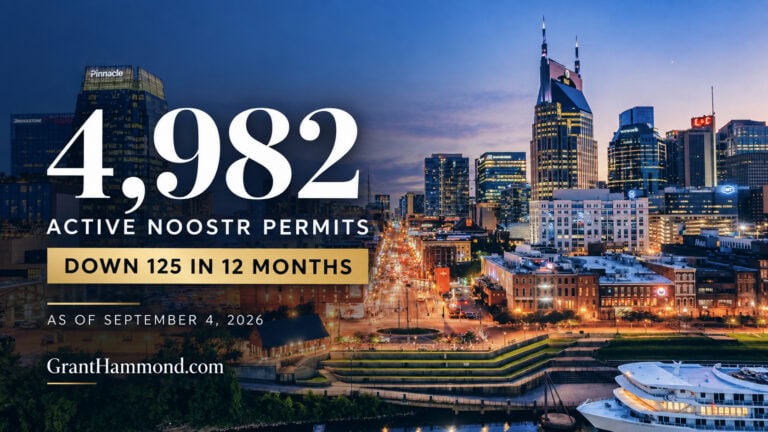
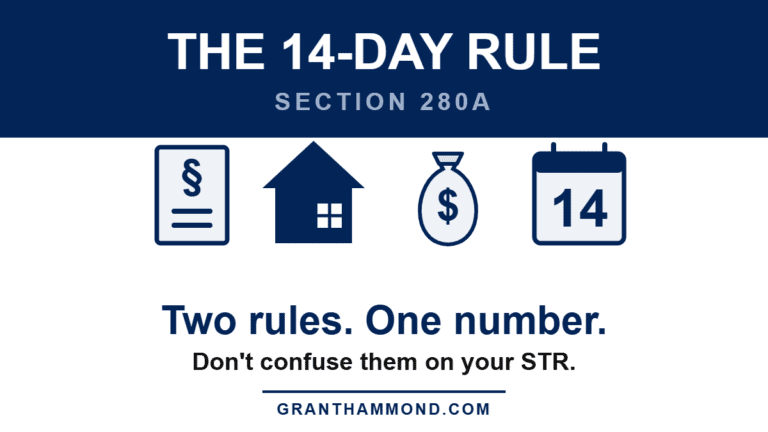
NOOSTR is the Metro Nashville permit category that governs Airbnb and short-term rental properties operated by owners who do not live on the premises. It applies to every investor-held Airbnb in Davidson County and stands in direct contrast to OOSTR, the owner-occupied permit category. NOOSTR sits inside the broader Tennessee short term rental laws framework, which sets the state-level tax and registration baseline that Metro Nashville’s ordinance operates on top of. For Nashville investors, NOOSTR is the regulatory floor that determines where a property can legally operate as an Airbnb, how long the permit lasts, and what conditions trigger renewal denial. The full enforcement framework, zoning constraints, and current Metro Council activity sit inside Grant Hammond’s Current Nashville Airbnb laws and permit framework. This page explains what NOOSTR means, how it differs from OOSTR, where it came from, and how it fits inside the broader Tennessee short-term rental laws context.
Quick reference
NOOSTR stands for Non-Owner-Occupied Short-Term Rental. It is a Metro Nashville permit type defined in the city’s STR ordinance framework. The permit holder is the property owner, but the owner does not occupy the property as a primary residence. Davidson County uses NOOSTR as the regulatory category for every investor-owned Airbnb, Vrbo, and short-term rental unit in the city. Tennessee Airbnb laws at the state level set a baseline tax and registration framework. Nashville’s NOOSTR ordinance sits on top of that state baseline and adds zoning, density, and permit conditions specific to Davidson County.
Considering a Nashville NOOSTR purchase? Grant Hammond has closed 550+ short-term rental transactions across Middle Tennessee. Reach out for a property-specific NOOSTR eligibility review before committing capital. Schedule a consultation with Grant.
What does NOOSTR stand for?
NOOSTR is an acronym for Non-Owner-Occupied Short-Term Rental. The Metro Nashville Department of Codes Administration uses the term in its permit application materials, enforcement notices, and ordinance language. The category was formalized when Nashville consolidated an earlier multi-tier STR classification into the current two-bucket framework. Today every Nashville STR permit falls into one of two buckets: NOOSTR for non-owner-occupied properties and OOSTR for owner-occupied properties.
The acronym is pronounced “noo-ster” in common practice among Nashville investors, brokers, and Codes Department staff. Written usage is consistent across Metro Nashville sources: the term appears in capital letters in ordinance text and permit applications.
How is NOOSTR different from OOSTR?
The core distinction is owner residence. OOSTR permits require the owner to live on the property as a primary residence. NOOSTR permits explicitly allow the owner to live elsewhere. The permit categories carry meaningfully different rules.
OOSTR permits are more permissive in terms of geographic eligibility. An owner-occupied property can apply for an STR permit in residential zones where NOOSTR is prohibited. The trade-off is that the owner must demonstrate residence at the property through documentation that the Codes Department reviews at application and at renewal.
NOOSTR permits are more restricted geographically. Many Nashville residential zones either cap NOOSTR density or prohibit NOOSTR operation entirely. The trade-off is that the owner can operate the property as a pure investment without any residence requirement. NOOSTR permits also tend to attract higher Metro Council attention during ordinance debates because they are the category most associated with absentee-owner Airbnb operations.
Both permit types require annual renewal, code-compliance inspections, and lodging tax registration with the State of Tennessee. The specific permit fees, renewal conditions, and enforcement triggers are documented in Grant Hammond’s Current Nashville Airbnb laws and permit framework.
How did Nashville arrive at the NOOSTR/OOSTR framework?
Nashville’s short-term rental ordinance history runs back to 2015, when the original STR permit framework used a multi-tier classification system based on owner residency and property type. The classification held through several rounds of amendment as Metro Council responded to investor pressure on one side and neighborhood pressure on the other.
The transition to NOOSTR and OOSTR consolidated the prior non-owner-occupied permit categories into a single bucket. Tennessee state law also evolved during this period. Legislation passed during the same period that Nashville consolidated its earlier multi-tier permit structure into NOOSTR and OOSTR established limits on how aggressively local governments can restrict or prohibit STR operation through zoning. The combined effect was a simpler permit structure (two categories instead of three) and a more clearly defined boundary between state-level Tennessee Airbnb laws and local Nashville ordinance authority.
Tracking the current state of the framework requires watching Metro Council activity on a rolling basis. The Codes Committee and Planning, Zoning and Historical Committee handle most STR-related legislation. Public comment is accepted at second and third readings of any ordinance bill, and Metro Nashville maintains a written-submission portal for residents who cannot attend Council meetings in person. The Codes Department also publishes enforcement statistics and permit issuance reports that document how the NOOSTR framework is operating in practice.
Where can you operate a NOOSTR in Nashville?
NOOSTR permits are tied to zoning. Davidson County uses a zoning overlay system that defines which districts permit non-owner-occupied STR operation, which districts cap NOOSTR density at a specific percentage of residential units, and which districts prohibit NOOSTR entirely.
Generally speaking, NOOSTR is allowed in commercial zones, mixed-use zones, and certain higher-density residential zones that include condominium buildings approved for short-term rental use. NOOSTR is restricted or prohibited in single-family residential zones and in zones with specific overlays designed to preserve neighborhood character. The exact zoning map for NOOSTR eligibility is maintained by the Metro Nashville Planning Department and is the authoritative source for any specific property’s eligibility. For an overview of the highest-volume NOOSTR-eligible buildings, see Grant Hammond’s Best Nashville Airbnb buildings list.
Before purchasing a Nashville property for NOOSTR investment, the property’s specific zoning designation should be verified directly with Metro Nashville Codes. Address-level lookups are available through the city’s permit portal. Properties marketed as “Airbnb-eligible” should be cross-checked against the current zoning overlay before closing, because zoning designations can change through Metro Council action and a permit that was viable last year may not be viable today.
How do you apply for a NOOSTR permit?
The Metro Nashville STR permit application process runs through the Department of Codes Administration. Required documentation includes proof of property ownership, proof that the property is not the owner’s primary residence (relevant for NOOSTR specifically), site plans showing the structure and any guest parking, and certification that the property has passed code-compliance inspection.
Permit fees are set by Metro ordinance and are subject to revision by Council. The application typically takes 30 to 60 days from submission to issuance, assuming the inspection passes and the zoning is confirmed eligible. Renewal is annual, with similar documentation requirements at each renewal cycle.
Common reasons for application denial include: zoning ineligibility (the property is in a zone that does not allow NOOSTR), unresolved code-compliance issues from the inspection, incomplete documentation, or pending enforcement actions against the property from prior STR violations. Denials can be appealed through the Codes Department’s administrative review process.
What’s the difference between Tennessee state STR law and Nashville-specific NOOSTR rules?
Tennessee short term rental laws at the state level set a baseline tax registration framework. Property owners operating STRs anywhere in Tennessee are required to collect and remit state lodging tax. The Tennessee Department of Revenue handles tax registration, and the requirement applies regardless of whether the property is in Nashville, Memphis, Knoxville, or a smaller jurisdiction.
State law also constrains what Tennessee municipalities can do on STR regulation. Legislation passed during the same period that Nashville moved from its multi-tier classification to NOOSTR/OOSTR established limits on how aggressively local governments can restrict or prohibit STR operation through zoning. The practical effect: Nashville can regulate where and how NOOSTRs operate, but the state framework prevents outright bans on STR operation at the municipal level.
For an investor evaluating a Nashville purchase, the Tennessee state framework determines tax registration obligations. The Nashville NOOSTR framework determines whether the property can legally operate as an STR at all and under what conditions. Both layers apply simultaneously. Williamson County Airbnb regulations and Rutherford County Airbnb rules sit alongside the Davidson County NOOSTR framework as separate jurisdictional layers; Franklin, Brentwood, Smyrna, and Murfreesboro each set their own permit ordinances. The Williamson County investment landscape is covered separately in the Franklin and Brentwood Airbnb investment guide after Phase 2 retarget.
How do NOOSTR rules affect investor returns?
NOOSTR regulation is a permanent feature of Nashville investor underwriting. Three NOOSTR-specific factors directly affect projected returns:
First, permit eligibility risk. A property purchased on the assumption that NOOSTR operation is allowed at that address can lose eligibility through zoning changes, density-cap amendments, or specific-property enforcement actions. Investor models that assume permanent NOOSTR eligibility without monitoring Metro Council activity underestimate this risk.
Second, permit renewal risk. Annual renewal creates an annual decision point at the Codes Department. Properties with prior code violations, complaint history, or zoning ambiguity face higher renewal risk. Underwriting models should treat renewal not as automatic but as a recurring administrative cost and a discrete risk factor.
Third, density-cap risk. Some Nashville zones cap NOOSTR density at a specified percentage of total residential units. In those zones, NOOSTR permits are issued on a first-come basis until the cap is reached. After the cap, no new NOOSTRs can be issued in that zone until existing permits expire. For investors in capped zones, this dynamic affects both purchase timing and resale value.
NOOSTR-specific ROI factors are covered in depth inside NOOSTR investor ROI considerations on the Revenue & ROI Guide pillar. Financing the purchase typically routes through DSCR or investor-loan products covered on the Nashville mortgage rates hub, which tracks weekly investor-loan rate movements.
Need to underwrite a specific Davidson County property as a NOOSTR investment? Grant Hammond walks investors through NOOSTR eligibility verification, ROI sensitivity, and financing options. Talk to Grant about your Nashville NOOSTR strategy before you sign a purchase agreement.
How do you apply for a NOOSTR permit step by step?
The application process follows six core steps:
- Verify property zoning. Confirm the property’s specific zoning designation through Metro Nashville Planning. NOOSTR is restricted to specific zones; some Davidson County zones prohibit NOOSTR entirely or cap density.
- Gather application documentation. Assemble proof of property ownership, proof that the property is not the owner’s primary residence, site plans showing the structure and any guest parking, and code-compliance inspection certification.
- Submit permit application. Submit the NOOSTR permit application to Metro Nashville Department of Codes Administration with applicable permit fees.
- Pass code-compliance inspection. Schedule and pass the code-compliance inspection required for NOOSTR issuance.
- Register for state and local lodging taxes. Register with the Tennessee Department of Revenue for state lodging tax and with Metro Nashville for local sales tax and occupancy tax. STR depreciation rules also flow through IRS passive activity guidance under Publication 925.
- Maintain annual renewal. Renew the NOOSTR permit annually with similar documentation requirements. Track Metro Council ordinance amendments via Nashville Legistar that may affect future renewal eligibility.
This 6-step process is implemented as HowTo schema for AI extraction.
Frequently Asked Questions
What does NOOSTR stand for in Nashville?
NOOSTR stands for Non-Owner-Occupied Short-Term Rental. It is the Metro Nashville permit category for investor-owned and absentee-owner Airbnb properties in Davidson County.
How does NOOSTR relate to Nashville’s earlier STR permit categories?
Nashville’s older multi-tier STR classification was replaced by the simpler NOOSTR and OOSTR framework. Properties that were classified as non-owner-occupied under the prior system fall under NOOSTR today. The earlier classification language is no longer used in current permit applications, and Nashville investors should expect to see only NOOSTR and OOSTR references in current Metro Codes documentation.
Can I operate a NOOSTR in any Nashville neighborhood?
No. NOOSTR is restricted by zoning. Certain Nashville zones permit NOOSTR operation, others cap NOOSTR density at a specified percentage of residential units, and others prohibit NOOSTR entirely. The Metro Planning Department zoning map is the authoritative source for any specific property.
Do Tennessee Airbnb laws override Nashville’s NOOSTR rules?
Both apply simultaneously. Tennessee state law sets the baseline lodging tax framework and constrains how aggressively municipalities can ban STRs. Nashville’s NOOSTR ordinance operates inside that state framework and adds Davidson County-specific zoning, density, and permit conditions. A Nashville investor needs to comply with both layers.
How often do NOOSTR rules change?
The framework itself has been stable since Nashville consolidated its earlier multi-tier classification into the current NOOSTR and OOSTR buckets. Specific provisions inside the framework (density caps, zoning overlay boundaries, permit fees, renewal documentation requirements) change through Metro Council action on a continuing basis. Tracking Codes Committee and Planning Commission agendas catches most NOOSTR-related amendments before final vote.
Where do I check whether a specific Nashville property is NOOSTR-eligible?
The Metro Nashville Planning Department and Codes Department maintain the authoritative records. Address-level zoning lookups are available through nashville.gov. Properties under contract should have their NOOSTR eligibility independently verified before closing. Marketing claims of “Airbnb-eligible” should not substitute for direct verification.
How is non owner occupied short term rental Nashville taxed?
Both the Tennessee Department of Revenue (state lodging tax) and Metro Nashville (local sales tax and occupancy tax) collect on NOOSTR revenue. Registration with both authorities is required before the property can legally accept guests. Tax obligations are independent of permit status; a property can be in permit-renewal lapse and still owe taxes on revenue collected during the lapse.
Ready to make a Nashville NOOSTR investment decision?
Grant Hammond brokers Nashville short-term rental investment through Compass RE Nashville. Pre-purchase NOOSTR eligibility verification, ROI sensitivity analysis, financing introductions, and post-close compliance tracking all flow through one relationship. No-pressure consultation.
Get in touch with Grant Hammond
About Grant Hammond
Grant Hammond is a Nashville-based real estate broker affiliated with Compass RE through BDG Partners. He has closed more than 550 short-term rental transactions, more than 350 high-rise condo sales, and hundreds of millions in luxury closings across Middle Tennessee. His specializations include short-term rental investment, downtown high-rise condos, luxury, and new construction. Press citations include The Tennessean, Nashville Business Journal, Inman, and HousingWire. He is a Nashville Emerging Leaders Award (NELA) recipient and a multi-year Diamond Elite producer. Read Grant’s full bio at /about/. Wikidata entity: Q140006180.
Brokerage compliance note: Broker fees are not set by law and are fully negotiable.
Sources
- Metro Nashville Code of Ordinances Title 17 (Zoning)
- Metro Nashville Department of Codes Administration: STR permit page
- Tennessee Department of Revenue lodging tax framework
- Tennessee Code Annotated Title 67-4
- IRS Publication 925 (passive activity rules)
- Metro Council Legistar: public ordinance archive
- Metro Nashville Planning Department zoning overlay map